When in Bible Study class, I am sometimes reminded of how easily we can view Scripture through the lens of others, at times, accepting ideas that aren’t actually in Scripture, as if they were scriptural. Not intentionally, but simply because certain voices in history have spoken so confidently that their words become integrated into the beliefs we hold.
Respected Christian thinkers, over time, have added details and embellishments to Scripture in such a way we often overlook their sources.
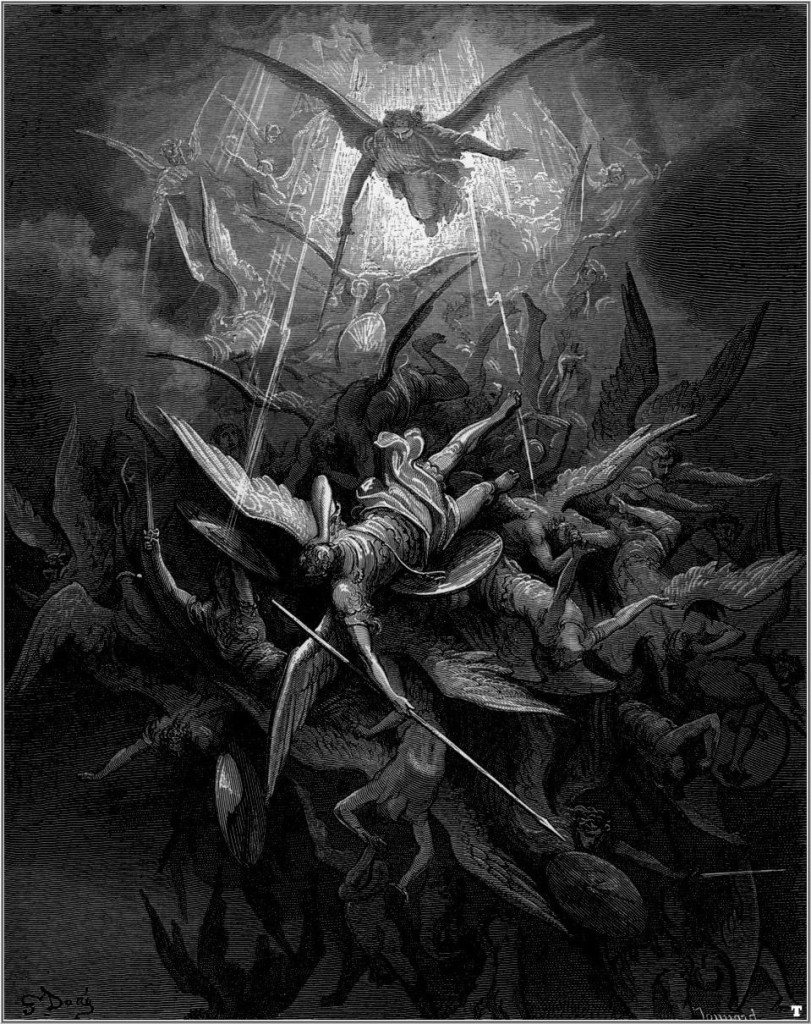
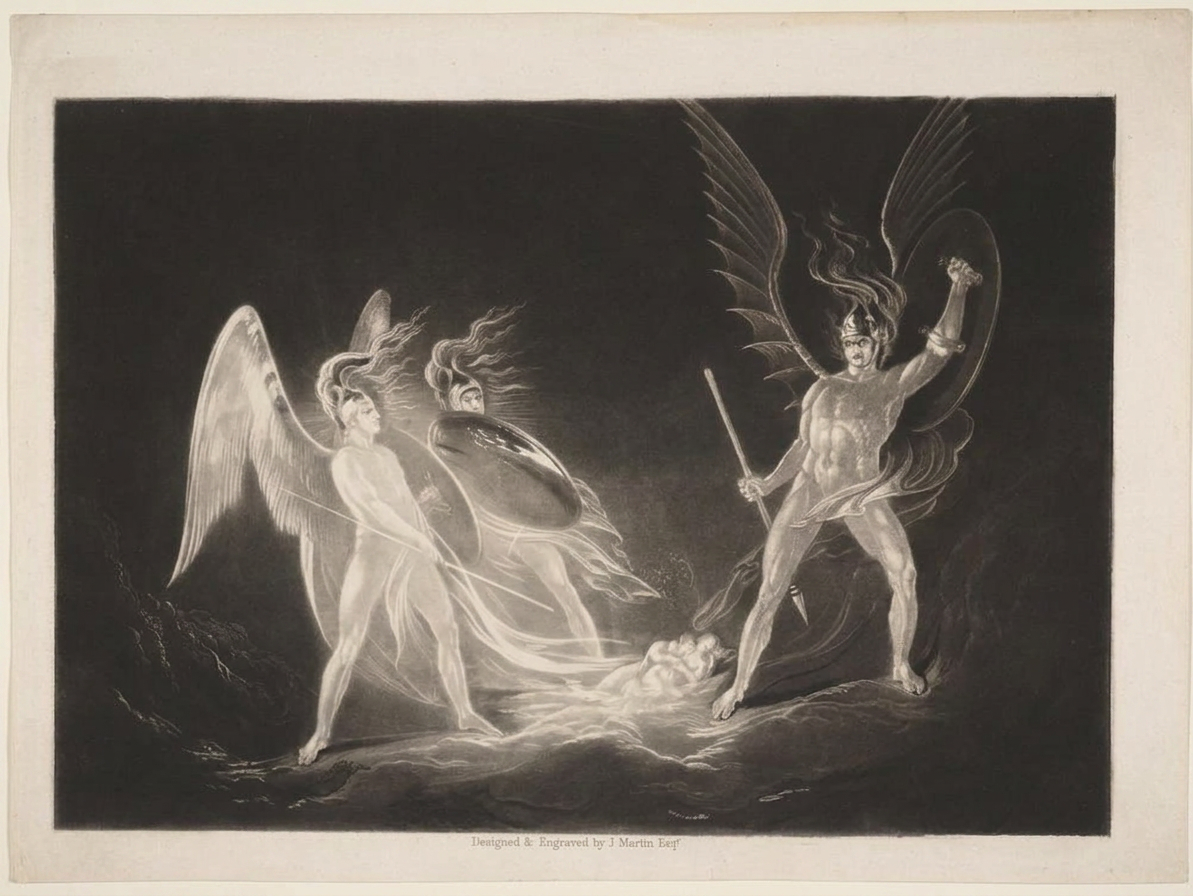
John Milton imagined elaborate scenes of heavenly battles and angelic hierarchies. Milton’s Paradise Lost (1667) completely redefined how we imagine the devil. He invented the concept of Lucifer as a beautiful prideful angel, rebelling because God promoted Jesus above the heavenly host. His imaginative poetry has also given us a backstory for Eve and her problem with apples. Milton’s work appeared in margins of KJV Bibles for centuries.
James Ussher calculated precise dates and chronologies which some creationists treat as Biblically accurate. Relying on the commonly available Masoretic text, and his personal preferences, he gave us a universe created on October 23, 4004 BC, precisely. (well actually the evening of October 22, 4004 BC was when it all began).
John Milton’s poetry taught that the Son (Jesus) was created by God at a specific point in time to serve as the active agent who creates and governs the universe. All evidence points to Milton treating Ussher’s chronology as poetic rather than literal. However, both authors found their way into the vernacular.
With Ussher’s dates in the margins and Milton’s ideas padding sermons in the pulpit, these individual theories hardened into a shared cultural architecture. The public ultimately ingested a worldview built entirely on this makeshift scaffolding, mistaking the poetic framing of Milton and the historical guesswork of Ussher for the solid foundation of the temple itself.
Over time, these additions and embellishments became so widely accepted that people quoted them as though they were part of the biblical text. How easily human additions can become canon.
We can observe this pattern across history, where something interesting happens whenever a community gathers around a strong spiritual voice. Scripture begins as the foundation, but over time, certain writers or visionaries speak with such conviction that their words slowly over time take on a weight that feels… more immediate than the ancient text.
In the eighteenth century, Emanuel Swedenborg produced vast volumes of visionary theology, providing a fresh, direct interpretive lens that carried authority for his followers. This pattern of reading the Bible through a specific filter was hardly unique. A century earlier, the German mystic Jakob Böhme had done the same, a tradition later mirrored in the nineteenth century by both the prophetic Joanna Southcott and Mary Baker Eddy, the founder of Christian Science. For each of these movements, the foundational scripture was viewed through the lens of a singular, charismatic interpreter.
None of these movements began with the intention of elevating a human interpreter; it just happened.
Once a community becomes accustomed to answering questions by asking, “What did she say?” instead of “What does Scripture say?”, the shift is already complete, and it is enough for it to be obvious. The interpreter becomes the anchor, with Scripture taking a back seat. The transition is almost invisible while it’s happening.
You will see this pattern repeated throughout history, although it does not occur in all churches.
The question remains: is the Bible enough for us?
We may deeply enjoy the themes of Miltonic allure in Paradise Lost—a cosmic grandeur that has echoed through the centuries in the gothic horrors of Mary Shelley’s Frankenstein, the visionary poetry of William Blake, and the theological fantasies of C.S. Lewis.
Writers have long borrowed Milton’s majestic imagery to colour their own worlds. Yet, we must remember that Milton’s epic is fundamentally an embroidery upon scriptural truth, not the truth itself. Every claim, no matter how poetically earnest, must be weighed carefully against the unadorned text of the Bible.
Illustration: Gustave Doré (1832–1883), Him the Almighty Power Hurled Headlong Flaming from the Ethereal Sky (Book 1, 44-45) (1866), engraving for ‘Paradise Lost’, John Milton, Cassell, Petter and Galpin, further details not known. Wikimedia Commons.
Once there was a wise and generous King whose kingdom was governed by a good law.
But an accuser arose and said: “Your law is impossible to keep. Your subjects obey only because you protect them. If you ever stopped helping them, they would break your law.”
The King replied: “My law is good, and my people can live according to it when they trust me.”
Over many years, people in different villages tried to follow the King’s law. Some succeeded remarkably well; others failed badly. Whenever someone failed, the King forgave them, taught them, and helped them begin again. Then one day the King announced that there would eventually be a final test. Before that test, he would examine the records of everyone in the kingdom. Those who had chosen to trust him would be accepted as his people.
Then came the final village…
The people there knew that the King’s representative would soon leave the village. After that, there would be no further opportunity to change their allegiance. So the people who had chosen the King spent their remaining time learning to live according to his ways. Their old habits were being removed. They became increasingly loyal and trustworthy.
Eventually the King’s representative announced: “The decision has been made. The records are closed.”
He left.
The people of the village now had to face the final crisis without the King’s representative standing beside them.
The accuser appeared and said: “Now we shall see whether they really belong to the King.”
The villagers were frightened. They did not suddenly become independent of the King. They had no confidence in themselves at all. But they remembered his promises and continued to trust him. They refused to betray him, even when doing so would have made their lives much easier.
At last the King himself arrived. The accuser was defeated.
Ellen White wrote extensively about God’s people being prepared for Christ’s return, including overcoming sin and standing through the final time of trouble, particularly in her book The Great Controversy. Later, M. L. Andreasen brought many of these ideas together into what became known as Last Generation Theology (LGT), placing particular emphasis on the final generation demonstrating what God’s grace can accomplish in the lives of His people.
Now notice the two ways the story can be interpreted in the context of Ellen G. White’s famous book and M. L. Andreasen’s well-known theology (amongst conservative Adventists), which emphasised the pre-Advent judgment and the righteousness by faith.
The Ellen White/Great Controversy emphasis could be represented by saying:
The final villagers really were transformed. Their old rebellion had been overcome. They had become loyal and were prepared to stand through the final crisis. That corresponds quite closely to Great Controversy p. 425: “Their robes must be spotless, their characters must be purified from sin” and they must be “conquerors in the battle with evil.”
But Andreasen adds something more to the story. He says, in effect: The King deliberately allows this final village to become the decisive demonstration that the accuser’s charge was false.
The villagers become the final evidence in the King’s case. Their Victory.
Imagine someone asking, “Did the King need the final villagers to become loyal before he could forgive them?” No, their acceptance had already been settled. “Did the villagers save themselves by becoming loyal?” No, the King had saved and transformed them. “Did the King stop loving or helping them when his representative left?” No, they continued to depend completely upon him. But, “Did their final loyalty provide evidence against the accuser’s claim?” Yes, in Andreasen’s interpretation, that’s a central purpose of the final generation.
The difference isn’t necessarily – Ellen White = grace and Andreasen = works. That’s too simplistic. It is more nearly:
Ellen White: God’s people must be purified, overcome sin, and be ready to stand through the final crisis.
Andreasen: Yes, and their perfected victory constitutes God’s final demonstration before the universe that Satan’s accusation is false and God’s law can be perfectly kept by fallen humanity.
If Ellen White herself explicitly says that the final generation’s perfection is God’s final demonstration to the universe, then Andreasen really is largely systematising what she already taught. If she doesn’t, then we’ve found the point where Andreasen’s LGT develops beyond her explicit statements.
This leaves us with a crucial question: if Paul, Peter, John, Luther, Wesley, and millions of faithful Christians throughout history have been saved through Christ’s righteousness and His ongoing ministry, why would God require the final generation to meet a higher standard in order to be saved?
Is God fair? Perhaps the heart of the gospel is that Christ remains our hope in every generation, including the last.
This latest evangelistic campaign run by the Seventh-Day Adventist Church marks 2,000 years since the baptism of Jesus Christ in AD 27.
Preparation for OneVoice27
Preparation for OneVoice27 centres on the Empowered by Prayer Initiatives, a worldwide emphasis on prayer, spiritual renewal, and helping people encounter Jesus. Participants are encouraged to spend time daily contemplating Christ’s life through The Desire of Ages, while also sharing their faith through acts of service and personal witness. The programme further promotes the study of Daniel and Revelation, focusing on Christ’s first and second comings, with additional reflection on prophetic themes explored in The Great Controversy.
For many Adventists, The Desire of Ages is relatively uncontroversial because it focuses on the life and ministry of Jesus. Even people who have questions about Ellen White’s authority often acknowledge that it contains some beautiful devotional reflections on Christ.
The Great Controversy is a different matter.
Many historians, both Adventist and non-Adventist, have documented issues with its historical sources, quotations, and interpretations. Within Adventism itself, scholars such as Arthur Patrick, Raymond Cottrell, and others have discussed these questions for decades. Then there is the Catholic issue. When The Great Controversy was written, nineteenth-century Protestantism was deeply anti-Catholic. Much of the book reflects that historical context. While many Adventists today would say their concern is with systems and institutions rather than individual Catholics, the language can still be read as hostile or accusatory toward Catholicism as a whole.
This raises a bigger question for a movement whose stated purpose is to point people to Jesus. How do we reconcile a message centred on the love, grace and compassion of Christ with a worldview that can sometimes feel like “us versus them”, those who are inside and those who are outside, those who understand the truth and those who are deceived?
If we are inviting people to encounter Jesus, should our message be shaped by fear and suspicion of the world around us, or by the same compassion Jesus showed toward people who did not believe as He did?
Perhaps before we ask the world to listen to the Adventist message, we should ask ourselves whether the message we are giving actually sounds like Jesus.
If the stated goal is to unite believers around Jesus, then The Desire of Ages fits naturally into that objective. But when The Great Controversy is placed alongside it as required preparation, some members may wonder whether the movement is really centred on Christ alone, or whether it is also centred on a particular interpretation of history, prophecy, and denominational identity.
If OneVoice27 seeks to unite Adventists around Jesus, what place should The Great Controversy have in that preparation? Historical errors can be corrected, sources re-examined, and outdated anti-Catholic language challenged. Nonetheless, what happens when the ideas in question are attributed to Ellen G. White and are therefore inseparable from questions about her prophetic authority?
Can a movement truly speak with “one voice” about Jesus while allowing room for members who have serious questions about the historical claims and prophetic authority underlying one of its recommended books?
If OneVoice27 is asking Adventists to engage with The Great Controversy as part of its preparation, when should we talk openly about the authority of Ellen G. White? Is it reasonable to encourage people to read a book as part of their spiritual preparation without also encouraging them to examine the evidence for the prophetic authority of its author?
We Are Still Challenged to Study for Ourselves
Aren’t we, as Christians, challenged to study and examine these things for ourselves? The Bereans were commended because they did not simply accept Paul’s teaching on the strength of his authority. They “examined the Scriptures every day to see if what Paul said was true” (Acts 17:11).
If believers were encouraged to test even the teaching of an apostle against Scripture, surely we should also be free to examine the writings of Ellen G. White, including The Great Controversy, and consider for ourselves the historical evidence, the sources, and the claims made in her writings.
Perhaps this is where the real meaning of OneVoice27 should begin. We do not need to have one voice about every book, every historical interpretation, every prophetic question, or even Ellen White’s authority. But we can have one voice about Jesus.
Unity does not require us to think alike. We can question, wrestle with difficult issues, disagree with one another and still search the Scriptures together. Perhaps the goal of OneVoice27 should not be to silence the many voices within Adventism, but to make sure that, above all the noise, we can still hear the voice of Jesus. After all, the most important question is not whether we are all saying the same thing, but whether what we are saying is leading people back to Him.
In recent years, a growing battle has emerged between Seventh-day Adventist Independent Ministries and former Adventists who have become critics of the church. While they stand on opposite sides of the Adventist spectrum, both groups can create ex-Adventists by focusing heavily on what is wrong with the church. Much of this conflict now unfolds through podcasts, YouTube channels, blogs, and social media. The debate is often framed as a struggle between faithful defenders of the church and those who have turned against it. Yet this narrative may overlook a much more important question: What version of Adventism are people actually leaving?
A common explanation offered by some Adventist apologists is that former members have been influenced by anti-Adventist ministries, secularism, or hostile critics of the church. While this may be true in some cases, it does not adequately explain the experiences of vast numbers of those who have left. A significant number of former Adventists were not initially shaped by anti-Adventist voices at all. Instead, they were influenced by a network of conservative supporting ministries, revival movements, independent speakers, and media personalities that exist within the wider Adventist world.
For many members, these ministries became their primary source of theological education through books, seminars, television programs, camp meetings, and lately through podcasts and online content. They presented a particular interpretation of Adventism centred on issues such as church authority, doctrinal purity, Last Generation Theology (LGT), gender equality, human sexuality, end-time events, and there has been some recent debate on the tithe storehouse; however, while these ministries represent Adventist perspectives, they cannot reflect the full diversity of thought that exists within the worldwide Seventh-day Adventist Church.
During the Ted Wilson years (2010 – 2025), supporting ministries enjoyed considerable visibility and influence within Adventist culture. Wilson frequently appeared at gatherings hosted by these organisations and encouraged cooperation between the official church and supporting ministries. While these ministries were not part of the denominational structure, many members came to regard them as authoritative interpreters of Adventism. Consequently, the theology and culture promoted by these ministries often became, in the minds of ordinary members, what Adventism itself was.
This distinction is important because many former Adventists are not necessarily reacting against the official beliefs of the Seventh-day Adventist Church as much as they are reacting against a particular version of Adventism that has been presented to them. When they later encountered alternative viewpoints within Adventism, or discovered that the denomination was far more diverse than they had been led to believe, many experienced confusion, disappointment and disillusionment.
The rise of former Adventist podcasters and online channels reflects this reality. Many are responding to experiences within conservative Adventist subcultures rather than to the denomination as a whole. Debates surrounding gender equality, church authority, tithing, vaccination, LGBTQ, and other controversial topics continue to shape these conversations. Yet critics often portray the entire church through the lens of their own experience, while apologists frequently dismiss them as merely influenced by anti-Adventist sources.
Perhaps the most uncomfortable question for Adventist apologists is this: What if many ex-Adventists were not primarily created by anti-Adventist ministries at all? What if they were first shaped by Adventism’s own conservative ecosystem?
Supporting ministries, independent speakers, prophecy seminars, media networks, and online personalities have exercised enormous influence over how members understand the church. In some cases, these voices have become more influential than official church publications or local congregations. As a result, many former Adventists are not reacting against the worldwide Seventh-day Adventist Church so much as they are reacting against a particular version of Adventism propagated as the only authentic form of the faith.
This creates an irony that no side is eager to acknowledge. Conservative ministries often warn members about former Adventists and critics, how the vaccination, the World Health Organisation (WHO), and the United Nations are going to control us, while some former Adventists portray the entire denomination through the lens of these extremist conservative ministries. These groups may be reinforcing each other’s narratives. Between them sits a much larger Adventist membership whose beliefs and experiences are far more diverse than any one group acknowledges.
One former Adventist podcaster offers an interesting way of illustrating this fragmentation by dividing modern Adventism into several broad categories. At one end is SDA Leadership, which he describes rather cynically as a “sales funnel.” Then there are Traditional Adventists, those who see Ellen White as a prophet and tend to gravitate towards conservative voices such as Dennis Priebe, seeing themselves as the guardians of “original” Adventism. Alongside them are Cultural Adventists, represented by things such as Haystacks, praise-and-worship music, hugs and what he jokingly calls “Hippie Jesus.”
A podcast host expounding on the haystacks tradition in the SDA Church.
Then come the Progressive Adventists, who view Adventism as reformative, regard Ellen White more devotionally than prophetically, and identify with the “Big Tent” approach, declaring, “That’s NOT my Adventism!” in response to complaints about conservative groups. Desmond Ford and his theological legacy also enter this picture. Finally, there are Hybrid Adventists, who combine elements from several of these traditions. Although this categorisation is obviously subjective and somewhat tongue-in-cheek, it highlights a genuine problem: when people talk about “Adventism,” they may actually be talking about entirely different Adventist cultures and theological worlds.
If meaningful dialogue is to occur, both apologists and critics must recognise that Adventism is not a monolith. It includes conservatives, moderates, progressives, traditionalists, and reformers. Understanding why people stay, leave, or return requires more than simplistic explanations. It requires listening to individual experiences and recognising that the story of modern Adventism is far more complex than either side is often willing to admit.
Ellen G. White spent much of her 87 years battling poor health. Severe illness, periods of exhaustion, and ongoing physical struggles shaped many of her views on health reform. Her personal experiences often became the lens through which she interpreted diet, disease, and the body’s relationship to health.
One of the more surprising examples is her attitude toward vinegar. Today, apple cider vinegar is widely promoted as a natural remedy for issues ranging from digestion to blood sugar regulation. In the nineteenth century, however, vinegar was often a much more strongly fermented product than the varieties commonly sold today. Modern manufacturing methods, preservatives, and improved sanitation have significantly changed the production of condiments. Ellen White, however, viewed vinegar as a dietary enemy. She claimed that it promoted fermentation in the stomach, contaminated the blood, and contributed to diseases of the liver and kidneys.
Interestingly, there is evidence that Ellen White may have been consuming apple cider, which in the nineteenth century was often an alcoholic beverage. This adds an intriguing layer of complexity to her views on vinegar. Regular consumption of alcohol is well known to have harmful effects on the liver and kidneys, raising the possibility that some of the health concerns she attributed to vinegar may have been associated with alcoholic cider instead.
What makes this position particularly interesting is that she openly admitted struggling with a strong craving for this particular beverage, whatever it was, herself.
Writing to a woman who was battling an unhealthy habit, White shared her own experience: “There was a time when I was in a situation similar in some respects to yours. I had indulged the desire for vinegar. But I resolved with the help of God to overcome this appetite. I fought the temptation, determined not to be mastered by this habit. If you will determine to overcome, the Lord … will give you strength to resist every temptation.“
According to White, giving up vinegar triggered a prolonged physical crisis. “For weeks I was very sick; but I kept saying over and over, The Lord knows all about it. If I die, I die; but I will not yield to this desire. The struggle continued, and I was sorely afflicted for many weeks. All thought that it was impossible for me to live.”
Eventually, she believed she had gained complete victory over the craving. “Now I have no inclination to taste anything of the kind. This experience has been of great value to me in many ways. I obtained a complete victory.“
Her account raises an intriguing historical question: what exactly was the “vinegar” that Ellen White found so difficult to withdraw from? As she says, “If I die, I die; but I will not yield to this desire.” A quick search of alcohol withdrawal reveals the serious medical risks that can accompany this.
Did Ellen White Mean Vinegar or Alcoholic Cider? There is still ongoing debate about the type of vinegar White was consuming. Was it apple cider vinegar, wine vinegar, alcoholic apple cider or one of the harsh commercial vinegars becoming common during the nineteenth century?
The Case for Apple Cider Vinegar The strongest evidence points toward apple cider vinegar. White grew up in Maine and spent much of her early ministry in New England and Michigan. During the nineteenth century, apples were the dominant orchard crop in these regions. Hard cider was a common household drink in Ellen White’s time, and when the fermentation process continued, it eventually produced apple cider vinegar. This is quite different from the apple cider vinegar sold in supermarkets today, which contains no meaningful amount of alcohol. In the nineteenth century, however, cider and vinegar were closely linked through the fermentation process, making them very different products from their modern counterparts.
For many rural families, apple cider vinegar was simply the vinegar. It was used in cooking, preserving food, and everyday household life. White frequently linked vinegar with “sour cider” in her writings. In 1870 she warned against both “cider and vinegar,” suggesting that she viewed them as different stages of the same fermentation process. This connection strongly supports the idea that apple cider vinegar was the substance she had in mind.
The Case for Wine Vinegar Others argue that White may have been referring to wine vinegar. During the nineteenth century, Adventists were heavily involved in debates about fermented and unfermented wine in the Bible. Wine vinegar also had a direct biblical connection, being the “vinegar” mentioned in the crucifixion accounts.
Later in life, White travelled extensively and spent nearly a decade in Australia, where grape-based vinegars were more commercially available than they had been in rural New England. Her strongest objections were directed not at apples or grapes themselves, but at the process of fermentation. Since wine vinegar was an obvious product of fermentation, some historians see it as fitting her concerns particularly well.
A Third Possibility: Commercial Vinegars There is also a third possibility that is often overlooked. The industrial revolution brought mass-produced vinegars onto the market. Many were made from fermented malt mash or from distilled wood alcohol products. These commercial vinegars were often far harsher than traditional homemade vinegars and were commonly used in pickled foods. White specifically mentioned cravings for highly seasoned pickles and condiments. It is entirely possible that some of the vinegar she consumed came from these commercially prepared products rather than from homemade apple cider vinegar alone.
The Bigger Issue: Fermentation Ultimately, the debate may focus too much on whether the source was apples, grapes, or malt. For Ellen White, the real issue was fermentation itself. She viewed fermentation as a process of decay and believed that fermented products introduced harmful influences into the body. In her mind, vinegar, hard cider, and alcoholic beverages all belonged to the same family because they were produced through similar biological processes. Whether the vinegar originated from an apple orchard in Maine, a vineyard in Australia, or a commercial factory, White saw it as evidence of what she called the “laws of fermentation” at work.
The irony is that one of her strongest health warnings grew out of a personal struggle. Long before she condemned vinegar in print, she had first fought a private battle with her own appetite for it, whether it was vinegar, apple cider vinegar, malt wine, or even alcoholic apple cider itself – a battle she later described as one of the most difficult victories of her life.
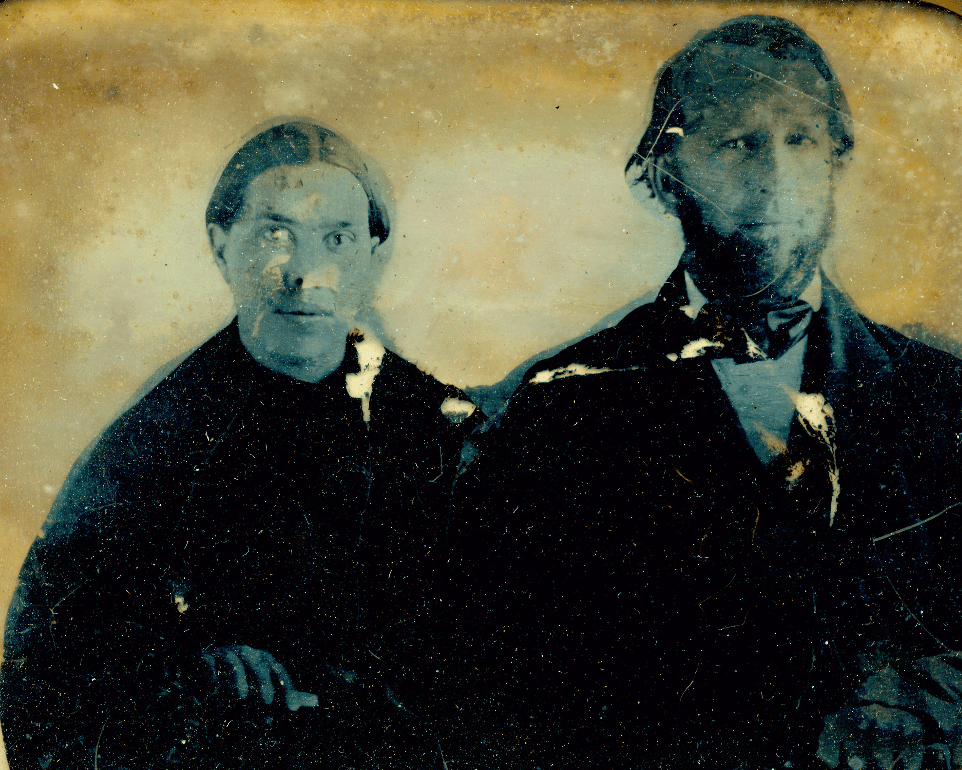
Ellen G. White and James White, circa 1857. Digital Commons. Andrews University
What is the “Shut Door”?
The Advent Movement of the early 1800’s expected Jesus to return in the year of 1844. As we all know, Jesus did not appear at that time. Yet instead of giving up what they experienced as a false revival; some within this movement decided that they had the correct date, but had expected the wrong event to occur. The Millerites decided that on that date Jesus entered the second compartment of the heavenly sanctuary and began an “investigative judgment” of his people. This period would be of very short duration, hence their expectation of his soon coming. In hand with this doctrine they taught the opportunity for salvation for the world was over; there was no way anyone could be saved other than the small group of Adventists who had accepted the Millerite message and the “Midnight Cry.” This particular doctrine was known as the Shut Door.
One of the first to propose this idea was O.R.L. Crosier, who states: “I kept the seventh day nearly a year, about 1848. In 1846 I explained the idea of the sanctuary in an article in an extra number of the Day Star, Cincinnati, O. The object of that article was to support the theory that the door of mercy was shut, a theory which I, and nearly all Adventists who had adopted William Miller’s views, held from 1844 to 1848. Yes, I know that Ellen G. Harmon – now Mrs. White – held that shut-door theory at that time. Truly yours, “O.R.L. Crosier.” Concerning Crosier article Ellen White stated: “I feel fully authorized by the Lord to recommend that extra to every saint” (“A Word to the Little Flock,” pp. 11, 12)
Did the Lord authorise his prophet to endorse a book that taught the time of salvation had passed for the sinner?
Another one of the early teachers of the ‘shut door’ doctrine was Joseph Turner. “But can any sinners be converted if the door is shut? Of course they cannot, though changes that may appear to be conversions may take place….” The Advent Mirror, that of January, 1845.
These and men like them led Joseph Bates into accepting the ‘shut door’ doctrine.
In the Review and Herald, Aug. 19, 1851, Joseph Bates says: “We understand that He [Christ] was a Mediator for all the world, ministering in the Holy Place (Heb. 9:26), in the Tabernacle called the Sanctuary, from the day of Pentecost (A.D. 31) until his appointed time, the end of the twenty-three hundred days, or years – the fall of 1844. At this point of time, then, the door was shut against the Sardis church [the Protestant church] and the wicked world.”
Joseph Bates added another twist to the doctrine, he explained the door was shut in 1844, and in the end of 7 years or in 1851 Christ would return. Joseph Bates was the one who lead James White and Ellen Harmon into the ‘light’ of the shut door.
James White explains the “Shut Door” in the same manner. In The Present Truth, May 1850, he dealt in great detail with the subject, especially on the shut door. In that article he says, page 79:
“From the best light we could then obtain from the autumnal types we were very confident that the days would end at the seventh month…. When we came up to that point of time, all our sympathy, burden and prayers for sinners ceased, and the unanimous feeling and testimony was, that our work for the world was finished for ever… But the sinner, to whom Jesus had stretched out his arms all the day long, and who had rejected the offers of salvation, was left without an advocate, when Jesus passed from the Holy Place, and shut that door in 1844. ”
NOTE: This article establishes that he still believed in the ‘Shut door’. His article was to establish that what they had been preaching for the previous five years was correct. Keep in mind the dates on these articles. They range from the Fall of 1844 up to 1850-51
In Selected Messages, Volume 1, page 63, Ellen explains what the term “shut door” originally meant, and admits that she did believe the doctrine like the rest of her associates. But, she insists that this was before her first vision, and that her visions corrected the error:
“For a time after the disappointment in 1844, I did hold, in common with the advent body, that the door of mercy was then forever closed to the world. This position was taken before my first vision was given me. It was the light given me of God that corrected our error, and enabled us to see the true position.”
NOTE: Ellen also explains the ‘Shut door’ doctrine in ‘Spirit of Prophecy Vol 4. p.268’.
There should be no misunderstanding on what the term “Shut Door” meant for Adventists in the years from 1844-1851, nor should we question the fact that all three of these believed in the doctrine.
During these 7 years this group taught that the only ones who could be converted were those who were under the age of accountability during the seventh month of 1844. Some Adventists point to the fact that James and Ellen ‘labored’ for lost souls during these years as proof that they did not believe the ‘shut door’, but this is false, they merely labored for the young people who were coming to age during this period. All other conversions were said to be false, that they only had the appearance of conversion but the ‘sinful’ heart remained.
Now in the previous quote of Ellen White she tells us that she came to this position before she had a vision, and it was actually her visions that taught the group that they had erred. She and her defenders deny that she ever had a vision that supported the ‘shut door’ doctrine. With just a little investigation we can see that this is false. First the clear history of this era teaches us that it took Ellen White six years to finally wake up. If it is true that she never had a vision that taught the classic “shut door” doctrine, it is strange that she never had a vision that condemned it as error either. She should have been condemning the error all those years, by inspiration, and correcting her husband, Bates, and the rest. This was not a ‘minor doctrine’ this was a doctrine that condemned the world, and taught the poor sinners that Jesus was no longer willing to save them. Yet we shall see that her visions did give support to the doctrine of ‘the shut door’. Ellen White’s Shut Door Visions
Her first vision is claimed for December 1844. It was not printed until it appeared in The Day Star, January 24, 1846. It was also printed in the broadside of April 6, 1846, and again in May, 1847 in James White’s booklet, A Word to the Little Flock.
in 1851, in experience and views, the most pointed Shut Door statements were deleted, and were from that time on in all subsequent printings. In the quotation below, the deleted portion of this section has been emphasized. This is just a small part of the “vision” that deals with the advent people, and the reestablishing of the positions taken concerning October 22, 1844:
“Others rashly denied the light behind them, and said that it was not God that had led them out so far. The light behind them went out leaving their feet in perfect darkness, and they stumbled and got their eyes off the mark and lost sight of Jesus, and fell off the path down in the dark and wicked world below. It was just as impossible for them to get on the path again and go to the city, as all the wicked world which God had rejected.”
What does the vision teach? That the faint hearted ‘Adventists’ that had left the light had forever lost their salvation just like the rest of the wicked world! This is the exact doctrine of the ‘shut door’.
What did James White say was the effect of the vision?
“When she received her first vision, Dec. 1844, she and all the band in Portland, Maine, [where her parents then resided] had given up the midnight-cry, and shut door, as being in the past. It was then that the Lord showed her in vision, the error into which she and the band in Portland had fallen. She then related her vision to the band, and about sixty confessed their error, and acknowledged their 7th month experience to be the work of God” A Word to the Little Flock, 1847, p.22.
Note what he says: After the failure of October 22, the group had given up the midnight-cry, and shut door; it was not in the past, but yet future. What turned them around to renew their faith in all of that, including the shut door, was Ellen White’s vision! And, the “shut door” they had given up before the vision, and the one they preached following that vision, was that opportunity for salvation for the world was over! When Brother Bates learned of her visions he wondered if she had read the tracts by Joseph Turner (The avid teacher of the ‘shut door’ doctrine). The following is a letter from her to Bates, notice her joy in finding that her first vision was in perfect agreement with Turner’s views.
Note what he says: After the failure of October 22, the group had given up the midnight cry and the “shut door”; it was not in the past, but yet to be in the future. What turned them around to renew their faith in all of that, including the “shut door,” was Ellen White’s vision! The concept they had relinquished before the vision, and the one they preached following that revelation, indicated that the opportunity for salvation for the world was over! When Brother Bates learned of her visions, he wondered if she had read the tracts by Joseph Turner (the avid teacher of the “shut door” doctrine). The following is a letter from her to Bates; notice her joy in finding that her first vision was in perfect agreement with Turner’s views.
“After I had the vision and God gave me light, he bade me deliver it to the band, but I shrank from it. I was young, and I thought they would not receive it from me. I disobeyed the Lord, and instead of remaining at home, where the meeting was to be that night, I got in a sleigh in the morning and rode three or four miles and there I found Joseph Turner. He merely inquired how I was and if I was in the way of my duty. I said nothing, for I knew I was not.
Very early next morning Joseph Turner called, said he was in haste going out of the city in a short time, and wanted I should tell him all that God had shown me in vision. It was with fear and trembling I told him all. After I had got through he said he had told out the same last evening. I rejoiced, for I had expected he was coming out against me, for all the while I had not heard any one say what he believed. He said the Lord had sent him to talk the evening before, but as I would not, he meant his children should have the light in some way, so he took him.”
Now notice in the same letter that her second vision was also used to confirm others in the shut door doctrine.
“There were but few out when he talked, so the next meeting I told my vision, and the band, believing my visions from God, received what God bade me deliver to them.”
“The view about the Bridegroom’s coming I had about the middle of February, 1845, while in Exeter, Maine, in meeting with Israel Dammon, James, and many others. Many of them did not believe in a shut door. I suffered much at the commencement of the meeting. Unbelief seemed to be on every hand.
“There was one sister there that was called very spiritual. She had traveled and been a powerful preacher the most of the time for twenty years. She had been truly a mother in Israel. But a division had risen in the band on the shut door. She had great sympathy, and could not believe the door was shut. I had known nothing of their difference. Sister Durben got up to talk. I felt very, very sad.”
“At length my soul seemed to be in agony, and while she was talking I fell from my chair to the floor. It was then I had a view of Jesus rising from His mediatorial throne and going to the holiest as Bridegroom to receive His kingdom. They were all deeply interested in the view. They all said it was entirely new to them. The Lord worked in mighty power, setting the truth home to their hearts.
“Most of them received the vision, and were settled upon the shut door. Previous to this I had no light on the coming of the Bridegroom, but had expected him to this earth to deliver His people on the tenth day of the seventh month. I did not hear a lecture or a word in any relating to the Bridegroom’s going to the holiest.” (Letter B-3-1847, Letter to Joseph Bates, July 13, 1847)
This letter speaks for its self. Yet another point to make is concerning Israel Dammon, in whose home the second “vision” was received, he became an avid shut-door advocate just like Joseph Turner. Though she does not relate her second vision in the letter to Bates, it appeared in the broadside of April 6, 1846. Note the following portion from it:
“Then Jesus rose up from the throne, and the most of those who were bowed down arose with Him; and I did not see one ray of light pass from Jesus to the careless multitude after He arose, and they were in perfect darkness.”
As the year of 1851 drew near, this was modified some. They eventually taught that children who came to age after 1844 could be converted, which can be seen in this article by David Arnold, which was endorsed by Ellen White.
“But, says the objector, does not this leave the present generation, who have passed the line of accountability, since that time without an intercessor or mediator, and leave them destitute of the means of salvation? In reply to this objection, I would remark that as they were then in a state of innocency, they were entitled to a record upon the breast-plate of judgment as much as those who had sinned and received pardon: and are therefore subjects of the present intercession of our great high priest.”
‘Present Truth’ December of 1849
In 1849 Ellen White’s visions were still denying any true conversions.
“I saw that the mysterious signs and wonders and false reformations would increase and spread. The reformations that were shown me were not reformations from error to truth, but from bad to worse; for those who professed a change of heart had only wrapped about them a religious garb, which covered up the iniquity of a wicked heart. Some appeared to have been really converted, so as to deceive God’s people; but if their hearts could be seen, they would appear as black as ever. My accompanying angel bade me look for the travail of soul for sinners, as used to be. I looked, but could not see it, for the time for their salvation was past.”
— Present Truth August, 1849, pp. 21, 22
In another vision she said,
“I saw the Brother Stowell of Paris was wavering upon the shut door. I felt that I must visit them…. We had free, powerful meetings with them. God gave me two visions while there, much to the comfort and strength of the brethren and sisters. Brother Stowell was established in the Shut Door and all the Present Truth he had doubted…. We came to this place yesterday; found our dear Brother Nichols’ family as well as usual, steadfast in the faith, and strong in all the present truth…. My accompanying angel bade me look for the travail of souls for sinners as used to be. I looked but could not see it for the time for their salvation is past. Dear brother and sister, I have now written the vision God gave me. I am tired sitting so long. Our position looks very clear. We know we have the truth, the midnight cry is behind us, the door was shut in 1844 and Jesus is soon to step out from between God and man.”
— Letter 5-1849, White Estate, (March 24-30, 1849).
Clearly Ellen White’s visions were still confirming the ‘Shut door’ doctrine. Which can also be seen by the comment concerning Brother Nichols, who again was an avid teacher of the ‘shut door’ doctrine.
In July of 1850 some in the Adventist Movement including Ellen White began to believe that Christians who did not have knowledge of the 1844 movement could be converted, and take the place of the Adventists who had fallen. But to be saved they had to be ‘baptized into’ the Shut door doctrine. This is clearly seen in the following article Joseph Bates.
“It is true, some persons that are ignorant of this message may, and undoubtedly will be saved if they die before Jesus leaves the Holiest. I mean those that were believers before 1844. Sinners and backsliders cannot get their names on the breast-plate of judgment now. God in infinite mercy has borne with our ignorance on this subject until now; and our children have been neglected as they should not have been. Let us then do all that our hands find to do toward their salvation.–Review and Herald, January, 1851, p. 39.
The most damning piece of evidence is the Camden vision dated June 29, 1851. The White Estates says they doubt the authenticity of the vision because they say Ellen was not in Camden in June 29, 1851. Nevertheless, we have the following proof. In 1866, in the Review, Uriah Smith, editor of the paper, had a series of articles defending the visions of Ellen White. These articles were later printed in booklet form under the same title. On page 20 of the booklet, Smith says:
“Our only proper course here, therefore, is to confine ourselves to what has been published under sister White’s own supervision, and by her own authority, and what appears in manuscript over her own signature in her own handwriting.”
Further, this article by Smith was highly commended by the leading ministers, including J.N. Andrews. It was also read before the General and Michigan State conferences. With those endorsements in mind, we note in Smith’s article of June 19, 1866, page 18, and reprinted on pages 27-28 of his booklet, these statements about the visions. The sentences that are emphasized are directly from the Camden vision:
‘His spirit and sympathy are now withdrawn from the world, and our sympathy should be with Him.’ ‘The wicked could not be benefitted by our prayers now.’ ‘The wicked world whom God had rejected.’ It seemed the whole world was taken in the snare; that there could not be one left, (referring to spiritualism). ‘The time for their salvation is past.’
There can be no doubt that Smith had a copy of the Camden Vision before him when he wrote the articles, and not only accepted it as authentic, but presumed the readers would too. We also note that the leading Adventists read and approved the articles for publication, and thereby accepted it as authentic. We note that Smith said that only those visions would be defended that were published under Ellen White’s direction, or were approved by her, or appeared over her signature in her own handwriting. The Camden Vision would have to be accepted in that number. Any discrepancy in date is of no consequence, for whatever the date, the vision was authentic. It takes the same “shut door” position for Ellen White all the way from October, 1844, to sometime in 1851, and it was the “shut door” position that Smith was defending Ellen White against in the above section of his writing; that included the Camden vision. The following is that vision.
“Then I saw that Jesus prayed for his enemies; but that should not cause us or lead us to pray for the wicked world, whom God had rejected – when He prayed for his enemies, there was hope for them, and they could be benefited and saved by his prayers, and also after he was a mediator in the outer apartment for the whole world; But now His spirit and sympathy were withdrawn from the world; And our sympathy must be with Jesus, and must be withdrawn from the ungodly. I saw that God loved his people – and, in answer to prayers, would send rain upon the just and unjust – I saw that now, in this time, that he watered the earth and caused the sun to shine for the saints and wicked by our prayers, by our Father sending rain upon the unjust, while he sent it upon the just. I saw that the wicked could not be benefitted by our prayers now – and although he sent it upon the unjust, yet their day was coming….then I saw concerning loving our neighbors. I saw that scripture did not mean the wicked whom god had rejected that we must love, but he meant our neighbors in the household, and did not extend beyond the household; yet I saw that we should not do the wicked around us any injustice; – but, our neighbors whom we were to love, were those who loved God and were serving Him….
How did Elder Bates view the visions and work of Ellen White? He said this: “I believe the work [of Mrs. White] is of God, and is given to comfort and strengthen his scattered, torn and peeled people, since the closing up of our work for the world in October, 1844.”
As the day drew near the 1851 deadline; in Ellen’s mind the time of Christ’s return was so close, that even the ‘angels of Ellen’ expected Jesus to return shortly.
“My accompanying angel said, ‘Time is almost finished. Get ready, get ready, get ready.’ . . . now time is almost finished. . . and what we have been years learning, they will have to learn in a few months.” (Early Writings, pp. 64-67). June 1850 This in turn caused Mrs. White to announce time is almost finished: “Some are looking too far off for the coming of the Lord. Time has continued a few years longer than they expected, therefore they think it may continue a few years more. . . I saw that the time for Jesus to be in the Holy Place was nearly finished, and that time can not last but a little longer.” ({ExV 46.1} 1851)
Please note that this is said early in 1851, and according to their doctrine Jesus had been in the Most Holy Place for but 6 years. Was his work there nearly finished? Was it even half way over? No, it had but begun! It was not even one thirtieth of the way over. The reason she said this is because she was proclaiming Jesus’ return in the fall of 1851!
When Jesus did not appear in 1851 the little band of Adventists began their work of covering up the visions of Ellen White.
Here is but one example: Elder J.N. Loughborough, in his book, “The Great Second Advent Movement,” page 263, edition 1905, desired to give Elder Joseph Bates’ testimony concerning Mrs. White’s work, as given on page 21 of “A Word to the Little Flock,” printed in 1847. The following illustrates the manner in which he uses the material from this early publication. He quotes:
“I believe the work [of Mrs. White] is of God, and is given to comfort and strengthen his scattered, torn and peeled people, since the closing up of our work. . . in October, 1844.”
Note those three little dots? They mean that something was left out of the passage quoted. What was it? Just three short words: We will insert those words omitted from the lines quoted and indicate them [in uppercase letters]. Here they are:
“since the closing up of our work FOR THE WORLD in October, 1844.”
These three words reveal the fact that Bates and Elder White, who published the tract in 1847, believed that their work for the world closed up in October, 1844. The cover up of these truths have been great. Visions have been deleted and edited, and the meaning of some perverted. But the truth is out there for those who wish to seek for it. There are many eyewitness accounts by Christian men and women who testify in full agreement that Ellen prophesied that the door of mercy was shut for sinners.
Later in her life Ellen White tried to explain away her statements in the following manner.
“I am still a believer in the shut-door theory, but not in the sense in which we at first employed the term or in which it is employed by my opponents… I was shown in vision, and I still believe, that there was a shut door in 1844. All who saw the light of the first and second angels’ messages and rejected that light, were left in darkness.{1SM 63.2-9}
Thus we see after 1851 the ‘shut door’ swung fully open for anyone, except for those who heard the Millerite message that Jesus was coming in 1844 and rejected it. I ask you, would you have accepted William Miller’s message that Jesus was coming in October of 1844? Even though Jesus said no Man knows the hour, and that he was coming in a day when no one expected? I hope you would not have fallen for this delusion. Also I ask, Would God condemn forever those who rejected the lie that Christ was returning in 1844? Quite to the contrary. CONCLUSION
We have the written proof that up to 1850 the Advent band was teaching the door of mercy was shut for sinners. The record of what Ellen taught and prophesied is open before us. The White Estate’s article on this subject tries to make the reader imagine that the Adventists were working for the souls of the sinners, yet in truth they were only laboring for the children and the Christian who had not heard of the ‘1844 Midnight Cry’. How can anyone believe with an honest heart, that God attended such a deceived and deluded message? Not once rebuking their fanaticism, but rather strengthening it through vision?
To many Adventists, Ellen G. White is regarded as a revered prophet; to some, she is held in high esteem, and in certain circles, treated with a degree of veneration. Conversely, there are individuals, both historically and contemporarily, who harbour questions regarding the nature and validity of her inspiration. Understanding this complex, implicitly entangled relationship with her is necessary.
The nostalgia for the beautifully written passages in some of her stories must be balanced with the facts of how they came to be. Her own words, the non-attributed borrowings, consist of words and ideas she utilised from others. White’s assertion that she writes under divine inspiration, “from the throne of God,” can be perplexing for some individuals.
The time-consuming, painstaking work of her literary assistants interwove her words with the beautiful explanations drawn from a large collection of authors who were also at pains to describe who Jesus really was. One is not merely hearing White here, but also the words and thoughts of others before her, such as James Russell Miller, who writes:
A true appreciation of the story of the teachings of the gospel will reveal the fact that our Lord himself exercised the most beautiful and thoughtful tact in all his mingling among the people. He was utterly incapable of rudeness. He never needlessly spoke a harsh word. He never gave needless pain to a sensitive heart. He was most considerate of human weakness. He was most gentle toward all human sorrow. He never suppressed the truth, but he uttered it always in love.
[James Russell Miller, Week-day Religion, 1880]
The historical context of her writings is important for understanding her often harsh statements towards fellow Adventists, particularly when her visions were questioned. In an era where prophetic voices were both revered and contested, she boldly asserted that anyone who dared to doubt her prophetic gift was under Satan’s banner, thus framing skepticism as a direct affront to God’s will and a challenge to the very foundations of the faith that she sought to uphold. This duality between faith and doubt permeated her teachings, emphasising that loyalty to her vision was synonymous with loyalty to divine instruction.
It can also be observed, through only a light research of her collection of writings, that she believed that those who rejected her as a prophet were “doomed,” “damned,” and “lost.” She argued that the stakes were incredibly high; to dismiss her guidance was not merely an oversight, but a perilous choice that could lead to spiritual ruin. Thus, her words served as both a warning and a rallying cry for her followers, urging them to remain steadfast in their belief and commitment to her prophetic mission.
However, this approach starkly contrasts with how Jesus behaved during His time on Earth, embodying grace, mercy, and understanding even towards those who doubted Him.
Analysing the key Adventists surrounding White is useful, as their behaviour significantly influenced her and vice versa. They faced challenges in their interpretations of God’s plan. White’s visions were often confirmation of the principles and beliefs that the Adventists had determined through prayer and bible study. Additionally, the movement grappled with an air of exclusivity that fostered a “them vs. us” mentality. This tendency was further exacerbated through the often harsh pronouncements by the prophet, alienating those who questioned her views. The tendency to alienate continues today, with various conservative factions, mainly associated with various independent ministries, asserting that anyone who questions their interpretation of White’s inspiration is destined for exclusion from heaven.
Ellen G. White, through a claim of divine guidance, addressed a multitude of subjects. White continued to fervently believe in the imminent second coming of Jesus. She maintained this belief despite being among the disappointed “Millerites” on March 21, 1844, and again on October 22, 1844 (and subsequent Adventist dates).
The Timing of Jesus’ Second Coming
Lucinda Burdick, a friend of Ellen White in the 1840s, shared how White frequently predicted the return of Christ. Lucinda Burdick was a pastor’s wife and an early associate of Ellen Harmon (later Ellen G. White) in the mid-1840s. She left one of the most detailed eyewitness accounts of Ellen Harmon’s earliest visions, especially during the Shut Door period, written in 1908 and notarized. Her testimony is often cited in Adventist historical studies because it provides a rare first-person description of Ellen’s early prophetic claims.
“I became acquainted with James White and Ellen Harmon (now Mrs. White) early in 1845. … She pretended God showed her things which did not come to pass. At one time she saw that the Lord would come the second time in June 1845. The prophecy was discussed in all the churches, and in a little ‘shut-door paper’ published in Portland, Maine. During the summer, after June passed, I heard a friend ask her how she accounted for the vision? She replied that ‘they told her in the language of Canaan, and she did not understand the language; that it was the next September that the Lord was coming, and the second growth of grass instead of the first in June.’ September passed, and many more have passed since, and we have not seen the Lord yet. It soon became evident to all candid persons, that many things must have been ‘told her in the language of Canaan,’ or some other which she did not understand, as there were repeated failures. I could mention many which I knew of myself.
Once, when on their way to the eastern part of Maine, she saw that they would have great trouble with the wicked, be put in prison, etc. This they told in the churches as they passed through. When they came back, they said they had a glorious time. Friends asked if they had seen any trouble with the wicked, or prisons? They replied, ‘None at all.’ People in all the churches soon began to get their eyes open, and came out decidedly against her visions; and, just as soon as they did so, she used to see them ‘with spots on their garments,’ as she expressed it. I was personally acquainted with several ministers, whom she saw landed in the kingdom with ‘Oh! such brilliant crowns, FULL of stars.’ As soon as they took a stand against the visions, she saw them ‘doomed, damned, and lost for ever, without hope.”
[Lucinda Burdick as quoted in Miles Grant, An Examination of Mrs. Ellen White’s Visions (Boston, Massachusetts: Advent Christian Publication Society, 1877]
Though Burdick’s testimony has encountered scrutiny from Adventist Apologetics, it is evident from White’s repeated warnings that she genuinely believed and conveyed through her visions that time was limited. Clearly, this did not come to fruition. After the June 1845 date passed without incident, another date was established for October 22, 1845, as this was purported to be the time of the Jubilee.
Joseph Bates, a pivotal co-founder of the Seventh-day Adventist Church alongside James and Ellen White had sold his farm to support the early Adventist movement. Even after selling the farm, he continued to experience prosperity and maintain his influence. As a devoted vegetarian, Bates steadfastly avoided drinking, smoking, and indulging in rich, unhealthy foods, fully embodying his health principles. As a health reformer, he played an influential role in establishing the motivation that led to the Adventist Health message.
Bates found himself grappling with skepticism regarding White’s visions, as her affirmation of the 1845 dates were now seen to be inaccurate.
In 1846, he published his book titled “The Opening Heavens” which reflected his passion for astronomy. Bates, with a warm spirit, often drew in those around him, engaging them in lively and enthusiastic discussions about the cosmos, sharing not just knowledge, but also his wonder for the universe.
Interplanetary Travels
Coincidentally, in November 1846, as disappointment hung heavily from the dashed expectations of Christ’s return during the seventh month, 1845, Ellen Harmon White claimed to experience a profound vision of the planets. What was even more amazing was that, the author of “The Opening Heavens“, Joseph Bates, was there on hand during her vision. As a result of her vision, a tract describing her journey to Jupiter, Saturn, and another planet was published and offered for sale in 1847. Years later J.N Loughborough also published an account. Subsequently in 1942 Seventh-day Adventist historian A.W. Spalding included White’s vision in his book. [Tract published by James White – A Word to the “Little Flock”, 22.]
Loughborough’s published account of the meeting based on Bates’ narration to him:
“Mrs. White, while in vision, began to talk about the stars, giving a glowing description of rosy-tinted belts which she saw across the surface of some planet, and added, ‘I see four moons.’ ‘Oh,’ said Elder Bates, ‘she is viewing Jupiter!’ Then having made motions as though traveling through space, she began giving a description of belts and rings in their ever-varying beauty, and said, ‘I see seven moons.’ Elder Bates exclaimed, ‘She is describing Saturn.’ Next came the description of Uranus, with its six moons; then wonderful description of the ‘opening heavens,’ with its glory, calling it an opening into a region more enlightened. Elder Bates said that her description far surpassed any account of the opening heavens he had ever read from any author. While she was talking and still in vision, he arose to his feet, and exclaimed, ‘O how I wish Lord John Rosse was here tonight!’ Elder White inquired, ‘Who is Lord John Rosse?’ ‘Oh,’ said Elder Bates, ‘he is the great English astronomer. I wish he was here to hear that woman talk astronomy, and to hear that description of the “opening heavens.” It is ahead of anything I ever read on the subject.’
[Ellen G. White: The Early Years: 1827-1862 (Vol.1)]
A.W. Spalding expanded on the vision in his book Pioneer Stories of the Second Advent Message, chapter 17, “The Opening Heavens and the Unchanged Law.”
“She told much more than astronomers knew about these, for they are not sure the planets are inhabited, but she saw that they are. On Saturn she saw good old Enoch, who was translated five thousand years ago, without dying. He said that was not his home, that he was only visiting there, that he lived in heaven, where God dwells, and there he was waiting until the earth should be restored as it had been in Eden. The people of these worlds were all very much more beautiful and strong than the people of earth, for sin has never entered there.”
Ellen G. White’s vision of the planets had helped restore Bates’ faith in her spiritual gift.
“Bates had been troubled with serious doubts as to the visions, but the evidence in the experience at Topsham was such that he accepted them wholeheartedly from that time forth. Ellen White never wrote out in detail what she was shown. It is evident that God’s purpose in giving this vision was to establish confidence in the heart of Joseph Bates. It should be borne in mind that the number of moons she was shown was what Bates, up to that time, had seen through the telescope. Stronger, more modern telescopes have brought into view additional moons circling the planets described. Nevertheless, had Ellen been shown what stronger telescopes now reveal, Bates’s doubts would have been confirmed, rather than alleviated.”
[1985 Ellen G. White: The early years: 1827 – 1862 (vol 1) 114:7]
Ellen White permitted the details to be published in a small tract sold at their next camp meeting without making corrections. There is no record of her writing down the vision, and once science caught up the White Estate explained that there is no record of her having named the planets. However, since many people were talking about planets like Jupiter and Saturn, it’s likely she believed she had visited those named planets rather than unknown ones in another galaxy.
White’s vision illuminating marvels far beyond the reach of any astronomer of her era, was the answer to Bates’ lingering doubts. It is not far-fetched to consider that uncovering additional moons may not have been a problem. Besides, how impressed would we be today if she had been able to see that Jupiter has between 80 and 95 moons? But, without a doubt, publishing a tract that avoided the opportunity to portray the beautiful and strong people of these captivating planets might not have caught the imagination of the early Adventists. Without confirmation of the then popular belief that Jupiter, Saturn and Mars were inhabited, White may not have persuaded Bates to use his influence to support her financially when others were experiencing doubt.
*For additional information on planetary travels, please refer to the Notes below.
The Risk of Gazing Too Far Into the Future
Meanwhile, returning to the topic of time-setting…
Joseph Bates’ “7 Year Theory” influenced White to promote a new date. She had a vision supporting Bates’ view; he published a transcript of her vision of November 18, 1848 (in Dorchester), in his 1849 book, The Seal of the Living God. The Whites (James and Ellen) appear to have adopted Joseph Bates’ prediction that the Day of Atonement would last seven years and that Jesus would return in the fall of 1851. White wrote,
“Some are looking too far off for the coming of the Lord. Time has continued a few years longer than they expected; therefore they think it may continue a few years more, and in this way their minds are being led from the present truth, out after the world. In these things I saw great danger; for if the mind is filled with other things, present truth is shut out, and there is no place in our foreheads for the seal of the living God. I saw that the time for Jesus to be in the Most Holy Place was nearly finished and that time can last but a very little longer.” – January 31, 1849
[Manuscript 4, 1849]
In 1850, Bates had explained that “the seven spots of blood on the Golden Altar and before the Mercy seat” symbolised the length of the judgment process for the living saints in the Most Holy. Each spot represented a year, meaning Christ’s heavenly service would last seven years. He was expected to return in the clouds in October 1851, seven years after the Millerite disappointment.
[ Joseph Bates, An Explanation of the Typical and Anti-typical Sanctuary, by the Scriptures (New Bedford, Mass.: Benjamin Lindsey, 1850), 10,11.]
Ellen White described a vision, a warning from her accompanying angel, whose words were filled with the usual urgency, reiterating that time is almost finished and there is little time to get ready. The angel urged her to share the insights she received.
“In a view given June 27, 1850, my accompanying angel said, ‘Time is almost finished. Do you reflect the lovely image of Jesus as you should?‘ Then I was pointed to the earth, and saw that there would have to be a getting ready among those who have of late embraced the third angel’s message. Said the angel, ‘Get ready, get ready, get ready.You will have to die a greater death to the world than ye have ever yet died.‘ I saw that there was a great work to do for them, and but little time in which to do it.”
[Early Writings, 64]
White describes the time constraint, emphasizing the urgency of the situation – “they will have to learn in a few months.” This limited timeframe presents a challenge, as each person must quickly adapt and absorb critical information. Each day becomes a race against the clock. As the deadline loom, the stress can be overwhelming. If this situation happened today, how would you react?
“Some of us have had time to get the truth, and to advance step by step, and every step we have taken has given us strength to take the next. But now time is almost finished, and what we have been years learning, they will have to learn in a few months. They will also have much to unlearn, and much to learn again.” (June 27, 1850)
[Early Writings, 67]
After the fall 1851 date passed, a new date was set for 1854, creating a sense of urgency among those involved in the early Adventist movement.
The uncertainty surrounding this timeline must have added to the stress for those following White’s writings, as they grappled with the implications of this delay on their work and hopes. It is easy to imagine the palpable tension among supporters, who may have felt both anticipation and anxiety as they awaited further direction and clarity from White.
As the 1854 date loomed, again Ellen White stressed again that there were only “…a few months” left until the return of Jesus.
“If those who have been in the church for weeks and months have not learned the straightness of the way, and what it is to be Christians, and can not hear all the straight truths of the Word of God, it were better that they were cut off from Israel. It is too late in the day to feed with milk. If souls a month or two old in the truth, who are about to enter the time of trouble such as never was, can not hear all the straight truth, or endure the strong meat of the straightness of the way, how will they stand in the day of battle? Truths that we have been years learning must be learned in a few months by those who now embrace the Third Angel’s Message.” (Feb. 12, 1854)
[1LtMs, Ms 1, 1854, par. 7]
There were also other general time-limited predictions. The following one is no doubt the most common one, frequently cited.
“I was shown the company present at the Conference. Said the angel: ‘Some food for worms, some subjects of the seven last plagues, some will be alive and remain upon the earth to be translated at the coming of Jesus.’”
[Testimonies for the Church, 1:131, 1856]
Another prediction was that the end of the world was in sight in 1885. The atmosphere of fear and uncertainty permeated their now formalised Seventh-day Adventist Church.
“The time has come when, in one sense, they that have wives be as though they had none. God wants us to be consistent people, our works corresponding with our faith.”
[Letter to Elder and Mrs C. L. Boyd – Ms 34, Feb 15, 1885 – Extracts of a testimony]
This statement was also repeated in October 22, 1885 (a longer version of same quote)
Christian history features numerous failed predictions of the world’s end, including Martin Luther’s belief that it would occur by 1600. Since 400 AD, various “no later than” dates have been suggested, often related to the end of centuries, by prophets, mathematicians, and Bible scholars, some of whom sought profit through these predictions.
Many sincere Christians have been influenced by apocalyptic excitement, despite Jesus’ clear statement that no one knows the time.
Although Ellen White supposedly opposed time-setting in some of her writings, her published visions, including her writings, do not align with a stance of opposition, leading to ongoing debate among scholars and enthusiasts alike. She opposed other people setting time, but early on she accepted time expectations that came through her own visions. She rejected other people’s time‑setting but accepted her own. Similar reaction to the Shut Door doctrine that White taught earlier on, based on her visions, but later denied as having never happened. The literal Shut Door was embarrassing. It contradicted Adventist evangelism, she denied it to protect her authority and the church supported the denial to maintain stability.
In the nineteenth-century children were expected to keep silent and out of the way of the adults. Punishments meted out were often extreme and, at times, violent. Early manuscripts contain severe warnings in which unruly children are described as hated by God and likely to be lost.
“God hates unruly children who manifest passion and evil tempers, etc. He can not save them in the time of trouble. They will be eternally lost through parents’ neglect. Their blood will be upon their parents. How can parents be saved with the blood of their children upon them, when they might have saved their children? God says, “I know Abraham, that he will command his household after him.”
[Genesis 18:19.]1LtMs, Ms 1, 1854, par. 12
“God despises our prayers for our children until we have done all on our part to save them. God corrects His children when they go astray from Him, and parents should correct their children when they disobey them. Correct their tempers. Above everything take care of them on the Sabbath. You may as well violate the Sabbath yourselves as to let your children do it… Your word should be their law. Parents, take hold of this work, for the destroying angel is soon to pass around and slay utterly both old and young, men, women, and little children. O do not be found wanting when weighed in the balance.”
[1LtMs, Ms 1, 1854, par. 18]
“The time is and has been for years, that the bringing of children into the world is more an occasion of grief than joy… Satan controls these children, and the Lord has but little to do with them. The time has come when, in one sense, that they that have wives be as though they had none.”
Later writings place much greater emphasis on understanding children’s emotional needs, parental patience, and loving discipline. Whether this represents a development in Ellen White’s thought, a change in emphasis, or simply different responses to different circumstances remains a matter of interpretation.
“I have been shown that while parents who have the fear of God before them restrain their children, they should study their dispositions and temperaments, and seek to meet their wants. Some parents attend carefully to the temporal wants of their children; they kindly and faithfully nurse them in sickness, and then think their duty done. Here they mistake. Their work has but just begun. The wants of the mind should be cared for. It requires skill to apply the proper remedies to cure a wounded mind. Children have trials just as hard to bear, just as grievous in character, as those of older persons. . . .Parents, when you feel fretful, you should not commit so great a sin as to poison the whole family with this dangerous irritability. At such times set a double watch over yourselves, and resolve in your heart not to offend with your lips, that you will utter only pleasant, cheerful words. Say to yourselves, ‘I will not mar the happiness of my children by a fretful word.’ By thus controlling yourselves, you will grow stronger. Your nervous system will not be so sensitive. You will be strengthened by the principles of right. . . . “The mother can and should do much toward controlling her nerves and mind when depressed; even when she is sick, she can, if she only schools herself, be pleasant and cheerful, and can bear more noise than she would once have thought possible. She should not make the children feel her infirmities, and cloud their young, sensitive minds by her depression of spirits, causing them to feel that the house is a tomb, and the mother’s room the most dismal place in the world. The mind and nerves gain tone and strength by the exercise of the will. The power of the will in many cases will prove a potent soother of the nerves.”
—Testimonies, vol. 1, pp. 384-387.
The material above originated from counsel written in 1863, when Ellen White was 35 years old. It was later incorporated into the larger compilation Testimonies for the Church, Volume 1.
Fundraising
Ellen White encouraged people to share their resources quickly, highlighting the need for generosity and community support as time was short. By giving their material possessions, early Adventists could assist in the urgent work related to Jesus’ imminent return. However, these days, the requests for donations are made in a much more polite manner. No one is made to feel guilty or that they may be denied a place in heaven, or lose children from sickness, as a result of not giving adequately.
“I saw that at present God did not call for the houses his people need to live in, unless expensive houses are exchanged for cheaper ones… But if those who have of their abundance do not hear his voice, and cut loose from the world, and dispose of a portion of their property and lands, and sacrifice for God, he will pass them by, and call for those who are willing to do anything for Jesus, even to sell their homes to meet the wants of the cause.”
[Review and Herald, November 26, 1857]
“Dear Brother, I saw that the Lord wanted your means which he has lent you. He calls for you to use it to advance His cause… I saw that you should work as fast as possible to remove means which God has lent you from the hands of unbelievers and transfer it to the believers… I saw that the scenes of this earth’s history are fast closing. It will soon all be finished, and what is to be done must be done quickly.”
[Letter 4, 1859]
In January 1857 she harshly castigated a family who had just buried two of their three precious children. She informed the distraught couple that God had taken their children to teach them a lesson. She said that this was God’s punishment for their failure to put the movement ahead of their children; “In the vision given at this place I was shown…God has been merciful to you. He has in mercy spared you one child… sell that you have, give alms… He took two idols from you that you might draw near unto Him… These children were snatched away to save you… From what God has shown me, I fear your property will shut you out of heaven… A terrible calamity came upon you, yet it has not had the effect that God designed it should.“- Letter Jan 28, 1857, to Burwells
In October 1857 she reiterated that God had taken the children, punishment for not giving enough for her work. She claimed that God would do far worse to the family if they continued refusing to “sacrifice for the truth”; “While at Monterey your case was shown me in vision. I saw that you were too sleepy… I viewed you in a fearful, critical situation. You do not yet possess the spirit of sacrifice… God, I saw, had tried to save you. Fearfully, terribly has He approached you, taken the fruit of your own body from you without hope… Anna* is in the broad road to hell… Unless the hand of God is turned aside… there is more anguish in store for you. God has given you a bitter cup to drink that it might purify you and wean you from this world… If you had followed the light God had given you, things would be entirely different… I was shown in vision at Monterey that God was calling upon those who have this world’s goods to sacrifice of their substance. I saw that God was testing those that have possessions”. Letter Oct 21, 1857, to Burwells
(*Anna Lucretia King – the remaining child, her life also threatened for her parents intransigence)
Due to the severe lack of surviving early correspondence, we have no sure record of how often Ellen White wrote to grieving families in this manner. An overview of the harsh and doctrinaire tone of much of her personal correspondence would suggest this is unlikely to have been an isolated incident.
As a comparison, James and Ellen had four sons, Henry Nichols (1847–1863), James Edson (1849–1928), William Clarence (1854–1937) and John Herbert (1860–1860). Interestingly, the deaths of her own sons, relatively soon after the Burwell children, gives no hint of the Whites ever applying God’s property ownership warnings to themselves, nor a commitment to sell any of the White family properties, nor adopt a life of poverty. In contrast to the Burwells, whose terrible loss was punishment direct from God, each untimely death of Sister White’s own children was explained by her to be Satanic forces opposing her work.
Marriage
Several peculiar warnings were exchanged among the early Adventists. In a Letter to Day Star dated October 11, 1845, James White is quoted regarding marriage, “We all perceive it as a snare of the devil“. Yet, just a year later, he married Ellen Harmon.
The idea of avoiding marriage has persisted… Some Adventists might recall considering this issue in the 1950s or 60s?
“In this age of the world, as the scenes of earth’s history are soon to close and we are about to enter upon the time of trouble such as never was, the fewer the marriages contracted, the better for all, both men and women.” (Feb. 13, 1885)
[Ellen White letter concerning marriage, 1885, in Testimonies on Sexual Behaviour, Adultery (1900), 14.]
“The time has come when, in one sense, they that have wives be as though they had none. God wants us to be consistent people, our works corresponding with our faith.”
[Letter to Elder and Mrs C. L. Boyd – Ms 34, Feb 15, 1885 – Extracts of a testimony]
Further along in the same letter she discusses the marriage of Christians with the ungodly – be not unequally yokes with unbelievers seems to be concatenated with not marry someone who doesn’t go to the same church (same religion) as you.
Letter [5Testimonies, 366] “Only 1 marriage in 100 sanctioned by God…”
“There should be no intermarriage between the white and the coloured race.”
[Manuscript 7 in Selected Messages, 2:343.]
Women
Claim:Women are sicklier than men and have less “vital” force.
“Infirmities and disease especially affect women.” [Testimonies vol. 1 (1855), 306]
“I was shown that infirmities and disease especially affect females.” [Review and Herald, April 22, 1862]
Scientific facts clearly demonstrate that women possess more robust immune responses than men and, generally, enjoy longer lifespans.
Claim:Women can be used more easily by Satan than men.
“Satan chooses women, for he can use them more successfully than he can men.”
[Manuscript 29, 1911, 13 (10MR 76.2)]
Modern research shows that women tend to be more spiritual than men, and take their religion more seriously.
Claim: Women should not vote or advocate for women’s rights to vote.
New Zealand was the pioneering nation to extend suffrage to women in 1893. Australia followed in 1902. Canada granted suffrage in 1917. The United States extended suffrage to women in 1919.
Ellen White wrote:
“Those who feel called out to join the movement of Women’s Rights, and the so-called Dress Reform, might as well sever all connection with the third angel’s message. The spirit which attends the one cannot be in harmony with the other. The Scriptures are plain upon the relations and rights of women and men.”
[Testimony for the Church #10, (1864), 30]
Ellen White wrote,
There are speculations as to woman’s rights and duties in regard to voting. Many are in no way disciplined to understand the bearing of important questions. They have lived lives of present gratification because it was the fashion. Women who might develop good intellects and have true moral worth are now mere slaves to fashion. They have not breadth of thought nor cultivated intellect. They can talk understandingly of the latest fashion, the styles of dress, this or that party or delightful ball. Such women are not prepared to intelligently take a prominent position in political matters. They are mere creatures of fashion and circumstance.
[Testimonies vol. 3 (1872), 565]
When Mrs. Graves met with Ellen White in 1874, she implored Mrs. White to get engaged in Women’s suffrage, but Mrs. White took no action.
[Ellen White to James White, July 10, 1874, Letter 40a, 1874]
In an article in the Review and Herald, White wrote,
I do not recommend that woman should become a voter or an office-holder…
[Review and Herald, Dec. 19, 1878. See also Signs of the Times, Sep. 16, 1886, and Gospel Workers (1892)]
To reiterate the importance of this statement, it was reprinted in Adventist publications in 1886 and 1892. Finally, in 1898, she urged people to not advocate for women’s rights:
“Whatever the opinions you may entertain in regard to casting your vote in political questions, you are not to proclaim it by pen or voice. Our people need to be silent upon questions which have no relation to the third angel’s message. If ever a people needed to draw nigh to God, it is Seventh-day Adventists. There have been wonderful devices and plans made. A burning desire has taken hold of men or women to proclaim something, or bind up with something; they do not know what. But the silence of Christ upon many subjects was true eloquence.”
[Ellen White to “Brethren”, February 20, 1898, Letter 4, 1898]
History has demonstrated that the women’s rights movement was both just and necessary, yielding significant benefits for women.
Avoid Living Near the Arctic Circle
Clearly, White’s attitude about avoiding living near the Artic Circle response revolves around observing the Sabbath, regarded as the Seal of God during the end times.
Ellen White wrote,
“In the countries where there is no sunset for months and again no sunrise for months the period of time will be calculated by the records kept. But God has a world large enough and proper and right for the human beings He has created to inhabit it without finding homes in those lands so objectionable in very many, many ways.”
[Letter 167, 23 March, 1900]
Since White penned those words in 1900, many Seventh-day Adventist churches have been established in countries like Norway, reflecting the global reach of the movement.
Inventions of Flying Machines are Evil
There is a world to be saved. We need not make a flying machine or some wonderful invention. What glory will that bring to Christ? Not a particle. … We are not to occupy our time and our brain to institute something that will bring glory from the people to us. It makes them foolish, so foolish, that they never will accept and find a place with Christ upon His throne. They will be spending their time instituting things to imperil their lives.
[Letters and Manuscripts – Vol 25 (1910-1915) Manuscript 75, March 25, 1910]
In a letter to A.G.Daniels;
“What strange occurrences are being brought to our notice in the daily papers. Men are hazarding their lives in an attempt to do strange things. The Lord has not laid upon any one the doing of these things; for souls are not saved through such exhibitions of foolhardiness. On certain occasions large companies of people are drawn together to witness the feats of men in flying through the air. The lives of many of those attempting these feats are sacrificed. It is not the God of heaven who leads men to attempt these hazardous feats. It is the god of this world whom they are serving. It is Satan who inspires men to enter into these foolhardy projects, just to see what men can do. … Satan is trying to bring about a condition of things that will make the world uncivilized. He desires to see strange things acted out, which God, who is too wise to err, has not ordained. But the Lord, yes, Our God, will be Ruler of the heavens and earth.”
[White to A. G. Daniells, Letters and Manuscripts – Volume 25 (1910-1915), Letter 114, Oct. 27, 1910]
Uriah Smith, in Daniel and the Revelation (1909) speaks favourably of flying machines. He had died before this edition was published, so obviously not his thoughts in regards to this topic.
In the 1940 edition it reads – “Navigation – The conquest of the air achieved by the aeroplane in 1903 is one of the most noteworthy triumphs of any age”
Ellen G. White’s Claims Regarding Her Own Significance
Many in the Adventist Church tell us that the writings of Mrs. White is the “Spirit of Prophecy” or the “testimony of Jesus” and they believe her writings are inspired. Others believe they are fallible but still contain good counsel. What I did not know was that Ellen White taught her books, her testimonies, and even her letters were inspired by God.
“Those who have helped souls to feel at liberty to specify what is of God in the Testimonies and what are the uninspired words of Sister White, will find that they were helping the devil in his work of deception.” (Selected Messages, Vol. 3, p.70)
“In my books, the truth is stated, barricaded by a ‘Thus saith the Lord.’ The Holy Spirit traced these truths upon my heart and mind as indelibly as the law was traced by the finger of God upon the tables of stone.” Letter 90, 1906
“The Holy Ghost is the Author of the Scriptures and of the Spirit of Prophecy.” (Selected Messages, Vol. 3, p. 30)
“In ancient times God spoke through the mouths of prophets and apostles. In these days he speaks to them by the Testimonies of his Spirit” (Testimonies, Vol. 4, p. 148; Vol. 5., p. 661)
“The testimonies are unread and unappreciated. God has spoken to you. Light has been shining from His word and from the testimonies, and both have been slighted and disregarded. (Testimonies, Vol. 5, p. 217)
“I am just as dependent upon the Spirit of the Lord in relating or writing a vision, as in having the vision. It is impossible for me to call up things which have been shown me unless the Lord brings them before me at the time that He is pleased to have me relate or write them.—Spiritual Gifts (1860), vol. 2, pp. 292, 293. {1SM 36.4}
“I cannot at my own impulse take up a work and launch out into it. I have to be impressed by the Spirit of God. I cannot write unless the Holy Spirit helps me.”—Letter 11, 1903. {3SM 49.1}
“I write all that the Lord gives me to write”.—Letter 52, 1906. {3SM 49.6}
“Weak and trembling, I arose at three o’clock in the morning to write to you. God was speaking through clay… In these letters which I write, in the testimonies I bear, I am presenting to you that which the Lord has presented to me. I do not write one article in the paper, expressing merely my own ideas. They are what God has opened before me in vision—the precious rays of light shining from the throne…. {1SM 27.2}
“In these letters which I write, in the testimonies I bear, I am presenting to you that which the Lord has presented to me.”—Testimonies, vol. 5, p. 67.
“If you seek to turn aside the counsel of God to suit yourselves, if you lessen the confidence of God’s people in the testimonies He has sent them, you are rebelling against God as were Korah, Dathan, and Abriam.” Testimonies 5 p. 66.
“I am thankful that the instruction contained in my books establishes present truth for this time. These books were written under the demonstration of the Holy Spirit.” (Letter 50, 1906)
These words are quite plain, she truly taught that her writings were inspired, she even warned people not to try to divide her writings into ‘personal opinion’ and inspiration.
The church’s approach to the Ellen White issue seems to struggle, leading to ongoing debates within the community. This has understandably resulted in a growing number of ex-Adventists online, who are sharing more verifiable information than previous generations, reflecting the deep need for clarity and understanding in this matter.
The Sabbath School Lesson in 1978 claimed her writings were inerrant. Ministry Magazine in 1981 said,
“We believe the revelation and inspiration of both the Bible and Ellen White’s writings to be on equal quality. The superintendence of the Holy Spirit was just as careful and thorough in one case as in the other.”
and in 1982 –
“We do not believe that the quality or degree of inspiration in the writings of Ellen White is different from that of the scripture.”
Ministry Magazine (1982)
Inerrancy No Longer a Defence
Inerrancy is no longer a valid defence. We have access to her writings, available online, therefore we are able to scrutinise her claims.*
From a sociological perspective, she serves as a powerful marketing tool for the denomination, attracting audiences and new members, yet she also drives many away who seek authenticity in their spiritual journeys, creating a complex dynamic in the community as her appeal can both invite newcomers and alienate skeptics.
Ultimately, this underscores a major challenge for the denomination as it seeks to engage with modern beliefs. Many scholars and church leaders are already discussing how Ellen White’s role might be reframed in light of contemporary understanding. It will be interesting to see where these conversations lead. Whatever the outcome, honesty and transparency must remain central.
Notes:
*SD Anonymous helped to facilitate the availability of Ellen White’s unpublished writings, with their “hacking” of the White Estate. The group, which claimed to consist of dozens of Seventh-day Adventists across 13 countries, was driven by a desire for denominational transparency. They argued that the Ellen G. White Estate was strictly controlling the interpretation of her writings rather than acting as open trustees. To force the issue, they began distributing the stolen documents online, pressuring church leadership to make the historical archives completely public.
ANN. (August 23, 2012) White Estate database hacked, stolen copyrighted materials sold online
Notes:
*Astronomy: “What did Mrs. White herself record regarding it? In her first autobiographical work, printed in 1860, she makes this brief mention of the vision: “August 30th, 1846 I was married to Elder James White. In a few months we attended a conference in Topsham, Me. Bro. J. Bates was present. He did not then fully believe that my visions were of Gon. It was a meeting of much interest. But I was suddenly taken ill and fainted. The brethren prayed for me, and I was restored to consciousness. The Spirit of GOD rested upon us in Bro. C.’s [Curtis’] humble dwelling, and I was wrapt in a vision of GOD’S glory, and for the first time had a view of other planets. After 1 came out of vision I related what I had seen. Bro. Bates asked if I had studied astronomy. I told hint I had no recollection of ever looking into an astronomy. Said he, ‘This is of the LORD.’ I never saw Bro. Bates so free and happy before. His countenance shone with the light of Heaven, and he exhorted the church with power.”—Spiritual Gifts, vol. 2, p. 83. Francis D. Nichol. – The Astronomy Vision. Ellen G. White and Her Critics. https://documents.adventistarchives.org/Books/EGWC1951.pdf
Additional “Visionaries” Who Envisioned Life on Jupiter, Saturn, and Beyond: For context, a collection of visionaries shared with an amazed public their “interplanetary travels.” However, nothing was visualised by them that wasn’t already supported by the astronomical data of their time. Some provided extraordinary descriptions for their spell-bound followers and enjoyed the greater monetary rewards this brought. In the 1840s, Andrew Jackson Davis, known as “The Poughkeepsie Seer,” captivated many with his vivid and imaginative depictions, described “life” on Jupiter as humans with faces “fair and beautiful.” Davis often channelled the influence of Emanuel Swedenborg, who was not only a mystic but also a respected scientist, philosopher, and theologian. Davis described those living on Saturn as not only worshippers of God, but more spiritually elevated than people on Earth. Davis also added how quickly the inhabitants of Jupiter have children born to them. According to Davis, the inhabitants of Jupiter experienced a spiritual communion that was also enjoyed by the inhabitants of Mars and Saturn. In 1844, Davis was in a semi-trance, a mental illumination, where he met Galen and Swedenborg. At times he believed he was controlled by Swedenborg in producing his lectures and books.
Satan squatted like a toad and whispered a dream into the ear of Eve.
Milton’s Paradise Lost explains in imaginative prose a fantastical story of the fall of Adam and Eve.
Eve’s Dream in Paradise Lost
In the poem Eve tells Adam of a dream she had: She dreamt that a most beautiful winged creature held forbidden fruit up to her mouth. The fruit smelled so good that she couldn’t stop herself from tasting it.
Then, in her dream, the creature lifted Eve into the sky, and together they flew high above the clouds. From there she could see the whole earth spread out before her — beautiful, and full of variety. She was amazed at how high she had flown and how different everything looked.
Suddenly, the creature disappeared, and she felt herself sinkingdown. Then she awoke and was relieved to discover it was only a dream.
Eve related the dream to Adam – the glorious winged creature, with an appearance of burnished gold, plucked forbidden fruit, touched it to her face, urging her to eat. Eve was assured that tasting the fruit was no more harmful than touching it, so she ate the fruit that the serpent had given her. She said to Adam,
“Even to my mouth of that same fruit held part Which he had pluckt; the pleasant savourie smell So quick’nd appetite, that I, methought, [ 85 ] Could not but taste.
In her dream, Eve wandered from Adam’s side, drawn away by the alluring serpent, with promises of wisdom and enlightenment. The serpent (Satan) praised her for her beauty, using the words, “nature’s desire”, joy” and “ravishment“. He flattered her that because it’s night, and she’s asleep, nobody can admire her beauty. Her beauty is wasted. In fact, all of nature is waiting to behold her beauty. He promised to make her a goddess, not confined to earth.
Eve was not especially attracted by Satan’s flattery, but was amazed that the serpent could speak. She asked how he had acquired the power of speech. He explained that his amazing powers were obtained through eating the forbidden fruit.
In Milton’s poem, Adam responded sadly, comforting Eve, because he sensed the dream was a forewarning of danger. The angel Raphael had warned Adam that a powerful fallen enemy was lurking in the garden to sabotage them.
However, when Eve gave the fruit to Adam, he ate it because “to lose thee, were to lose myself.”
Because of Milton’s powerful prose, this fantastical scene became part of Protestant lore. Milton’s serpent‑temptation scene, his detailed expansion of Genesis, was never meant to be historical fact.
The Biblical Account: Simple and Unembellished
“Now the serpent was more cunning than any beast of the field which the Lord God had made. And he said to the woman, ‘Has God indeed said, “You shall not eat of every tree of the garden”?’ And the woman said to the serpent, ‘We may eat the fruit of the trees of the garden; but of the fruit of the tree which is in the midst of the garden, God has said, “You shall not eat it, nor shall you touch it, lest you die.”’ Then the serpent said to the woman, ‘You will not surely die. For God knows that in the day you eat of it your eyes will be opened, and you will be like God, knowing good and evil.’ So when the woman saw that the tree was good for food, that it was pleasant to the eyes, and desirable to make one wise,she took of its fruit and ate. She also gave to her husband with her, and he ate.” (Genesis 3:1-6)
Milton’s imagery emerges as a depiction of a dream experienced by Eve.
What Genesis Does Not Say
Eve dreamed before the temptation.
Satan appearing as a toad or whispering dreams.
Eve wandering away from Adam. (Genesis clearly states that Adam was “with her”)
Eve wandering off alone, lured by the serpent; (Genesis shows Adam standing with her)
Angels sent to caution Adam or Eve of the devices of Satan, nor for Eve to never wander from Adam’s side. (They were told only not to eat the fruit)
Flattery nor appeals to Eve’s beauty (only a direct question)
Eve asked the serpent how he gained his power of speech.
The serpent told Eve that his power of speech was gained by eating the forbidden fruit.
The serpent of Eden had wings.
The serpent as a brilliant creature of burnished gold.
The serpent plucked the fruit and forced it onto her face. The Bible says only that Eve took the fruit.
She was told that eating it was no more harm it touching her.
That Adam ate the fruit because he could not endure to be parted from Eve.
Insight into Satan’s psychological strategy.
How Milton’s Version Became Protestant Lore
For nearly three hundred years, Paradise Lost was the second most widely read book in the English‑speaking world, next only to the King James Bible. Sermons, expositions, and commentaries frequently used Milton’s ideas to illustrate and simplify spiritual concepts.
Details in Milton’s poetic invention morphed into accepted facts about the Fall, much as a child accepts a bedtime story. The work of Milton was considered a quasi‑biblical authority.
Church leaders believed Milton’s Paradise Lost was of great value to Christianity. Methodist founder, John Wesley, promoted Milton’s work, insisted pastors study and use it in sermons. He arranged for copies to be sold and placed in libraries. Wesley believed it was of such importance that he produced a simplified version of the poem to enable Christians with a basic education to read and understand.
Milton’s Eden became the Protestant imagination’s Eden. Milton’s prose was converted into Biblical truth in the mind of the masses. By the 19th Century, American Protestant preachers routinely retold the Eden story using Miltons detailed descriptions as if they were historical truth. Most churchgoers were unaware that the extra details were notfrom the Bible.
The Theological Problem: Entrapment?
But here’s the thing that really stands out for me: If the entire plan of redemption is to prove that God is fair, then a story in which Satan plucks the fruit and forces it against her skin, raises serious theological tension. Is this a form of entrapment – a situation where a person is deliberately induced or persuaded to commit a crime they would not have otherwise committed. Satan’s action in the poem suggests that Eve’s action may be a product of manipulation rather than free will. This reinforces that the action of forcing the fruit onto Eve, was just part of a dream. If this forced touch really happened, would not this suggest that God is not fair to blame Eve?
Milton’s Intent vs. Biblical Truth
Milton’s only intent was to dramatise temptation symbolically using prosaic imagery to capture the imagination. He had no expectation that his Christian Fiction would, over time, be used as historical fact.
To discern the authentic teachings and principles of the Bible we must continually separate Biblical truth from Christian Fiction. Imaginative narratives can help illustrate biblical principles but they should not be confused with Biblical text.
Sermons, commentaries, books and stories have their place, but it’s important to return to the text of the Bible to discover what the Bible actually says.
Eve’s dream – Satan aroused (from John Milton’s Paradise Lost) John Martin; artist; 1823-1827; England
Further Reading:
(John Milton, Paradise Lost, Books 4, 5, 7, 9)
Book 5, The Argument
“Morning approacht, Eve relates to Adam her troublesome dream; he likes it not, yet comforts her: They come forth to thir day labours: Thir Morning Hymn at the Door of thir Bower. God to render Man inexcusable sends Raphael to admonish him of his obedience, of his free estate, of his enemy near at hand; who he is, and why his enemy, and whatever else may avail Adam to know. Raphael comes down to Paradise, his appearance describ’d, his coming discern’d by Adam afar off sitting at the door of his Bower; he goes out to meet him, brings him to his lodge, entertains him with the choycest fruits of Paradise got together by Eve; thir discourse at Table: Raphael performs his message, minds Adam of his state and of his enemy; relates at Adamsrequest who that enemy is, and how he came to be so, beginning from his first revolt in Heaven, and the occasion thereof; how he drew his Legions after him to the parts of the North, and there incited them to rebel with him, perswading all but only Abdiel a Seraph, who in Argument diswades and opposes him, then forsakes him.“
Below is an excerpt from further down in book 5 –
“Even to my mouth of that same fruit held part Which he had pluckt; the pleasant savourie smell So quick’nd appetite, that I, methought, [ 85 ] Could not but taste. Forthwith up to the Clouds With him I flew, and underneath beheld The Earth outstretcht immense, a prospect wide And various: wondring at my flight and change To this high exaltation; suddenly [ 90 ] My Guide was gon, and I, me thought, sunk down, And fell asleep; but O how glad I wak’d To find this but a dream! Thus Eve her Night Related, and thus Adam answerd sad.”
Throughout history, manufacturing an enemy has served to centralise ecclesiastical and dogmatic authority, exhort doctrinal conformity, and “protect” followers from the evils of the world. When a movement secures its identity through what it opposes, an existential threat becomes necessary to maintain momentum.
Prominent historical examples illustrate this pattern:
Throughout human history, the most potent weapon for consolidating power has not been the sword or the law, but the invention of a shared external threat.
When a ruling elite or an unstable society is facing internal division, nothing unifies fractured groups faster than a carefully constructed, terrifying enemy. If you frame an out‑group as a real danger, people fall in line, dissent gets quiet, and leaders can justify whatever comes next.
When you look at this across very different periods, from ancient Canaan to nineteenth‑century America, the same pattern keeps showing up. Seeing it laid out like that has been really eye‑opening for me, revealing uncomfortable truths about control, manipulation, and institutional survival that I certainly never learned at school.
The underlying pattern of this approach can be seen in the ancient Near East. As recorded in the Israelite story of Joshua, the tribes of Israel emerged from the wilderness needing a unified national and spiritual identity.
Before anyone feels alarmed at my direction, I want to say that I’m simply focusing on the wider historical pattern here, and I recognise that the story of the Israelites, Caleb and Joshua holds deep meaning for many.
The narrative shows this pattern by framing the indigenous Canaanite populations as spiritually corrupted agents whose very existence would contaminate the Promised Land. If left to fester, this contamination would lead to fragmentation and infighting.
To enforce absolute social obedience and and maintain unity of twelve tribes, Israelite leaders utilized fear-mongering of the enemy. Joshua instructed maximum physical violence against the perceived enemies.
Genocide of the enemy was practised. Captured Canaanite kings were subjected to rituals of domination: their necks were stepped on, they were publicly executed, their bodies were hung on trees to inflict psychological terror on all who observed, and they were buried under massive rock piles as permanent monuments of Israelite dominance.
𝑹𝒐𝒎𝒆
Centuries later, the imperial government of Rome employed this blueprint to maintain civic and religious conformity across its sprawling empire.
Emperors like Nero and administrators like Trajan framed early Christians as unpatriotic, anti-social subversives who refused to worship Roman gods. Because Christians refused to sacrifice to the Emperor or buy sacrificial goods, they were blamed for disrupting temple economies and threatening the peace of the gods (Pax Romana).
Nero famously used the minority sect as a political scapegoat to divert public anger away from his own failures, subjecting Christians to horrific executions for the entertainment of his subjects, crucifying them, feeding them to wild beasts, or burning them alive as human torches.
We’ve all learned about the crusades where Popes killed Muslims and Jews. We’ve also heard about the Popish persecution of Protestants.
What no one told us was that during a 250-year period Roman Emperors were responsible for the martyrdom of 25 Popes, men who were prepared to be tortured and die for their faith.
In both antiquity and the classical world, the state asserted its absolute power over the individual by making a public spectacle of the designated enemy.
𝑴𝒆𝒅𝒊𝒆𝒗𝒂𝒍 𝑹𝒖𝒔𝒔𝒊𝒂 𝒂𝒏𝒅 𝑵𝒂𝒕𝒊𝒗𝒊𝒔𝒕 𝑨𝒎𝒆𝒓𝒊𝒄𝒂
As state structures evolved, the target of the moral panic often shifted from external rivals to internal heretics. In the 1400s, as the Grand Duchy of Moscow sought to centralize autocratic power over independent territories like Novgorod, the Russian Orthodox Church and Tsarist crown built a theology dependent on purging all religious deviation.
They targeted the “Judaizers” and seventh-day Sabbath worshippers, framing them as insidious, hidden subversives out to corrupt the Holy Orthodox faith. By warning of a heresy infecting the royal court, prominent church leaders outlawed dissent and consolidated absolute rule, unifying a deeply unstable feudal realm under a fiercely nationalistic Orthodox identity. Religious dissenters faced horrific public executions, including being paraded through cities backward on horses while wearing mocking attire and burned alive in cages.
By the nineteenth century, a sanitised version of demonising minorities immigrated to the United States.
As millions of Irish and German Catholic immigrants arrived in the 1800s, segments of American Protestantism generated a theology built on anti-Catholic nativism. Prominent preachers and politicians warned that the Pope was the Anti-Christ, leader of a vast “papal conspiracy” sent to overthrow American democracy. This shared external threat successfully unified highly fractured Protestant denominations, Baptists, Methodists, and Presbyterians, who otherwise held vast theological disagreements.
While the “violence” in this democratic context was primarily rhetorical and legal, nativists produced anti-Catholic newspapers, tracts and books; such as that of Pastor Lyman Beecher in his 1835 book “A Plea for the West” warning that the Pope was plotting to send millions of Catholic immigrants to establish a papal empire in the Mississippi Valley, thus overthrowing democracy from within.
Meanwhile in the USA in 1844, hostile Protestant Nativist sentiment exploded into deadly riots. Protestant mobs burned down Catholic Churches, a Catholic Seminary, and homes of Catholic immigrants. Again in 1855, anti-Catholic mobs attacked Irish and German Catholic neighbourhoods, burning buildings and killing at least 20 people. Discovering this history has helped me understand the political backdrop and rhetoric that dominates Ellen G. White’s book “The Great Controversy” with its targeted demonisation, used to cement the legitimacy of her leadership.
Recognizing historical patterns changes how we view political and religious rhetoric. It helps us to overcome a cultivated victim mentality – a persecution complex.
Historians and theologians note that exaggeration of persecution is historically used to enforce loyalty and ensure the survival of belief systems. Understanding history allows us to look past the sensationalised threats paraded before us and ask a more critical question: who benefits from my fear?
And this question matters even more for Christians, because fear‑based end‑time narratives can quietly take hold, in institutions and independent ministries alike, repeating the very pattern we’ve seen throughout history
In 1901, Ellen White shared a vision that left her deeply distressed. She wrote, “During the night I was sorely distressed. A great burden rested upon me. I had been pleading with God to work in behalf of his people. My attention was called to the money which they had invested in photographs. I was taken from house to house, through the homes of our people, and as I went from room to room, my Instructor said, “Behold the idols which have accumulated!” [Advent Review and Sabbath Herald, September 10, 1901]
Her words were sharp, her concern sincere: photography, she believed, had become an indulgence that robbed God of time, money, and devotion. This wasn’t the first time she had spoken against photographs. In 1891, she lamented that “the senses are pleased, but God is robbed,” and in early 1901, she warned of albums filled with family and friends’ portraits, “making and exchanging of photographs is a species of idolatry.” She asked whether the money spent on such images should instead “have been placed in the Lord’s treasury to advance His cause.”
These statements carry weight. They are the voice of a respected leader, who the church believes is a prophet, concerned with stewardship, mission, and the spiritual health of a growing church. And yet, they also raise a difficult question: Was this burden imposed on ordinary believers realistic and fair?
The Cost of a Photograph
In 1867, a single studio portrait could cost more than a laborer’s monthly wage. Even in 1888, a roll of 100 developed photos cost the same. Photography was a luxury, one that visibly marked wealth and status. So when Ellen White condemned the practice, she wasn’t just critiquing vanity; she was challenging economic priorities in a church funded entirely by member donations.
Interestingly, Ellen White herself was an avid collector of photographs. The White’s began sitting for photographic portraits in 1867, when a single photograph cost more than a labourers monthly salary, when photography was a pursuit reserved for only the wealthiest gentry.
Almost ten years later her letters reveal her excitement over receiving portraits from multiple studios. She wrote to James White, comparing quality, expressing preferences, and sending duplicates of Edson and Emma’s images. She proudly declared, “I do not think I shall ever get a picture to equal the one Dunham has made for me,” though weeks later she was dissatisfied with twelve others.
She hung portraits in her home, traveled with her photo albums, and even instructed her son to bring additional albums after she had left some behind, when on tour. Her portrait collection was so significant that in her will, she specifically dispersed her photographs.
A Moral Dilemma
So how do we reconcile her public admonitions with her private actions? Was Ellen White’s personal use of photography exempt from her prophetic warnings? Did she see her own portraits as ministry tools, while others’ were mere indulgence? Or was this a case of evolving standards, where cultural shifts outpaced theological clarity?
In 1900, Kodak made photography accessible to the masses. What was previously a symbol of wealth was suddenly a common household item. Perhaps White’s earlier warnings were rooted in a time when photography truly did represent excess. But by 1901, her continued denunciations, calling photo albums the work of Satan, felt increasingly out of step with everyday life.
For church members already sacrificing to fund pastors, print tracts, build meeting houses, and purchase her books, the idea that a family portrait was spiritual idolatry may have felt like a burden too heavy to bear. In 1901 displaying a family portrait was not considered frivolous, it was often a rare and cherished possession, especially for those separated by distance or death. Being able to have family photographs was no less of a joy then than it is today.
A Call for Grace, Discernment, and Perspective
This isn’t about dismissing Ellen White’s prophetic voice. We need to consider the complexity of applying absolute moral standards to evolving cultural practices. Her concern for spiritual focus and faithful stewardship remains relevant. But the lesson here is not just about photographs – it is about grace, consistency, and the humility to revisit our convictions when they no longer serve the people we are called to shepherd.
Ellen White’s writings are elevated to a level of authority that may discourage healthy questioning. When her personal practices diverged from her public admonitions, as they did with photography, we are wise to reflect not only on her humanity, but on our own tendency to absolutise inspired insight. To place her on an infallible pedestal is to risk turning a prophetic voice into a rigid rulebook, akin to the pharisees, rather than a guide pointing to Christ.
When the church fails to address questions like these openly, we supply ammunition for an increasing number of hostile YouTube channels and websites. Stifling discussion and cancelling the distribution of books such as “Reclaiming the Prophet:An Honest Defence of Ellen White’s Gift” only exacerbates the situation.
If we are to honour Ellen White’s legacy, we ought to do so by engaging her counsel with the same courage, discernment, and grace she modelled, and by remembering that our authority is not in any human voice, but in the living Word.
I grew up in a church where worship was a very subdued affair—hymns sung from the pews, hands firmly by our sides, and any movement, even a gentle sway, was considered suspiciously theatrical. Raising hands? That was for the spiritually unruly. We were carefully groomed to believe that emotional displays (except for musically accompanied altar calls) were likely to be the devil’s playground, not a sign of divine connection.
Fast forward a few years, and I found myself in a very different setting—a Pentecostal church. I went in expecting discussions about being a better person, maybe a few tips on parenthood, and some gentle encouragement. What I didn’t expect was an incredible emotional spectacle with spiritual manifestations and prostrations.
After a long, revivalist song service, the speaker began speaking in a language I couldn’t understand—their voice shifted, and suddenly the room felt electric. Gradually people around me started speaking in tongues, some collapsed to the floor, and others lined up for the laying on of hands. When touched, they fell backward. Helpers stood by to assist, to catch them once they lost control and fell. Some had towels to cover any who had fallen and needed assistance with modesty issues or other concerns.
It was surreal, but obviously quite normal for those around me. This was just another routine encounter with the “Holy Spirit”. As was the case with Shouting Methodists 200 years ago, these and other manifestations are considered proof of divine presence.
Historical Echoes: 18th–19th Century Revivals
During the revivals led by John Wesley and George Whitefield in the 18th century, people often collapsed, screamed, wailed, and prophesied under “the power of the Spirit.” Wesley himself documented these events, noting that some collapsed from conviction, others from joy.1
In the Kentucky revivals of the early 1800s, entire crowds swooned, trembled, wailed and cried out. Methodist circuit riders like PeterCartwright described people falling “as dead” during services. Even Charles Finney, a key figure in the Second Great Awakening, spoke of people fainting under the weight of spiritual conviction.
Wesley and the Supernatural
John Wesley didn’t shy away from the mystical. He believed in visions, dreams, angelic encounters, and even ghostly disturbances—like the famous “Old Jeffrey” poltergeist that haunted his childhood home in Epworth.2 For Wesley, these weren’t fringe beliefs but part of a vibrant spiritual reality that defied Enlightenment skepticism.3
In Methodist and Charismatic theology, manifestations were seen as evidence of the Holy Spirit’s active presence.
Speaking in tongues is viewed as a spiritual gift (based on 1 Corinthians 12 and Acts 2), either as a prayer language or a prophetic utterance.
Falling under the power (sometimes called being “slain in the Spirit”) is interpreted as a physical response to divine presence or anointing.
These experiences are often framed as part of the “latter rain” outpouring—a belief that the end times will be marked by a resurgence of spiritual gifts and miracles.
Historical Protestant Interpretations
During the 18th and 19th centuries, revival movements—especially Methodism—grappled with similar phenomena.
John Wesley documented believers trembling, crying out, and collapsing during his sermons. He saw these as signs of conviction or divine encounter, though he warned against emotionalism without transformation.
George Whitefield and Charles Finney also witnessed intense physical reactions during revivals. Finney believed these were the result of the Holy Spirit’s power, but emphasized repentance and reform over spectacle.
In these contexts, all kinds of manifestations were welcomed. These included fits, trances, prophecies, visions, hysteria, anguish, losing bodily control, accompanied by shouts of “Glory, glory, glory…”. Prophecies often included accusations against other attendees who didn’t quite meet up to “God’s standards “.
I was surprised to learn that Seventh-Day Adventist heritage is largely based on the experiences of Shouting Methodists. Sister White (Ellen Harmon) and her family were deeply entrenched in Shouting Methodism. Ellen was especially taken by the “enthusiasms” displayed by the most extreme performers on the circuit. She joined other (mostly young females) visionaries who created the confusion and cacophony of a typical Shouting Methodist service. In fact she and her parents were expelled from their Shouting Methodist congregation because they were considered too extreme and too disruptive, while her twin sister, as well as her older brother and sister were never disfellowshipped.
Ellen was one of many young ladies in Shouting Methodism who claimed the gift of prophecy, accompanied by speaking in a shrill voice, shouting, “Glory, glory, glory”, and other shouts, tongues, swooning, and falling to the ground “as one dead”. The more dramatic the “enthusiasms”, the more likely it was to be believed by the congregation as manifestations of the Holy Spirit.
James White became Ellen’s constant companion accompanying her from meeting to meeting where she would demonstrate her manifestations. Most young prophets faded into obscurity, as very few had the resources to become known outside their local congregation, but some, who were carefully managed found their star rising. James was a resourceful man who recognised the power of the printed word and Ellen’s fame spread rapidly. Because of their constant companionship, and travel, good christians started to question their celibacy. They decided to marry. Once married Ellen’s manifestations began to fade and she relied almost exclusively on dispersing her message by the printed word and talks that she gave.
Their paths may never have crossed if it had not been for the work of William Miller and his followers. Ellen was absolutely fascinated by the end of the world and James was an astute follower of Miller’s theories. The Great Disappointment of October 22, 1844 helped to unite them and inspire Ellen’s manifestations which became a uniting force amongst the Adventist movement which grew out of that disappointment.
Although James was deeply intrigued by the manifestations of Ellen, he hailed from a more subdued background—the Christian Connection, a thoughtful and reserved congregation. Other early Adventists who did not share the exuberant Shouting Methodist upbringing also found it challenging to embrace the dramatic visions Ellen displayed. Ultimately, for the growth of the Church, these vivid public manifestations became quieter trance-like confirmations of God’s approval during committee meetings of decisions made by the brethren. Finally, most of her revelations began to emerge in the “night season” after which she would write letters of approval or disapproval.
There has always been ongoing debate about the source and significance of Ellen’s visions. It is helpful to note that she started having these visions as one of many young women prophesying in the Shouting Methodist denomination, but she is one of the few who remained accepted throughout her life.
Cautious and Critical Theologies
Many Reformed and mainline Protestant churches prioritise careful examination of scripture and theological alignment regarding spiritual manifestations. This caution arises from a history of skepticism towards emotional faith displays.
They may see them as psychological responses to group dynamics or emotional auto-suggestion.
Some theologians argue that true spiritual fruit is measured not by personal ecstatic experience but by love, humility, and obedience of true disciples (Galatians 5:22–23).
Although enthusiastic manifestations were common and normalised in the religious life of the Harmon family, none of her family ever followed her into Adventism. In contrast, Ellen’s manifestations were a powerful uniting force amongst the “Little Flock” of remaining Adventists who finally grew to become the Seventh-Day Adventist Church.
Even within Pentecostalism, scholars like Gordon Fee have urged discernment, warning against chasing manifestations.
Modern Reflections
Today, skeptics, along with some theologians, debate these manifestations. Some see them as part of spiritual expression; others argue that they distract from the gospel’s core message.
The key question often becomes:
Do these manifestations glorify Christ —or do they largely serve as a form of spiritual addiction?
Footnotes:
*Methodist songbook, The Hesperian Harp of 1848, has a “dialogue song” between a “Methodist” and a “Formalist,” in which the “Formalist” gives a similar picture of the Methodists.
Such groaning and shouting, it sets me to doubting. I fear such religion is only a dream. The preachers were stamping, the people were jumping, And screaming so loud that I nothing could hear…. The men they were bawling, the women were squalling, I know not for my part how any could pray…. Amid such a clatter who knows what’s the matter? Or who can attend unto what is declared? To see them behaving, like drunkards, all raving, And lying and rolling prostrate on the ground. I really felt awful, and sometimes felt fearful That I’d be the next that would come tumbling down. In the end, he did come tumbling down. His heart was “glowing,” Christ’s love was “flowing,” and “peace, pardon, and comfort” he found.
*Supernatural Physical Manifestations in the Evangelical and Holiness Revival Movements, Presented at the 32nd Society of Pentecostal Studies/Wesleyan Theological Society. Joint Conference, March 21, 2003 (Paul King Ministries)
*Rutkowski, P. (2009) ‘Witches, Demoniacs and Ghosts: John Wesley’s Methodism in defence of Real Christianity’, in Bystydzieńska, G. and Harris, E. (eds.) From Queen Anne to Queen Victoria. Readings in 18th and 19th century British literature and culture, Vol. 1. Warszawa: Ośrodek Studiów Brytyjskich UW, pp. 387-396. Available from: Academia.edu database.
*Pedlar, J.E. (2016) ‘Review of Methodism and the Miraculous: John Wesley’s Idea of the Supernatural and the Identification of Methodists in the Eighteenth-Century, by Robert Webster’, PNEUMA: The Journal of the Society for Pentecostal Studies, 38(3), pp. 364-365. Available from: Online Journal database.
*Burt, Merlin B. The Ellen G. White Letters and Manuscripts: Volume 1, Appendix B: Ellen G. White and Religious Enthusiasm in Early Adventist Experience.
“During the years immediately preceding the 1844 disappointment, and to a lesser degree in the next few years, Ellen (Harmon) White and other early Adventists were involved with intense charismatic-like experiences. These experiences included outbursts of spiritual rapture in the form of shouted exclamations of praise, prayer, and testimony; physical prostration under the influence of the Holy Spirit; and on at least one occasion, holy laughter. In Ellen White’s experience, shouts of praise and physical prostration were often the precursors of visions or physical healing. Such physical manifestations were familiar occurrences up until about 1860. For Ellen White and many other Adventists, physical demonstration was a part of their spiritual heritage.” (Merlin Burt)
*Levterov, T.N. (2011) The Development of the Seventh-day Adventist Understanding of Ellen G. White’s Prophetic Gift, 1844-1889. PhD dissertation. Andrews University. Available from: Digital Commons @ Andrews University database (Accessed: 13 June [Year]; link subsequently removed).
*The Shouting Ellen White – Fits, Trances, and Visions*. Experiencing Religion and Explaining Experience from Wesley to James. By Ann Taves. Princeton: Princeton University Press, 1999. Reviewed by A. Gregory Schneider
Many people have an irresistible fascination with the supernatural, and as a result, when normal life fails to excite, the paranormal captivates. The allure of the unknown fuels this addiction, driving businesses to capitalise on the intrigue surrounding unexplained phenomena.
Seers, psychics and prophets have shared insights about our planet and solar system, but their “spirit guides” often contradict one another. For spiritualists, these entities are typically seen as spirits or guides, often deceased relatives, while religious individuals view them as angels or messengers from God.
Dr Isaac K. Funk (1839-1912) was ordained as a Lutheran pastor. In 1872, he moved to a career in publishing, as he became interested in psychical research (around the 1890s to early 1900s). Funk was convinced that spiritualism could be harmonised with both religious belief and scientific inquiry, .1
Funk suggested that contradiction or “lack of harmony” arises because the spirits may not be truthful, as he illustrates differences in visions of the planet Mars,
“Note this lack of harmony: Through one medium of remarkable power and, to my mind, unqualified honesty, a spirit described to me with great particularity his trip to the planet Mars; he described the inhabitants, their civilization as further advanced than ours, the fauna, the flora—all this from personal observation. Some time afterward, through another medium equally creditable, another spirit told me of his trip to Mars, telling me that he found it wholly uninhabited, and practically destitute of animal and vegetable life. I informed this latter intelligence of what the other spirit had assured me he had found true in his trip to that ruddy planet. His reply was: “I can not help what he said. I am telling you what I know.”
Some “spirits” assure me that there are animals and flowers and trees galore on the spirit plateaus, connected with the earth; others tell me there are not. Some tell me they have there hospitals, schools, and churches; others the reverse. Some tell me no one in the spirit realm believes in what we here call God; others that He is preached and believed in far more there than here.“
According to Funk, it is an undeniable fact that even those “spirits” claiming to be the most advanced of spiritual beings present such conflicting statements, that achieving any form of agreement among them is completely unfeasible.2
The Discerning of Spirits
“Beloved, believe not every spirit, but try the spirits whether they are of God: because many false prophets are gone out into the world.” – 1 John 4:1
A call for discernment is especially relevant when evaluating spiritual claims, visions, and prophetic authority. John urges testing spirits to avoid deception, which Funk applies by questioning the truthfulness of spirits’ claims. Conflicting visions of Mars or the spirit realms suggest that some spirits may be false, either deliberately misleading or simply mistaken.
In the mid-1800s, “visionists” among Methodists and other revivalist groups often had experiences that included enthusiastically falling down, becoming still, and shouting messages. This was a time of great interest in the supernatural and strong religious excitement, with many prophets, often single young women, entering trances during gatherings.
Mrs Goodridge’s enthusiasm was like the rest of them, obviously not single, had a husband who defended and promoted her most fiercely. She was prone to extravagant fits, shouting, jumping, screaming and “denouncing the brethren” etc (Daystar Feb 7, 1846)
Those who were “slain in the spirit” sometimes jumped up to share a vision or message from God. This was accompanied by loud singing, praises, shouting at the devil, faith healings, “Holy” laughter, crawling on the floor, speaking in tongues and generally disturbing the neighbours late at night! Sometimes the police would be called.
During this period several notable visionaries arose, all vying for attention in a culture where visions and enthusiastic manifestations were common. All claimed profound visions from God. Most did not have access to a wide audience, printing presses or influential men with financial resources. Those who became most notable had the mentorship of men who were keen to use the visions as confirmation of their own ambitions. There were many others whose impact was silenced due to intense competition and lack of resources, their visions and voices becoming mere shadows in history.
Importance of Verification
In The Survival of Man (1909), Sir Oliver Lodge, a British physicist and spiritualist, emphasised the need for critical evaluation of spiritual or mediumistic messages, warning against accepting all communications as divine truth.3 This aligned with Funk’s approach, as both sought to filter out unreliable or subjective spirit reports, especially those lacking verifiable facts.
Funk believed that visions or dreams must contain verifiable facts otherwise unknown to the medium to be considered supernormal. The Mars accounts fail this test, as no vision (inhabited or barren) could be verified in Funk’s time, given the lack of evidence about Mars’ surface which was only resolved by NASA’s Mariner 9 mission in 1971, confirming Mars’ lifelessness.
In the 19th and early 20th Centuries Mars’ true nature was unknown, making mediumistic claims speculative and untestable. Modern psychical research, building on Funk’s and Lodge’s work, demonstrates the need for double-blind experiments to eliminate subconscious influences. For example, the SPR’s studies on clairvoyance required mediums to provide specific, verifiable details (e.g., names, dates) to rule out chance or imagination,4 a standard Funk applied but found lacking in the Mars visions.
Subconscious Influences
According to James Hyslop in his book “Contact from the Other World“, many visions and hallucinations stem from the subconscious and can be traced to prior experiences, so supernormal dreams or visions cannot be confirmed unless the influence of these experiences is removed. We can only consider dreams or visions valid if they contain verifiable facts unknown to the individual.5
In Multiple Personality Disorder (MPD), the secondary personality may be aware of the primary self, but in some cases, both can have amnesia. If phenomena that seem spiritistic can be attributed to dual personalities, one should reject the notion of spiritual influence. Many secondary personalities do not suggest the existence of spirits, and if spirit agency claims can be explained by normal experiences, the concept of spirits loses validity. Objections to these claims often indicate subconscious influences, demonstrating that dual personality reflects the subconscious mind.
For example – one personality might make an observation, or read a book, which is now stored in their subconscious, but the other personality is completely unaware of the observation or the book, thus attributing the subconscious knowledge to external spiritual forces. This is called Split Consciousness and Misattributed Insight, in cases of Dissociative Identity Disorder or less extreme forms of compartmentalised memory. One personality or mental state may absorb information (like reading a book or witnessing an event) that another personality is totally unaware of. Later, when that knowledge surfaces, it feels alien. The person will deny the event ever too place and may attribute it to external spiritual sources, such as divine inspiration, spirit guides, or even demonic influence. The person obviously cannot recognise their psychological condition and cannot be said to be deliberately dishonest.
Whether from the subconscious or the spiritual realm, Funk did acknowledge that, when spirits are involved, they are not always trustworthy. In the murky terrain of apparitions and impressions, discernment is important. John urges in unmistakable clarity, “Try the spirits whether they are of God,” for not every whisper from beyond deserves our ear. Some are but noise in spiritual disguise.
Footnotes:
Dr Isaac K. Funk’s work, such as The Widow’s Mite and Other Psychic Phenomena (1904), reflects his investigations into spiritualism and paranormal phenomena during this period. ↩︎
The psychic riddle, Funk, Isaac K, 1907. p. 203, 204. ↩︎
The Survival of Man: A Study in Unrecognised Human Faculty (1909) ↩︎
The SPR’s journal and archives contain numerous case studies where accuracy of details was cross-checked with living witnesses or historical records. For further information – Psi Encyclopedia and the SPR Journal include detailed reports and analyses of clairvoyant sessions, often with commentary on the reliability of information provided. ↩︎
Contact with the Other World, Hyslop, James H.,1919. p. 59 ↩︎
A small remnant are sure the end times began in 2020 with lockdowns and vaccinations, and that a specific period of tribulation, including a global Sunday law and death decree, is expected in September 2025 or early 2026. Some believe this sequence will culminate in 2027, while others argue these events signal the end to be 2032 or 2033. There are many variations stemming from ambiguity in terms such as, the “little time of trouble” or the “time of trouble such as never was.” These interpretations often rely on complex calculations and selective readings of proof-texts, which overshadow the core message of the Gospel.
This discussion briefly examines how individuals, both historically and today, set such dates, the arguments they employ, and how these efforts divert focus from Jesus’ message of salvation. What is most concerning is that the repetitive practice of date-setting can lead to long-term mental health challenges in followers. While initially appearing benign, this behaviour can undermine the psychological well-being of individuals who fervently track each new prediction or speculation.
𝗞𝗲𝘆 𝗔𝗿𝗴𝘂𝗺𝗲𝗻𝘁𝘀 𝗳𝗼𝗿 𝗗𝗮𝘁𝗲-𝗦𝗲𝘁𝘁𝗶𝗻𝗴
Some Christians argue that while Jesus said no one knows “the day or the hour” (Matthew 24:36), this only prohibits pinpointing an exact date, not a broader timeframe like a year. They claim that by studying diverse biblical signs, the year of Christ’s return can be known. Others assert that Jesus’ caution only applied to His disciples at the time, not to future believers who would receive new revelations. Many point to Ellen G. White, who, after the 1844 Millerite disappointment, stated there would be no more time prophecies since the world was already in the last days. Thus, specific dates like 2025 or 2027 are framed not as prophecies but as fulfillments of prophecy and therefore knowable.
Another argument is that God reveals hidden truths to His “remnant” at the appointed time. Citing Daniel 12:4, where the prophet is told to “seal the book until the time of the end,” some claim that this time has arrived, and previously concealed prophecies are now unsealed, revealing exact dates. These revelations are supposedly clear to the righteous but hidden from the “wicked”.
Ellen G. White described the second coming of Jesus, and end of the world “and then the Jubilee” – Through intricate calculations and interpretations tailored to current events, some believe she gave infallible proof that the second coming will be at the beginning of the Jubilee of Jubilees, or Great Jubilee. They believe they know the exact date.
[calculations based on assumptions of when and how many jubilees have elapsed since whatever starting date they decide to assume. Some people say the 50th year is a Jubilee, others the 49th etc]
𝗛𝗶𝘀𝘁𝗼𝗿𝗶𝗰𝗮𝗹 𝗖𝗼𝗻𝘁𝗲𝘅𝘁 𝗼𝗳 𝗗𝗼𝗼𝗺𝘀𝗱𝗮𝘆 𝗣𝗿𝗲𝗱𝗶𝗰𝘁𝗶𝗼𝗻𝘀
Christian history is rife with failed attempts to predict the end. Martin Luther, for instance, believed the world would end by 1600. From as early as 400 AD, “no later than” dates were frequently proposed, often tied to the end of centuries. These predictions were made by prophets, mathematicians, and Bible scholars who believed they had unlocked divine secrets or, in some cases, exploited followers for profit with each subsequent prediction.
Despite Jesus’ clear statement that no one knows the time, many earnest Christians have been swayed by apocalyptic fervor. John Wesley predicted the end would be 1836, while 18th-century European clerics fuelled interest in Daniel and Revelation through scholarly journals like the London Christian Observer, which was reprinted in America. This set the stage for the Millerite movement, whose leaders, including future Seventh-day Adventist (SDA) founders, repeatedly set dates between 1843 and 1845. Their predictions—March 21, 1843, April 28, 1843, December 31, 1843, March 21, 1844, April 18, 1844, and the infamous October 22, 1844—relied on non-contextual interpretations (eisegesis) to justify their expectations. When these failed, they rationalized the errors as divine tests, citing scriptures like Ezekiel 12:22 or Habakkuk 2:2-3.
After the 1844 “Great Disappointment,” some Millerites, particularly the Sabbath and Shut Door Adventists, believed salvation was closed to all but their group. This led to further date-setting, including June and October 1845, and continued revisions until at least 1854. These predictions often sparked intense religious fervor, with creative proof-texting to explain failures. Over time, the focus shifted from exclusive salvation to cautious evangelism, but the reliance on eisegesis combined with current events—wars, famines, pestilences, persisting as evidence of imminent doom.
𝗘𝗹𝗹𝗲𝗻 𝗚. 𝗪𝗵𝗶𝘁𝗲 𝗮𝗻𝗱 𝗔𝗱𝘃𝗲𝗻𝘁𝗶𝘀𝘁 𝗣𝗿𝗲𝗱𝗶𝗰𝘁𝗶𝗼𝗻𝘀
Ellen G. White’s visions reflected the urgency of time. In 1848, she declared the “time of trouble” had begun. On January 31, 1849 she warned about the risk of gazing too far into the future;
“Some are looking too far off for the coming of the Lord. Time has continued a few years longer than they expected; therefore they think it may continue a few years more, and in this way their minds are being led from the present truth, out after the world. In these things I saw great danger; for if the mind is filled with other things, present truth is shut out, and there is no place in our foreheads for the seal of the living God. I saw that the time for Jesus to be in the Most Holy Place was nearly finished and that time can last but a very little longer.” [Broadside2 January 31, 1849, par. 11]. [ https://text.egwwritings.org/read/509.1 ]
Additionally, in 1849, amid a cholera epidemic, Ellen G. White warned of escalating pestilence as signs of the end. By 1850, she proclaimed the “sealing time” was nearly over and that “time is almost finished,”(the angel told her while they had years, others only have months) predicting Christ’s return within months, specifically by 1851. After that failure, she focussed on a new date of 1854, emphasizing the “shortness of time.” When 1854 passed, Adventist predictions became less specific but retained a sense of urgency.
[While a cholera epidemic raged, she said “God has shown me that he gave his people a bitter cup to drink…” and that God will send “another and another” until the bitter cups have their desired effect. She continued “What we have seen and heard of the pestilence, is but the beginning of what we shall see and hear. Soon the dead and dying will be all around us…”]
White’s visions, influenced by her Shouting Methodist background, groaning, shouting and falling down – slain by the spirit (lengthy, loud and chaotic) contrasted with the conservative approach of her husband, James White, and co-founder Joseph Bates. The Seventh-day Adventist Church, which they established, while moving away from explicit date-setting, retained an apocalyptic worldview, continuing to be shaped by proof-texting and current events.
𝗧𝗵𝗲 𝗚𝗿𝗲𝗮𝘁 𝗪𝗲𝗲𝗸 𝗼𝗳 𝗧𝗶𝗺𝗲 𝗮𝗻𝗱 𝗠𝗼𝗱𝗲𝗿𝗻 𝗣𝗿𝗲𝗱𝗶𝗰𝘁𝗶𝗼𝗻𝘀
Many Adventist predictions, including those of William Miller, relied on James Ussher’s chronology, which dated creation to 4004 BC based on the Masoretic text. Alternative texts, like the Septuagint, suggest different dates (e.g., 5554 BC), highlighting the variability in such calculations. The “Great Week of Time” theory, popularised to Adventists (in Review & Herald) by John N. Andrews in 1883, posits that human history spans 6,000 years, with Christ’s return, no later than 1899, marking the start of a seventh-millennium “Sabbath.”
This theory persists in modern Adventist thought, as seen in G. Edward Reid’s 1994 book “Even at the Door” (published by Review & Herald), which argued that the world would end by 2000 based on the 6,000-year timeline and signs from Matthew 24. Reid, like others, hedged his predictions, claiming he wasn’t setting an exact date while confidently asserting the end was imminent. When 2000 passed without incident, he reframed the timeline, suggesting the seventh millennium had begun and that current events (often U.S.-centric) confirmed his theory. Despite these failures, Reid remains influential in Adventist circles, contributing to Sabbath School lessons as recently as 2023.
[Reid was main contributor to quarterly on Stewardship, 1st quarter, 2023 – “Managing for the Master, Till He Comes“]
The influence of David Reid in Adventist circles and his contributions to the official Sabbath School lesson quarterly suggest that end-time forecasting remains deeply embedded in the DNA of the SDA Church. Despite Ellen G. White’s warnings to others against predicting specific dates for the Second Coming, her own practices create ambiguity. As previously mentioned, White wrote that an angel told her that what Adventists had taken years to learn, others would have only months to grasp. Her angel warned, “But now time is almost finished, and what we have been years learning, they will have to learn in a few months.”(“Early Writings“, p. 67, 1850).
Similarly, the official view of the church that the world would end before 1900, and Ellen G. White’s 1856 vision where her angel declared that some at a conference would be “food for worms, some subjects of the seven last plagues, some will be alive and remain upon the earth to be translated at the coming of Jesus” (“Testimonies for the Church”, vol. 1, p. 131-132), imply an expectation of Christ’s return within the lifetime of those present, most of whom died before 1900. This vision, in hindsight claimed to be conditional, but coupled with her fierce emphasis on the nearness of the end, as seen in her writings like “time is almost finished” (Early Writings, p. 64), continued to fuel a sense of frantic urgency.
Historian George R. Knight notes in “A Search for Identity: The Development of Seventh-day Adventist Beliefs” wrote,
“The early Adventists, including Ellen G. White, lived with the constant expectation that Christ would return in their lifetime. This sense of imminence shaped their preaching, their mission, and their personal lives.” (2000, p. 67)
This urgency is further evidenced this year by the General Conference’s decision at the 2025 Session in St. Louis to distribute copies of the book “Last Day Events”, a compilation of White’s end-times writings to all delegates (Adventist Today, July 4, 2025). White’s stance, condemning date-setting in others, while subtly engaging in it herself, explains the persistent pattern of devout Adventists setting dates for Christ’s return, continuing end-time forecasting as a part of the SDA Church’s culture.
𝗧𝗵𝗲 𝗔𝗱𝗱𝗶𝗰𝘁𝗶𝘃𝗲 𝗣𝘂𝗹𝗹 𝗼𝗳 𝗘𝗻𝗱-𝗧𝗶𝗺𝗲 𝗙𝗼𝗿𝗲𝗰𝗮𝘀𝘁𝗶𝗻𝗴
While not an addiction in the clinical sense, end-time forecasting in the SDA Church exhibits addictive characteristics due to its emotional rewards, communal reinforcement, cognitive biases, and the unresolved tension in Ellen White’s teachings. The thrill of anticipating the Second Coming, coupled with the church’s eschatological culture, creates a self-perpetuating cycle that keeps devout Adventists returning to the habit of forecasting speculative timelines.
Apologists who posit that what Ellen G. White wrote before the church was officially formed in 1863 is somehow less relevant than what she wrote in later years are being farcically selective. The church teaches that when she says, “I was shown” or “my angel…” or similar, that this was God directly speaking to her. Choosing which visions to take seriously and when to believe her angel, excusing by saying, “that was before the church was organised“, just plays into the cognitive biases of those desperately trying to feed their addiction.
𝗟𝗼𝗻𝗴-𝗧𝗲𝗿𝗺 𝗜𝗺𝗽𝗮𝗰𝘁 𝗼𝗻 𝗠𝗲𝗻𝘁𝗮𝗹 𝗛𝗲𝗮𝗹𝘁𝗵
The persistent focus on end-times obviously distracts from the Gospel’s core message of salvation through Christ. By prioritising speculative timelines and proof-texts, proponents foster fear rather than faith, alienating outsiders with sensational claims of Sunday laws and death decrees. While these ideas energise a small group, they often undermine the broader mission of sharing Jesus’ love and grace.
Repeated cycles of this type of dysfunction is not helpful and clearly misrepresents God. The accompanying disappointment can erode trust in religious leaders, scriptures, or personal faith, leading to existential crises or spiritual burnout. For some, this may result in leaving the SDA Church, which can disrupt social networks and identity, further impacting mental health. Ronald L. Numbers notes in “Prophetess of Health” (2008, p. 45) that the Millerite disappointment left lasting psychological scars on early Adventists, a pattern that may recur with modern end-time predictions. Chronic engagement in this cycle, driven by the “addictive” pull of eschatological speculation, can contribute to long-term mental health challenges, including generalized anxiety or depressive disorders.
While it can offer temporary purpose and community, the anxiety, cognitive dissonance, emotional volatility, and social isolation it fosters often outweigh these benefits. The “addictive” nature of date-setting, driven by emotional highs, communal reinforcement, and the need to resolve prophetic ambiguity—can trap believers in a cycle of anticipation and disappointment, with potential long-term consequences for mental well-being.
By prioritising eschatological speculation, end-time speculation risks distorting the gospel’s emphasis on present spiritual growth and relationships with God and others. As George R. Knight observes, early Adventists’ belief in an imminent Second Coming shaped their mission but often at the cost of broader gospel priorities (“A Search for Identity,” 2000, p. 67). Recognising this misalignment is critical, as the gospel of Jesus calls for a life of trust and compassion, not a preoccupation with dates that can harm mental health and spiritual balance.
While I was scrolling through my Facebook feed a headline grabbed my attention. “Autism Linked With DNA Our Ancestors Inherited From Neanderthals“.
The article stated that, “Some time deep in our evolutionary past, most likely more than once, a significant amount of Neanderthal DNA became mixed in with our own, influencing everything from how we now fight illness to even our appearance.” (Science Alert)
This brought to mind some statements Ellen White had made about the amalgamation of man and beast:
“But if there was one sin above another which called for the destruction of the race by the flood, it was the base crime of amalgamation of man and beast which defaced the image of God, and caused confusion everywhere.” — Spiritual Gifts, Vol. 3, p. 642
“Since the flood there has been amalgamation of man and beast, as may be seen in the almost endless varieties of species of animals, and in certain races of men.” — Spiritual Gifts, Vol. 3, p. 752
Recent apologists have argued that she did not mean interbreeding between humans and animals, because this was thought biologically implausible. Some suggest she referred to interracial or interfaith unions, especially between the “sons of God” and “daughters of men” in Genesis 6. Others interpret “amalgamation” as Satanic corruption of creation, including unnatural species and moral decline.
𝗨𝗿𝗶𝗮𝗵 𝗦𝗺𝗶𝘁𝗵 𝘁𝗼 𝘁𝗵𝗲 𝗥𝗲𝘀𝗰𝘂𝗲:
In the early reception of Ellen White’s “amalgamation” statements; In 1868, Uriah Smith, a highly regarded supporter of White, produced a pamphlet titled “The Visions of Mrs. E.G. White: A Manifestation of Spiritual Gifts According to the Scriptures”, which defended her comments about the “amalgamation of man and beast” (published by the Review & Herald). Smith was clear that she was referring to a literal interbreeding between humans and animals, and stated that these groups included the Bushmen of Africa, certain Hottentot tribes, and possibly Digger Indians were the result of such unions.
Smith stated, “Moreover, naturalists affirm that the line of demarcation between the human and animal races is lost in confusion. It is impossible, as they affirm, to tell just where the human ends and the animal begins. Can we suppose that this was ordained of God in the beginning? Rather has not sin marred the boundaries of these two kingdoms?”
The White Estate states that Ellen White never hinted at subhuman beings or any kind of animal-human hybridization. However, this explanation fails to account for James White’s endorsement of Uriah Smith’s pamphlet, which defended the literal interpretation of “amalgamation of man and beast.” James claimed to have “carefully read the manuscript” and called it a valuable defense of Ellen’s prophetic gift. Not only that—both James and Ellen transported thousands of copies to distribute (sell) at camp meetings that year. Considering Ellen White’s well-established candor and her history of publicly correcting theological error, her silence on this issue is difficult to ignore. If she had opposed Smith’s interpretation, one would expect her to say so—clearly and firmly.
The pamphlet backfired in many ways. Smith’s defence implied that certain racial groups were subhuman hybrids, an offensive and scientifically unfounded claim. Instead of calming dissent, the pamphlet hardened literalist readings and made it harder for later Adventist scholars to reinterpret the statements metaphorically. It also complicated views of prophetic authority. The endorsement by both Uriah and James White suggested institutional support for a biologically implausible and ethically troubling view. The troublesome statements were omitted from her later work Patriarchs and Prophets (1890).
Later Adventist thinkers, such as Frank Marsh in the 1940s, tried to reframe “amalgamation” as interbreeding among animal species, not between humans and animals. By then the statements had become a flashpoint for debates about inspiration, race, and science.
Yet, after all this time with so many people trying to reframe her statements, should we re-examine Ellen White’s “amalgamation of man and beast” as referring to Neanderthals or other archaic hominins, rather than the layman’s definition of animals?
Is it possible that Neanderthal DNA crossing with Homo Sapiens DNA was what Ellen White had been shown? Neanderthals are not considered as human by anthropologists and the amalgamation, in layman’s terms, is therefore between man and beast.
𝗔𝗿𝗴𝘂𝗺𝗲𝗻𝘁 𝗳𝗼𝗿 𝗮 𝗡𝗲𝗮𝗻𝗱𝗲𝗿𝘁𝗵𝗮𝗹 𝗜𝗻𝘁𝗲𝗿𝗽𝗿𝗲𝘁𝗮𝘁𝗶𝗼𝗻:
19th-Century Scientific Awareness: Neanderthals were first identified in 1856, and by the 1860s–70s, discussions about prehistoric humans were circulating in scientific and popular literature. As an avid reader Ellen White may have been exposed to these novel ideas.
“Beast” as Subhuman or Degenerate: In some theological frameworks, “beast” refers to morally or spiritually degraded humans. If Ellen White viewed Neanderthals, or similar hominins, as degenerate post-Fall beings, she may have used “beast” to describe them metaphorically.
“Certain races of men” and degeneration: While this raises racial implications, it also opens the door to viewing Neanderthals as part of that “confused” lineage.
Advanced Antediluvian Civilization: Ellen White described pre-Flood humans as intellectually superior and technologically advanced. If Neanderthals were seen as remnants of a corrupted or devolved branch of humanity, it is possible that they could fit her narrative of degeneration through amalgamation.
Satanic Engineering: She later wrote that Satan used “ingenious methods of amalgamation” to corrupt creation (Selected Messages, Book 2, p. 288). This could be interpreted as a proto-genetic manipulation—perhaps even hybridisation between human and subhuman forms.
Could this interconnection between Neanderthals and modern humans serve as a proof that Ellen White was right all along?
The Simpsons predicted that on June 20th everything will come to an end. In a 2007 episode Lisa holds a book titled “The Last Day of Civilization June 20th, 2025“.
“A total blackout plunges the city into darkness. A clock blinks and shows June 20th. Suddenly the power cuts off, cars stop in the middle of the streets, people rush outside but there’s no signal, no light, no sound. The sky turns red as if something massive is approaching. In the episode Homer screams but no one can hear him. The news station collapses mid broadcast leaving a single frame stating, “THIS IS NOT A DRILL” and on the next line “June 20th”, “prepare“. Sirens wail in the distance but they’re not from this world. A giant shadow covers the town stretching across Springfield. In the chaos Marge whispers, “We were warned. We just didn’t listen”. The book Lisa holds burns in her hands but the title remains untouched. The last day of civilisation glows eerily through the smoke.” (found on X)
However, this prediction is just made up by some quack. There is no episode in which Lisa Simpson predicted the end to be June 20th, 2025. Many actual predictions have passed without the great event happening, which served only to drain the bank accounts of gullible people. Many individuals will accept whatever information they receive without skepticism when it confirms their biases. This is the reason misinformation spreads rapidly across certain communities.
There are sincere people who strongly believe the Sunday Law will be enforced in September 2025, with resulting persecution. They believe that Sabbath keepers must flee to the mountains or be murdered for refusing to worship on Sunday. This is by no means the first time we have heard such specific predictions; such predictions have been occurring regularly in Adventist circles since the 1840s.
A friend, worried about the impending Sunday Law, was considering ending his apartment lease and talking excitedly about packing essentials ready to leave. He often provides updates from his conservative sources and asks for advice. We confirmed that it’s wise to be ready for emergencies at any time by keeping five days supply of food, water, and medications at all times.
It is sometimes hard to know what to say without causing discouragement. It would only be fair for those who are spreading these predictions to open their homes to victims of their fear mongering. It is heartbreaking to see how constant end-time predictions keep people trapped in a cycle of fear and anxiety. It is clear that some honest but gullible Christians are living in constant dread of a catastrophe that may be nothing like their expectation.
Obviously end-times predictions aren’t new—they’ve been around for centuries, often tied to specific dates or events, only to pass routinely without incident. Yet, they spread like wildfire, especially now, on social media, where fear grabs attention because “this time is going to be different!”. The result? People making life-altering decisions based on completely unverified claims, sacrificing their peace, stability, and relationships.
This is not to say we shouldn’t be prepared for emergencies. Having extra food, water, and medications on hand is solid—it’s practical for natural disasters or unexpected disruptions. But there’s a big difference between being wisely prepared and being driven by panic over apocalyptic prophecies. One empowers you; the other paralyzes you.
So, how can we break this cycle? I think it starts with pausing and questioning what we hear. Check the sources. Are they based on verifiable evidence, or are they just the latest viral claim by snake- oil salesmen? Talk to trusted friends, family, or faith leaders to improve your perspective. Most importantly, focus on living with purpose and peace today, rather than being consumed by fear of tomorrow.
For those caught in these fears, Jesus makes our path clear. We are not to run after every cunningly devised fable. We are instead to accept the peace that He gives us when He promised us His protection. It is hard to step back when you’re convinced the end is nigh and you do not have the assurance of a healthy relationship with Jesus. Consider this: living in constant alarm steals the joy and strength you need for whatever challenges life does bring. It is denying the promises of Jesus that we can be both at peace, and ready for His joyous return.
Let’s all encourage one another to trust Jesus, seek truth, stay grounded, and hold onto the blessed hope, not fear mongering.
Recently notorious in wider Seventh-day Adventist (SDA) circles is a man long recognised by conservative SDAs for his brash and forthright appearances on one of the denomination’s most conservative independent media channels. His sudden departure from this broadcasting and publishing empire has generated considerable publicity for himself, while also driving revenue increases for ex-SDA and disgruntled SDA internet channels that feature his opinions.
The dispute with his former employer—privately controlled but SDA-aligned—arose over the inspiration of SDA founder and prophet Ellen G. White, known among conservative SDAs as “Sister White” and “The Spirit of Prophecy.” Sister White taught that all her writings and pronouncements, collectively known as The Spirit of Prophecy, came directly from God. She insisted that her admonitions, instructions, and directions were as divinely inspired as the words of the Bible and as unchangeable as the indelible finger of God on the two tablets of stone held by Moses. She repeatedly warned that ignoring or disputing any of her instructions would lead to eternal damnation.
SDA members traditionally self-describe as “People of the Book,” a reference to the Protestant belief in Sola Scriptura —the supremacy of the Bible. However, this belief inevitably creates tension with another SDA doctrine: the conviction that their church has an inspired latter-day prophet, the sole expounder of biblical truth, while all others are considered charlatans. Sister White’s Spirit of Prophecy writings are regarded as infallible, containing divine revelations from God, and thus the only valid interpretation of the Bible. Her work is prefaced by “Thus saith the Lord,” making it impossible for truth to be at variance with anything she stated in her lifetime of recorded and published pronouncements.
It is interesting to observe the reactions of concerned conservative SDA followers regarding the high-profile media figure’s recent YouTube appearances. Commenters do not criticise him for abandoning Sola Scriptura or even for rejecting core SDA tenets. In fact, he has reaffirmed his support for unique SDA beliefs—except for the disputed supremacy of Sister White. Yet, for this single doubt, commenters are convinced that Satan has taken control of his life and that he will be eternally damned. His crime appears to be publicly expressing the opinion that Holy Scripture stands supreme and that Ellen G. White should not be the sole lens through which Scripture is interpreted.
How do SDAs reconcile these two seemingly incongruent principles—upholding Sola Scriptura while treating transgression against White’s teachings as an almost unpardonable sin, even when it appears to contradict biblical supremacy?
On one hand, SDAs teach that the Bible is its own interpreter—“The Bible, and the Bible alone.” On the other, they believe that the teachings of their prophet are paramount and that her version of “Truth” must be accepted verbatim. Despite significant advances in scholarship uncovering historical contexts, literary borrowing, unfulfilled predictions, editorial revisions, and apparent contradictions, SDA doctrine allows no variance between biblical interpretation and White’s Spirit of Prophecy writings.
How long can this juxtaposition persist without leading to a serious loss of competent scholarship and an inevitable decline in relevance within a diverse and complex modern society?
“While the Bible is infallible and is the basis of all Christian faith, it needs to be infallibly interpreted to avoid confusion and division.” – R. S. Owen
Each year inevitably brings a crop of prophetic predictions telling us what we should expect in the coming year. I don’t usually bother to read what the prophets are predicting for this year. It is much more interesting to dig out their prosaic pronouncements from twelve months prior, find any specific, measurable claims, and see if they came even close to happening. Reading year-old prophetic blunders was an amusing parlor game in our family, so each year we would look in junk shops for old magazines promoting the exciting new prophecies of the last year.
Thanks to Google, Brave, and DuckDuckGo, it now takes milliseconds to find and check last year’s wildly varying, sometimes baffling, and generally vague predictions. Most 21st-century prophets are smart enough not to make quantifiable predictions, relying almost entirely on vague claims that may be fulfilled by almost any event and esoteric promises that by their very nature can’t be proved wrong because they can’t be seen or heard. Either way, the famous prophets can claim their prophetic gift lives on because it is impossible to disprove there are fairies at the bottom of the garden.
As an added bonus, some prophets throw in a few relatively obvious predictions. These might refer to events that a groundhog or octopus has a high chance of predicting, or reliably obvious predictions with a high probability of success in any given year. A recent development appears to be peculiar to Christian prophets in the USA, amongst whom religion and politics are apparently inseparable functions of Christian nationalism. Viewing the longstanding claim of the USA to be a “Christian nation”N1
The Seventh-day Adventist Church self-identifies as the “Remnant Church” and believes it has a prophetic messenger with divine inerrancy. In 1980, the church codified fundamental beliefs, including the authority of Prophet Ellen G. White; “One of the gifts of the Holy Spirit is prophecy. This gift is an identifying mark of the remnant church and was manifested in the ministry of Ellen G. White. As the Lord’s messenger, her writings are a continuing and authoritative source of truth that provide for the church comfort, guidance, instruction, and correction.”
The Church takes this fundamental belief no less seriously than its belief in the authority of the Bible as the eternal Word of God. The claim of authority for Ellen G. White parallels the Biblical claim of authority for Scripture: “All Scripture is given by inspiration of God, and is profitable for doctrine, for reproof, for correction, for instruction in righteousness.”- 2 Timothy 3:16
Biblical prophets were often ostracized, treated harshly, exiled, or killed for delivering the message God gave them. They lived humbly, often in trying conditions, following whatever path God set before them. They were not distracted by the accumulation of wealth. Often, they had only the most basic living conditions, sometimes completely homeless for long periods of time. Jesus spoke of them in parables, illustrating the sordid history of murdered prophets and pointing to His own death while proclaiming the good news of hope for everyone.
Modern prophets are undoubtedly the superstars of “christian” churches. Their elite status brings them lifestyles of the rich and famous. They are masters of the psychology of group behaviour, allowing them to manipulate followers and achieve unquestioning loyalty. They command adulation, devotion, wealth and fame, and publicly disparage dissenters. Crowds flock to hear their utterances and praise their brilliance. Within the group they command, they are treated as apostles and pseudo-popes.
The sardanapalian life of a modern apostle/prophet includes the veneration of great crowds, a life bracketed by opulence, luxury travel, and ownership of ever larger mansions resplendent with staff waiting to meet their every demand. Often they dabble in politics and populism, seeking to satiate their ego by attention from a wider audience. They know the importance of media to manipulate a compliant congregation, networking wherever might enhance their image, extend their reach, and increase their income.
Something has changed. Is it the message, or the messengers?
Seventh-day Adventist Church president Ted N C Wilson regularly reinforces the claim that Ellen G White, is the “Spirit of Prophecy” N2.
Consequently the prophet was a prolific producer and promoter of her own written material, much of which can still be examined. Although there is a significant amount of repetition and duplication, her “literary production” totals over 100,000 pages.
Elder Wilson, the third Wilson generation to hold key management positions in the Seventh-day Adventist Church, states unequivocally that E G White and the Bible are of equal status; “The Bible and the Spirit of Prophecy are absolutely trustworthy and accurate… I stand here today to state that both the Bible and the Spirit of Prophecy are absolutely reliable and are inspired by the Creator Himself.”N3
“The Spirit of Prophecy was given to nurture and assist God’s last-day movement with instruction from heaven… I fully believe that the Spirit of Prophecy is inspired by the same heavenly inspiration as that of the Bible since it is the testimony of Jesus… The Word of God and the Spirit of Prophecy both are products of heavenly inspiration and are thus accurate accounts… The Spirit of Prophecy is as relevant today as it was when it was written. It is accurate, uplifting, instructive and powerful as it points to Christ and to the Holy Bible. It is truly the testimony of Jesus and that’s why I believe in the prophetic ministry of Ellen White.”N4
Elder Wilson’s claim is predicated on statements of authority made by Ellen White herself as pen and voice of the testimonies of His Spirit. Facing questions about the authenticity of her gift, she rhetorically insisted that there is absolutely no room for doubt that her work is the divinely inspired and accurate word of God; “My work for the past thirty years bears the stamp of God or the stamp of the enemy. There is no halfway work in the matter. The Testimonies are of the Spirit of God, or of the devil. In arraying yourself against the servants of God you are doing a work either for God or for the devil.”N5
Elder Wilson’s statement, confirming the authority of Ellen G White as the Spirit of God, is not without precedent. His father and grandfather defended the official church position during their influential tenures, and senior executives before them had regularly done the same. At the ninth annual session of the General Conference of Seventh-day Adventists, convened in Battle Creek, Michigan, Feb. 7th 1871, the seventeen delegates present voted “that we reaffirm our abiding confidence in the Testimonies of Sister White to the church, as the teaching of the Spirit of God.” The most senior delegate presiding at that meeting was James Springer White, undoubtedly in a position to know Sister White better than any other Seventh-day Adventist leader.
Previous GC Presidents were also forthright about the divinely inspired messenger of God. G I Butler wrote in 1883; “Our position on the Testimonies is like the keystone of the arch, take that out and there is no logical stopping-place till all the special truths of the message are gone…. Nothing is more sure than this, that this message and the visions belong together, and stand or fall together… We firmly believe the visions of Mrs. White are a genuine manifestation of spiritual gifts. They bear every test the Bible gives to distinguish between true and spurious manifestations.”N6
“It is from the standpoint of the light that has come through the Spirit of Prophecy (Mrs. White’s writings) that the question will be considered, believing as we do that the Spirit of Prophecy is the only infallible interpreter of Bible principles, since it is the Christ, through this agency, giving real meaning of his own words.”N7
Notes:
While observing their actions, has contributed to a shrinking interest in Christianity amongst other developed nations. Church of the Holy Trinity v. United States, 143 U.S. 457 (1892), Supreme Court of USA, “These, and many other matters which might be noticed, add a volume of unofficial declarations to the mass of organic utterances that this is a Christian nation.”
Testimony for the Church, Pamphet No. 27 p.129, 1876
The Visions : How they are held among S. D. Adventists. Elder. G. I. Butler. Review and Herald Supplement, August 14, 1883. In the same supplement Butler also said, “Our enemies try very hard to make it appear that we make the visions a test of fellowship. It would be most absurd and impossible to do so, even if we would do it. With people in all parts of the world embracing our views who never saw Sister White or heard of her, how could we make them a test of fellowship?…. They claim that there are many among us who do not believe the visions. This is true; yet these are in our churches, and are not disfellowshipped. They have claimed…that Elders Smith, Canright, and Gage did not believe the visions; yet all of them are members of our churches, two of them hold credentials as ministers, and one of them holds very important offices….No, we do not make the visions a test, and never have.” (Review & Herald, Vol. 60, No. 33, pg. 12)
G. A. Irwin, General Conference President, from the tract The Mark of the Beast, p. 1.
This subject is of great importance to Seventh-day Adventists. There is significant discussion and tension regarding Ellen G. White’s authority, especially recently following Pr. Ryan Day’s resignation from his role at 3ABN.
Clearly, Day is not the only prominent individual who has departed from the church for this or related reasons. One may wonder about the reasons behind this. Is this the beginning of the “shaking” that some devoted Adventists are promoting via viral YouTube videos or in social media comments? Are there deeper issues involved that require further careful examination?
Ellen G. White: Her Background as a Shouting Methodist
Whenever examining a religious movement, including their beliefs, it’s helpful to travel back to the very start.
Historically Adventists were refugees from Baptist and Methodist churches, bringing with them the most fervent excesses of their former worship styles. They believed and expected that manifestations and loss of control were the ways God confirmed His relationship with them.
From the very beginning, Methodism was both anti-intellectual and pro-manifestation, adopting a wide variety of physical demonstrations as proof of the presence of God. Ellen G. White was raised by her family in this environment, where swooning, fainting, yelling, prophesying, and other spiritual manifestations were a common occurrence. Early in her prophetic career, Ellen Harmon (White) was among Adventists who adopted the lengthy, loud, and chaotic style of “Shouting Methodist” services, a worship style that had arisen during the First Great Awakening and had reached its’ peak during the early 19th Century.
To provide an illustration, the following example is from a Methodist songbook, The Hesperian Harp of 1848, a song between a “Methodist” and a “Formalist,” in which the “Formalist” gives a picture of the Methodists:
“Such groaning and shouting, it sets me to doubting.
I fear such religion is only a dream.
The preachers were stamping, the people were jumping,
And screaming so loud that I nothing could hear….
The men they were bawling, the women were squalling,
I know not for my part how any could pray….
Amid such a clatter who knows what’s the matter?
Or who can attend unto what is declared?
To see them behaving, like drunkards, all raving,
And lying and rolling prostrate on the ground.
I really felt awful, and sometimes felt fearful
That I’d be the next that would come tumbling down.”
In the end, the “Formalist” came “tumbling down”. His heart was “glowing,” Christ’s love was “flowing,” and “peace, pardon, and comfort” he found.”1
These manifestations were regarded by the Shouting Methodist as undeniable evidence that the spirit of God has powerfully descended upon the affected congregant, and that the spirit had taken control of them.
A Medical Condition or a Spiritual Experience?
Molleurus Couperus, M.D. wrote about the significance of Ellen White’s brain injury. Click here for full article. Many scholars have wondered if her brain injury contributed to her visions, hyper-moralism, and other unexplained behaviours. They argue that a significant brain injury may have contributed to her visions, similarly to how some individuals with epilepsy perceive auras, angelic forms, and other remarkable manifestations during seizures. However, it is unlikely that the affected Methodist congregants were all experiencing epileptic seizures; such a claim would be untenable .
It would be naïve to assume that Ellen White was the only Shouting Methodist to receive legitimate dreams and visions. Many young women, before and during White’s time, experienced similar manifestations. A key difference is that most did not have access to a wide audience, printing presses and influential men with financial resources, who were keen to use the visions as confirmation of their ideas.
During this period several other religious visionaries also arose, all vying for attention in a culture where visions and other manifestations were common. All claimed profound visions and messages from God, resonating with some of those seeking truth. There were many others whose impact was silenced due to fierce competition and a lack of resources, their visions and voices becoming mere shadows in history.
The Authority of Ellen G. White
Ellen G. White’s authority is the focal point of this discussion. The Seventh-day Adventist Church holds that she is a messenger of God, and many believe her writings should be regarded as on par with scripture. Church members are guided to interpret the Bible through the perspective of her writings.
Below are some quotes dealing with White’s authority, as sourced by Couperus;
In 1851, when Ellen G. White was not viewed as an authority, James White wrote in the Review and Herald (April 21, 1851):
“Every Christian is, therefore, duty bound to take the Bible as a perfect rule of faith and duty…. He is not at liberty to turn from them [the Scriptures] to learn his duty through any of the gifts. We say that the very moment he does, he places the gifts in the wrong place, and takes an extremely dangerous position.”
In the same Review, he added:
“God’s Word is an ever-lasting rock. On that we can stand with confidence at all time. Though the Lord gives dreams, designed generally for the individuals who have them, to comfort, correct, or to instruct in extreme trials or dangers, yet to suppose that he designs to guide in general duties by dreams, is unscriptural, and very dangerous.”
Four years later, James White wrote:
“There is a class of persons who are determined that the Review and its conductors make the view of Mrs. White a test of doctrine and Christian fellowship…. What has the Review to do with Mrs. W.’s views? The sentiments published in its columns are all drawn from the Holy Scriptures. No writer of the Review has ever referred to them as authority on any point.”
In 1883, Elder G.I. Butler, president of the General Conference of Seventh-day Adventists, wrote:
“Our enemies try very hard to make it appear that we make the visions a test of fellowship. It would be most absurd and impossible to do so, even if we would do it. With people in all parts of the world embracing our views who never saw Sister White or heard of her, how could we make them a test of fellowship?…. They claim that there are many among us who do not believe the visions. This is true; yet these are in our churches, and are not disfellowshipped. They have claimed…that Elders Smith, Canright, and Gage did not believe the visions; yet all of them are members of our churches, two of them hold credentials as ministers, and one of them holds very important offices….No, we do not make the visions a test, and never have.” (Review & Herald, Vol. 60, No. 33, pg. 12)
As time went on, Ellen White was more and more accepted in the Seventh-day Adventist church as a person with authority; and her influence became that of a real prophet, even though she herself refused to call herself one – preferring the title “the Lord’s Messenger.” She believed that her work included “much more than the word ‘prophet’ signifies.”1
What she believed about the importance of, and divine involvement in, her work is clear in the following statements:
“The Testimonies are of the Spirit of God, or of the devil. In arraying yourself against the servants of God you are doing a work either for God or for the devil.”2
“If you seek to turn aside the counsel of God to suit yourselves, if you lessen the confidence of God’s people in the testimonies He has sent them, you are rebelling against God as certainly as were Korah, Dathan, and Abiram…. In these letters which I write, in the testimonies I bear, I am presenting to you that which the Lord has presented to me. I do not write one article in the paper expressing merely my own ideas. They are what God has opened before me in vision – the precious rays of light shining from the throne. It is true concerning the articles in our papers and in the many volumes of my books.”3,4
Why did Ellen reach these conclusions about her work? It may have been a gradual process influenced by those who believed her visionary experiences were of divine origin. Starting with her first dreams and continuing to her last vision, Ellen became convinced that they were direct, divine revelations, allowing her to affirm: “In ancient times God spoke to men by the mouths of the prophets and apostles. In these days He speaks to them by the Testimonies of His Spirit.“5
However, during Ellen’s lifetime there were those who questioned the divine origin of her visions. James White in 1847 published a letter from “a beloved brother” regarding Ellen’s visions.
“I cannot endorse sister Ellen’s visions as being of divine inspiration, as you and she think them to be; yet I do not suspect the least shade of dishonesty in either of you in this matter….I think that what she and you regard as visions from the Lord, are only religious reveries, in which her imagination runs without control upon themes in which she is most deeply interested. While so absorbed in these reveries, she is lost to everything around her. Reveries are of two kinds, sinful and religious. Hers is the latter.”6
Others suggest mental or physical causes. Ellen mentions mesmerism (a form of hypnosis) as being claimed as a cause or explanation for her visions. This possibility even suggested itself to her. 7
Another explanation for her visions was hysteria, a diagnosis she also attributed to a fellow church member.
“Dear Sister F., you have a diseased imagination…. You are doing positive injury, not only to yourself, but to the other members of your family, and – especially your mother…. Her mind is becoming unbalanced by the frequent fits of hysteria which she is compelled to witness.” 8
Early coworkers of Ellen and James, such as Isaac Wellcome, baptized by James White in 1844 and active in the Second Advent Movement, dismissed the supernatural origin of Ellen’s visions. He wrote:
“Ellen G. Harmon… was strangely exercised in body and mind… falling to the floor… (we remember catching her twice to save her from falling upon the floor)… in meetings she would speak with great vehemence and rapidity until falling down, when, as she claimed, wonderful views of heaven and what was being transacted there were shown her. She claimed to have seen that Christ had left the office of mediation and assumed that of Judge, had closed the door of mercy, and was blotting out the names, from the book of life…. We saw her in Poland, Portland, Topsham, and Brunswick during the beginning of this career, and often heard her speak, and several times saw her fall, and heard her relate wonders which she said her heavenly Father permitted her to see. Her supernatural or abnormal views were not readily understood as visions, but as spiritual views of unseen things, which were quite common among the Methodists…. These visions were but the echoes of Elder [Joseph] Turner and others’ preaching, and we regard them as the product of the overexcited imagination of her mind, and not as facts.” 9
With a multitude of prophets, both past and present, asserting they have received divine messages from God, the task of discerning the truth of these claims is a subject for research amongst scholars and laypersons alike.
Numerous discussions have emerged regarding Ellen White’s inspiration, with an abundance of websites, YouTube and other social media posts, featuring Adventists, former Adventists and other individuals. The Internet Archive also contains much relevant historical material which can assist in historical research.
The Ellen G. White Estate has recently made available many online resources for study. Ultimately, it is up to each individual to examine the evidence, reflect and reach their own conclusions. While this debate ensues I believe it would be unwise for Seventh-day Adventist Church leaders to actively discourage the debate amongst enquiring minds.
Citations
1. Winthrop S. Hudson. Encounter, Winter 1968, volume 29
2. E. G. White, Selected Messages 1:32.
3. E. G. White, Testimonies for the Church 4 (1876):230 (reprint Oakland, California: Pacific Press Publishing Association, 1948).
4. Ibid. 5:66-67; idem, Selected Messages 1:29.
5. Review and Herald, 20 Jan. 1903; Ellen G. White, Colporteur Ministry (Mountain View, California: Pacific Press Publishing Association, 1953). 125.
6. E. G. White, Testimonies for the Church 4:147-148.
7. J. White. A Word to the Little Flock. 22.
8. E. G- White, Early Writings of Mrs. White (1882; reprint, Washington, D.C.: Review and Herald Publishing Association. 1925). 22.
9. E. G. White, Testimonies for the Church 5:3 1 0.
10. Isaac Wellcome, History of the Second Advent Message (Yarmouth, Maine: Advent Christian Publication Society, 1874); Jacob Brinkerhoff, The Seventh-day Adventists and Mrs. White’s Visions (Marion, Iowa: Advent and Sabbath Advocate, 1884), 4-6.
You think we’re here for scandal, but no—we’re here for understanding. We’re here to uncover, not to destroy; to reveal, not to ridicule. So let’s start where most don’t—with respect.
Because no faith tradition appears out of nowhere. Every belief system is built on conviction, doctrine, and purpose. People don’t commit to their faith lightly. They hold onto it because it gives them meaning, direction, and hope. But commitment alone doesn’t make something true. Just like sincerity doesn’t equal truth. See, we can be passionately wrong and still believe we’re serving what is right. So let’s shine some light.
Every religious group has defining beliefs and practices. Some worship on different days, some follow specific rituals, some adhere to dietary laws, some live in expectation of divine intervention. But here’s the thing—every movement of faith raises questions that must be asked.
Have we built our beliefs on sacred texts or on tradition? Are we following Jesus, or are we following a personality? Do we preach freedom, or do we chain people with fear?
Let’s expose something right now. Religion without love is a prison. Faith without grace is a whip. And prophecy without humility? That’s just pride dressed up in holy clothes.
Some say one religious group is just another denomination. Some say another is a cult. Some say theirs is the only truth.
But what I say is—test it. Open the scriptures.
Search for yourself.
Don’t just accept what you’re fed.
Question it.
Examine it.
Test it.
Because truth doesn’t need to hide. It doesn’t tremble under scrutiny.
Truth says, “Ask me anything. I’ve got nothing to fear.”
So when we talk about exposing belief systems, we’re not talking scandal—we’re talking clarity. We’re talking about removing the fog, so people can seek truth beyond systems and structures. And if what is taught stands the test, then stand with it. But if it doesn’t, let it go. Because when it’s all said and done, you won’t be judged by what religious institution you belonged to—you’ll be measured by who you followed, what you trusted, and what lived in your heart.
So expose it all. Question every tradition, every creed, every claim. Because when the light hits, only the truth will still be standing. Truth doesn’t fear exposure.
That statement might sound bold, even confrontational, but at its core, it is one of the most liberating principles we can live by. Truth by nature is not fragile. It does not tremble under scrutiny. It does not run from questions. And it does not hide behind the comfort of tradition or the authority of institutions.
If something is truly true, then no amount of testing, questioning, or challenging will destroy it. In fact, exposure only makes it stronger.
We live in a world where people protect beliefs like family heirlooms—wrapped in velvet, placed behind glass, never touched or questioned. But truth doesn’t need to be protected like that. If a belief falls apart the moment hard questions are asked, it wasn’t truth to begin with. It was convenience. It was comfort. It was inherited, not investigated.
“If a belief disintegrates under hard questions, it wasn’t truth but convenience, comfort, or inheritance.”
When we talk about truth in the context of religion, things get even more sensitive. People have given their lives for what they believe. They’ve built communities, families, and generations on certain doctrines and teachings. So even suggesting that beliefs should be examined closely can feel like an attack.
But it’s not an attack—it’s a responsibility. Because if what we believe is true, then exposing it to the light should reveal its strength, not its weakness. Truth invites the spotlight. It invites the microscope. It says, “Go ahead, look closer. Ask me anything. Challenge me.”
It doesn’t flinch. It doesn’t squirm. You can turn it upside down, dissect it, throw every doubt and every argument against it—and still, it stands.
That’s what separates truth from assumption, from indoctrination, from blind loyalty.
A lot of people mistake loyalty for faith. They think defending a religious institution is the same as defending truth.
It’s not.
You can be loyal to a lie for your whole life and never know it. But truth doesn’t ask for loyalty—it asks for honesty. It asks for people brave enough to say, “I will follow where the evidence leads, even if it costs me comfort, even if it costs me tradition, even if it costs me everything.”
When you look at any faith group and start asking questions, people get uncomfortable.
“I will follow where the evidence leads, even if it costs me comfort, even if it costs me tradition, even if it costs me everything.”
Why do you worship the way you do? What do you believe about the afterlife? Where did these doctrines come from? That discomfort isn’t necessarily a sign that you’re doing something wrong. Often, it’s a sign you’re finally doing something right. Because if your faith has never been tested, it’s not faith—it’s just assumption. If your religious community has never been questioned, it might not be a community of truth seekers; it might be a bubble of fear. And fear is the enemy of truth. Always has been, always will be.
Truth doesn’t need bodyguards. It doesn’t need gatekeepers. It doesn’t panic when someone challenges it. In fact, challenge is where truth shines—because every question is an opportunity to clarify, to refine, to strip away what’s false, and to expose what’s real. Truth is like gold—it doesn’t mind the fire because the fire only burns away the impurities.
Some people treat exposure like it’s a threat, like it’s an attack on their faith. But the real threat is never the exposure. The real threat is living your whole life on autopilot, believing something just because you were told to, and never daring to ask, “Is this real?” If you’re afraid of exposure, you might be clinging to something that can’t survive it. And that’s not truth.
Conviction is not confirmation. Just because a person believes something deeply, passionately, even sacrificially, doesn’t mean what they believe is true. This is one of the most difficult realities for people to accept. We tend to equate intensity with accuracy, devotion with divine approval. But you can be sincerely wrong. You can be completely convinced of a falsehood. And that conviction alone won’t make it any less false.
Throughout history, people have held tightly to beliefs that were later proven to be dangerous, misguided, or outright false. They fought wars, started movements, and built legacies on ideas that crumbled under the weight of truth. Their convictions were real. Their sincerity was undeniable. But none of that changed the reality they were blind to.
Conviction can be a powerful force, but when it’s not anchored in truth, it becomes dangerous. It can fuel fanaticism. It can justify oppression. It can silence questions and elevate pride under the mask of loyalty to tradition.
When you walk into a room full of people united by a shared faith—singing the same songs, reading the same texts, and reciting the same beliefs—it’s easy to mistake that unity for truth. But emotional energy and spiritual passion are not evidence of divine endorsement. You can feel something profound in a room and still be wrong about its meaning. You can cry during a sermon and still misinterpret the message. The human heart is capable of deep feeling without deep understanding. Conviction often grows in emotional soil, but confirmation must come from something more stable—something objective, tested, and proven.
“But emotional energy and spiritual passion are not evidence of divine endorsement. “
This is especially important when it comes to religious belief. People devote their lives to what they believe about the divine. They raise their children with these beliefs. They shape their identity around them. And once identity is fused with belief, it becomes almost impossible to question it—because now, challenging the doctrine feels like attacking the self.
That’s where conviction becomes a shield—deflecting doubt, shutting out correction, even from sacred texts. And yet, the very foundation of truth-seeking demands humility. It demands the willingness to be corrected.
There are entire systems of belief built on the testimony of someone’s conviction—a prophet said it, a leader taught it, a tradition passed it down. And because the message was delivered with fire, with confidence, with unwavering certainty, people believed it must be true. But boldness isn’t proof. Eloquence isn’t evidence. And charisma isn’t confirmation. We have to stop confusing persuasion with revelation.
In many religious communities, convictions run deep. That’s not a weakness—it’s a strength, when it’s grounded in truth. But the moment conviction becomes a wall instead of a window, it stops serving truth and starts serving pride.
When you can’t question your beliefs without fear, when honest inquiry is labeled rebellion, when sacred texts are filtered through tradition rather than tradition being tested by sacred texts, you’re no longer walking by faith—you’re walking by force. The truth doesn’t need your approval to remain true. It doesn’t require your emotional commitment to validate its authority.
Truth existed before you believed in it. Truth will exist even if you ever walk away from it. So conviction, while powerful, must always be subjected to something higher. It must kneel before wisdom, reason, and divine insight. It must be open to the possibility that even lifelong beliefs might need to be re-examined in the light of deeper understanding.
Conviction becomes confirmation only when it’s tested and found to align with truth. Until then, it’s just a fire—burning bright, but not necessarily burning clean. Fire can warm, or it can consume. And belief, no matter how sincere, must never be exempt from testing.
Test doctrine, not just tradition. It’s easy to inherit a belief system and never question it. Most people are born into a faith, raised in it, taught to respect it, and warned not to question it. Over time, tradition becomes sacred—not necessarily because it’s true, but because it’s familiar. And familiarity feels safe. It feels stable. But stability is not the same as truth. Tradition can anchor you, but it can also trap you.
So let’s keep asking. Let’s keep refining. Because truth never fears the light.
Beliefs must be weighed, examined, and proven—because belief without testing isn’t true conviction, it’s assumption.
Every spiritual tradition develops customs over time. Often, these customs begin with sincere attempts to honor God, uphold truth, and preserve purity. But as generations pass, tradition can elevate itself above the very truths it was meant to protect. It becomes untouchable. And when doctrine becomes confused with tradition, people stop questioning it. They simply accept. They repeat what they were taught, follow what was modeled, and cling to patterns without ever asking whether those patterns are rooted in sacred texts or just human habit.
No spiritual path was ever meant to be followed blindly. From the beginning, seekers have been invited to reason, to discern, to question, and to explore.
Truth worth believing is never afraid of examination. It does not require cultural reinforcement or generational repetition to stand firm. It is meant to be tested—not by emotions, opinions, or tradition, but by evidence, wisdom, and sincere search for understanding.
The danger of untested tradition is that it creates a false sense of security. People begin to believe that their practices are truth simply because they have been done for generations. But longevity is not evidence. A belief does not become true simply because it is old—it becomes true when it aligns with what is authentic, just, and good. And if it doesn’t, it needs to be reevaluated, no matter how long it has been held.
Within every faith tradition, there must be a willingness to distinguish between what is truly foundational and what is merely cultural. Sacred texts, moral principles, and core spiritual truths should be examined, studied, and upheld—if they hold up under scrutiny. But other customs, cultural norms, and religious practices may have evolved over time without a solid foundation in truth, and those must be challenged.
Throughout history, spiritual communities have faced this exact tension. Many have struggled to balance ancient traditions with evolving understanding. Some practices were deeply ingrained—rituals, dietary laws, worship customs. But wisdom demands discernment: What remains essential, and what has become an unnecessary burden?
The challenge is not to reject tradition outright but to recognize its proper place. Tradition can serve a purpose—it can create order, provide structure, and offer rhythm to worship. But the moment tradition becomes immune to examination, it begins to compete with truth rather than support it. And no divine authority is confined to human customs.
But the moment tradition becomes immune to examination, it begins to compete with truth rather than support it.
Many spiritual teachers throughout history, including revered prophets and enlightened sages, have called out this tendency. They warned against elevating tradition above deeper truths. They exposed doctrines that were nothing more than inherited customs. They urged people to distinguish between divine principles and human-made rules.
Testing belief means returning to the source. It means approaching wisdom with a heart willing to learn and a spirit open to correction. The strongest faith is not the one that fears scrutiny—it is the one that withstands it.
Similarly, exploring sacred texts—free from institutional bias, pressure to conform, or fear of judgment—means asking hard questions with an open heart and a submitted will. Truth does not shy away from scrutiny. If a belief is valid, it will stand. If it’s flawed, it will fall. But it must be tested.
Every time religion exists without love, it becomes a prison. What begins as a sincere pursuit of a relationship with Jesus can easily become rigid and oppressive. When love is removed from the center, rules take the throne. Fear becomes the motivator. Guilt becomes the leash. People start following out of obligation rather than devotion, out of anxiety instead of joy, out of pressure rather than purpose. And when love is absent, even the most sacred teachings can feel like chains instead of wings.
It’s possible to follow all the right rituals, avoid all the forbidden practices, dress reverently, speak carefully—and still be bound by a spirit that does not reflect true wisdom. When spirituality is stripped of love, discipline turns into pride, convictions become weapons, communities turn into courtrooms, and worship becomes performance. God is no longer seen as a source of hope, but as a taskmaster. Faith feels like a burden rather than a blessing.
People stop growing because they fear failure. They stop asking questions because they fear judgment. They stop being honest because rigid religion does not allow room for doubt, struggle, or humanity.
Love is not weakness. Love is not compromise. Love is the very thing that gives spirituality meaning. The greatest teachers did not just come to correct doctrine; they came to transform hearts. They did not inspire people to become more religious, but to become free—free from corruption, free from fear, free from the burdens of tradition that weighed them down instead of lifting them up.
The moment spirituality forgets that, it becomes a counterfeit of what was originally intended. There are faith communities where people follow every rule, recite every prayer, and still feel distant from God.
Stripped of love, spirituality turns into self-righteousness, convictions become weapons, communities become courtrooms, and rituals become performance. God is seen as a taskmaster instead of a source of wisdom and compassion. Faith becomes a burden instead of a blessing.
People stop growing because they’re too afraid to fail. They stop asking questions because they fear judgment. They stop being real because rigid belief systems don’t allow space for doubt, struggle, or humanity.
Love is not weakness. Love is not compromise. Love is the very thing that gives spirituality meaning. The greatest spiritual teachers didn’t come just to enforce rules—they came to transform hearts. They didn’t spread wisdom so people could become more rigid in their practices. They called people to freedom. Freedom from guilt. Freedom from shame. Freedom from the weight of lifeless tradition.
The moment spirituality forgets that, it becomes a counterfeit of what was originally intended. There are places of worship where people gather every week, follow every custom, and yet still feel distant from the divine.
Not because they don’t care, but because everything is driven by fear of judgment instead of love for truth. Fear may produce obedience, but only love produces transformation. Fear keeps people in line; love sets them free. Fear can make someone appear righteous, but love makes them seek righteousness. That’s the difference—one is forced, the other is chosen.
Fear can make someone appear righteous, but love makes them seek righteousness. That’s the difference—one is forced, the other is chosen.
Sacred texts, teachings, and wisdom throughout history emphasize the power of love. It has been said that without love, knowledge is empty. Without love, rituals lack meaning. Without love, even the deepest spiritual practices can become hollow. That tells us everything we need to know about what is truly valued. It’s not enough to be doctrinally accurate if love is missing. It’s not enough to preach truth if it’s delivered without compassion. Truth without love turns into condemnation. Rules without love turn into oppression.
When belief is built on love, correction is healing, not humiliating. Accountability is supportive, not controlling. Worship is an act of devotion, not obligation. Love doesn’t erase the need for discipline—it fuels it. True obedience is not about fear, nor is it about appearances. It is a response to something deeper—a connection that grows from love, not pressure.
Without love, religion becomes obsessed with appearances. People start competing for holiness. They measure their worth by how many rituals they follow or how much knowledge they possess. They look down on others who don’t measure up. Legalism begins to take hold. Mercy fades. Forgiveness becomes rare. Grace becomes suspect. People start policing each other instead of uplifting one another. And the presence of wisdom, compassion, and truth is replaced by the pressure to conform.
History is full of religious leaders who knew the customs, upheld tradition, and enforced laws with absolute precision—but missed the heart of spirituality altogether. The true test of faith is not rigid adherence to tradition; it is the ability to love, to learn, and to grow.
Spirituality must be built on wisdom, compassion, and truth—not just appearances or strict adherence to rules. When faith becomes rigid, legalism begins to take hold, mercy fades, forgiveness grows rare, and grace becomes suspect. Instead of supporting one another, people start judging each other, enforcing conformity rather than fostering genuine connection to God.
Throughout history, many religious leaders were well-versed in sacred laws, rituals, and traditions. They followed every rule with precision, yet missed the deeper essence of faith—love, humility, and authenticity. They upheld the structure, but overlooked the heart.
Because love was never their foundation—control was, appearances were, pride was. And spiritual teachers across traditions have spoken against this mindset, calling out hypocrisy, warning against empty rituals, and urging followers to seek genuine enlightenment rather than performative devotion.
Spirituality must start with love. It must be drenched in love, because love is not an accessory to faith—it is the essence of it. If love is absent, true faith is absent. And if love is missing, it becomes difficult to call any system of belief truly sacred.
Faith should be rooted in universal truths, not merely in personalities. Throughout time, people have gravitated toward leaders who inspire, who speak with authority, who seem to carry a special spiritual weight. Charisma has a way of captivating the heart—a dynamic speaker, a passionate teacher, a visionary founder.
These individuals can draw crowds, build institutions, and shape entire belief systems. But when faith becomes centered on the messenger rather than the message, the foundation is compromised. This is a temptation as old as religion itself. Humans seek leaders—someone visible, someone they can admire and emulate. But no matter how gifted, how wise, or how sincere a leader may be, they are still human. They can be wrong. They can fail. They can mislead, even unintentionally.
And when people build their faith on a personality, they inherit not just the person’s wisdom, but also their errors, their blind spots, and their limitations.
And when people build their faith on a personality, they inherit not just the person’s wisdom, but also their errors, their blind spots, and their limitations.
True spirituality has never been about following human figures. It has always been about seeking higher truth, deep wisdom, and a connection to something greater. Many revered teachers throughout history warned against the dangers of elevating individuals over sacred understanding. They reminded people that traditions may guide, teachers may enlighten, but ultimate truth cannot be confined to any one person or institution.
The focus has never been on the teacher, but on the wisdom they share.
When people place their trust entirely in a single leader instead of seeking wisdom for themselves, they become spiritually vulnerable. Their faith rises and falls with the moods, actions, or teachings of that individual. If the leader stumbles, their faith collapses. If the leader changes doctrine, they follow without question. If the leader becomes rigid, they become rigid. If the leader becomes proud, they mirror that pride.
But true faith is not built on individuals—it is built on wisdom, love, and truth that transcends any one person.
Personality-driven faith is fragile, reactive, and often blind. This is particularly relevant in movements that are deeply shaped by founding figures.
The Seventh-day Adventist Church, for instance, was heavily influenced by the writings and teachings of Ellen G. White. Her impact is undeniable—her commitment, her insights, and her spiritual authority all played a role in shaping the direction of the church. But the danger lies in elevating her voice above or even equal to scripture. No prophet, no teacher, no leader—no matter how sincere or effective—can take the place of Christ.
Christ is the only unshakable foundation. He is the same yesterday, today, and forever. His words are life; His authority is eternal. He cannot be manipulated, swayed, or corrupted. He is the plumb line against which all other teachings must be measured. When faith is rooted in Him, it is secure—even when leaders fail. When doctrine is tested by His words, not merely accepted because of tradition or reputation, it becomes strong, enduring, and life-giving.
A faith built on personality will always require defending the person, excusing the flaws, justifying the inconsistencies. A faith built on Christ doesn’t need to defend anyone; it simply abides in the truth. It walks in light, listens to His voice, and submits to His authority. No spiritual leader should want followers who depend solely on them. A true leader points people away from themselves and toward the cross. They make themselves smaller so Christ becomes greater.
A faith built on personality will always require defending the person, excusing the flaws, justifying the inconsistencies.
Every follower of Christ must learn to study the Word for themselves. They must seek God’s voice directly through prayer and scripture, not only through books, sermons, or personalities. Teachers can guide, but they cannot replace. Prophets can illuminate, but they cannot define truth. Only Christ can do that. He is the standard. He is the shepherd. He is the cornerstone.
Only truth stands when the light shines. In a world full of opinions, ideologies, and religious systems, there is a sobering reality: when all is said and done, only what is true will remain. Everything else will collapse under the pressure of examination. Light reveals. It doesn’t care about tradition, bow to popularity, or bend for comfort—it simply exposes. And what survives that exposure is truth. What crumbles in it was never truth to begin with.
The idea of truth standing in the light isn’t just poetic; it’s scriptural. Jesus said He is the light of the world, and wherever He is, darkness cannot remain. His presence demands clarity. His words cut through layers of man-made doctrine and tradition. That’s why His ministry was so disruptive. He didn’t just comfort the brokenhearted—He confronted the status quo. He pulled back the curtain on religious performance and showed people the heart of God. He didn’t add more rules; He fulfilled the law with love, grace, and power.
Light has no loyalty to anyone’s system. It has no interest in preserving reputations, institutions, or traditions. It only serves one master: truth. That’s why when someone truly seeks God with a heart wide open, they often find themselves challenged at a foundational level. The light doesn’t stop at the surface—it goes deep. It reveals motives, intentions, and hidden assumptions. And in that exposure, falsehood dies, hypocrisy withers, pretension melts away.
For some people, that process is terrifying. They’ve built their identity around beliefs that may not withstand the test of scripture. But true faith chooses the discomfort of light over the comfort of darkness. It lets go of the counterfeit to embrace the authentic. It lays down what was inherited to receive what was revealed. Only truth can do that. Only truth can withstand that kind of fire. Only truth stands when the light shines.
They’ve built their identity around their beliefs, their sense of worth, their community, their spiritual confidence—it’s all tied to a system they were taught was infallible. But if a belief cannot survive the light of scripture, it should not be held. If a teaching must be protected from hard questions, it’s already suspect. If a doctrine needs to hide behind emotionalism or tradition, then it’s not strong enough to build a life on.
There’s a difference between defending truth and protecting a narrative. One is rooted in the integrity of God’s word. The other is driven by fear—fear of losing control, losing members, losing face. But God’s truth doesn’t need protection; it just needs to be proclaimed. And when it’s proclaimed in the power of the Spirit and under the light of the Word, it will do what it’s always done—set people free.
Many people confuse unity with truth. Just because a group agrees doesn’t mean it’s right. There are false religions with millions of followers. There are cults with unwavering commitment. There are churches full of sincere people who are sincerely misled. Numbers are not proof. Agreement is not confirmation. Only truth, standing alone in the light—unflinching and unmoved—proves itself over time.
Only truth, standing alone in the light—unflinching and unmoved—proves itself over time.
Light also separates. It doesn’t just reveal truth; it exposes division between what is real and what is imitation. Some people will reject the light because it threatens what they’ve built. Others will run to it because they’re tired of living in shadows. But the light does not apologize. It comes to reveal what’s always been there—not to destroy for the sake of destruction, but to refine, to purify, to restore what’s worth keeping and burn away what’s not.
The test of time, the test of scripture, the test of the Spirit’s leading—these are not enemies of faith. They are the guardians of truth. If a teaching survives all three, it can be trusted. If it falls short, it must be surrendered, no matter how beloved, no matter how long held. That’s what real faith does. It chooses the discomfort of light over the comfort of darkness. It lets go of the counterfeit to embrace the authentic. It lays down what was inherited to receive what was revealed.
Only truth can do that. Only truth can withstand that kind of fire. Only truth stands when the light shines.
Context In June of 1985, Molleurus Couperus, M.D., wrote a ground-breaking article describing the significance of Ellen White’s brain injury. Since then, many have wondered if her brain injury contributed to her visions, hyper-moralism, and other inexplicable behaviour. However, she did belong to the “shouting methodists” prior to her visions, where swooning, fainting, yelling, and spiritual manifestations were common. Early in her prophetic career, Ellen Harmon (White) was amongst Adventists who adopted the lengthy, loud and chaotic style of “Shouting Methodist” services , a worship style that had arisen during the First Great Awakening. Lavingtons 1749 treatise commences;
“SEVERAL Excellent Treatifes have been already publiflied againft that Enthufiaftic and Fanatical Spirit now working in a fet of pretended Reformers among us, call’d Methodift.”
The enthusiasm of Methodists and Papists compared 2nd Ed 1749, George Lavington
Meetings beginning in daylight would continue well past midnight, the constant cacaphony upsetting neighbours and occasionally prompting police or vigilante intervention. Histrionics were a major feature, with individuals singing, shouting, laughing, wailing, uttering tongues, and demonstrating other manifestations. The cacaphony of noise and physical performance was considered proof that the Spirit was working mightily amongst His people.
Molleurus Couperus’s endeavor to understand Ellen G. White and her visions is particularly intriguing.
The Significance of Ellen White’s Head Injury
by Molleurus Couperus, M.D., Adventist Currents, June 1985
Introduction by Doug Hackleman
The attempt to understand Ellen G. White and her visions has taken many forms. Few are more interesting than the exhaustive research of Dr. Molleurus Couperus, retired physician and founding Editor of Spectrum magazine.
Couperus’ article, “The Significance of Ellen White’s Head Injury” – termed “overkill” by one basically approving neurologist – is the author’s effort to understand how Ellen White might honestly feel, believe, and claim that God was coming to her repeatedly in vision – even if it wasn’t so.
The reasons why one might question Ellen White’s claims are myriad, but one class of reason stands out. When Ellen White insisted she had seen something in vision, or said ‘I was shown’, or (most significant) purported to be quoting an angel, her guide, or Jesus Himself, and the very words are now found published in an earlier article or book, rational human beings may be forgiven for disbelieving her veracity.
But since Mrs. White is such an integral part of our Adventists roots, and since it is disconcerting to think of mother as mendacious, we look for mitigating circumstances or alternate explanations that might rescue her integrity.
The notion that a mild form of posttrauma seizure could explain both her “visions” and her personality foibles seems, therefore, attractive. Most neurologists agree that a missile-induced head injury such as the one that caused Ellen Harmon three weeks of coma followed by amnesia at age nine increases manifold the likelihood that she would develop subsequently some kind of seizure disorder.
While a neurological explanation for Ellen White’s vision appears to have the potential to rescue her reputation as a truthful woman, it simultaneously seems to preclude supernatural explanations.
White Estate officials have repeatedly indicated their ‘a priori’ rejection of any naturalistic causes for Mrs. White’s visions – having gone so far as to establish an Ellen G. White Health Committee from among the medical staff at Loma Linda University to pronounce the impossibility that any form of temporal lobe epilepsy could account for White’s visionary experiences.
Because the thesis of Couperus’ article will so scandalize many Seventh-day Adventists, it seems only fair to let the author make his best case – including all 210 references.
It is clear that wide disagreement remains among neurologists regarding what behaviors and personality traits should indicate a diagnosis of temporal lobe epilepsy. Three reputable, non-Adventist neurologists were asked to read the manuscript in draft form. Two of the three affirmed the scientific validity of Couperus’ thesis and one did not. One positive previewer refused to go on record for practical reasons. The other was not asked to go on record because his earlier published research on the topic is cited substantially in the paper.
The previewer who doubted the author’s concluding diagnosis is Dr. Thomas Babb, professor of Neurology in residence, UCLA.
The Significance of Ellen White’s Head Injury
by Molleurus Couperus, M.D.
Ellen G. White undoubtedly was one of the most influential individuals in the history of the Seventh-day Adventist church – a spiritual leader considered by many to be a prophet. Seventy years have passed since Ellen died in 1915, and it is the purpose of his presentation to reexamine the life and work of this exceptional Christian woman in the light of current knowledge.
Ellen Gould Harmon and her twin sister, Elizabeth, were born November 26, 1827, in Gorham, Maine. Her parents were devout members of the Methodist Episcopal church, as were their eight children. Of Ellen and her family, James White wrote:
“Both the parents possess a large degree of physical endurance, and the children inherited this blessing, as also the activity, force of character, and executive ability which were especially developed in the mother. In Ellen, both mental and physical development were rapid and vigorous. While but a child she displayed a love of study, a quick perception, and a retentive memory. She was of a buoyant, hopeful disposition, fond of society, courageous, resolute, and persevering.” 1
It was also stated that “reverence for God, and respect for parental authority, were early and firmly inculcated; and the children were faithfully taught, both by precept and example, those lessons of integrity and diligence which have molded the characters of many of the world’s noblest workers.” Such traits typified values of devout, nineteenth-century Methodist families.
When the Harmon family became acquainted with William Miller’s stirring warning of Christ’s imminent return, they accepted his message with deep conviction, finally “coming out” of the Methodist church in 1843.
At the age of nine Ellen was involved in a serious accident that she said affected her whole life.
“In company with my twin sister and one of our schoolmates, I was crossing a common in the city of Portland, Maine, when a girl of about thirteen years of age followed us, threatening to strike us….We were running towards home but the girl was following us rapidly, with a stone in her hand. I turned to see how far she was behind me, and as I turned, the stone hit me on my nose. A blinding, stunning sensation overpowered me and I fell senseless. When consciousness again returned, I found myself in a merchant’s store; my garments covered with the blood streaming from my nose, and a large stream of blood on the floor. A kind stranger offered to take me home in his carriage. I knew not how weak I was, and told him I should greatly soil his carriage with my blood, and that I could walk home. I had walked but a few steps when I grew dizzy and faint. My twin sister and my schoolmate carried me home. I have no recollection of anything for some time after the accident. My mother says that I noticed nothing, but lay in a stupid state for three weeks…. As I aroused to consciousness, it seemed to me that I had been asleep. I was not aware of the accident, and knew not of the cause of my sickness…. I was shocked at the change in my appearance. Every feature of my face seemed changed…. The bones of my nose proved to be broken.” 2
Ellen states that her father was in Georgia when the accident occurred, and when he finally returned home he did not recognize his daughter. Apparently the physicians who were taking care of her considered repairing the broken bones with silver wires. But they decided against this, according to Ellen, because her recovery was unlikely. It is possible that her physicians attempted to align the broken bones manually, but there seems to be no record of this. After regaining consciousness Ellen was confined to bed for many weeks and “was reduced almost to a skeleton.” 3 For two years she was unable to breathe through her nose.
Summarizing the essential facts of Ellen’s injury from a medical standpoint, one finds the following:
At age nine Ellen received a projectile-type blunt injury to the nasal area of the face and fell to the ground.
She was immediately unconscious.
There was severe and prolonged bleeding, and she was carried to a nearby store.
After a brief interval of consciousness she becomes unconscious again; this lasted for some three weeks.
When she regained consciousness she had no recollection of what had taken place.
She noticed that her face was markedly deformed at that time.
After regaining consciousness she was confined to bed for “many weeks” and was reduced “almost to a skeleton.”
The area of the head where Ellen received the impact of the stone thrown at her by a thirteen-year old girl contributed significantly to the severity of the injury that followed. The stone hit Ellen on the nose as she turned her head back to see how near the pursuing girl was, and Ellen fell senseless to the ground. Girgis has observed that the temporal lobe is peculiarly vulnerable to injury because of its location low in the skull behind the eye orbit. There the skull bone is thinnest and puncture wounds can penetrate the brain with relatively little force. Landolt and de Jong also have emphasized the fragility and vulnerability of the temporal area of the skull, one reason that resulting temporal lobe epilepsy is so common. 4
When a head injury occurs, there is first the danger of the object in motion (in Ellen’s case a stone) causing injury to the overlying skin and the structures immediately beneath it, such as blood vessels, nerves, and the underlying bone. Following this is the effect of the impact on the brain itself, which sometimes includes direct destructive action if there is a fracture or a hematoma.
In a so-called closed-head injury (such as Ellen apparently sustained), the force or impact of the flying object through its accelerating effect (a jolt) throws the brain against the opposite side of the skull, causing a diffuse injury to the brain. The head of a person thrown from a speeding vehicle, striking a tree trunk, would be subject to the same acceleration and deceleration injury to the brain. The resulting damage in both cases could be either mild or severe, depending on the force of the impact. Most head injuries in civilian life come from such closed-head injuries. In these injuries the temporal lobe is often more extensively damaged than any other part of the brain.
The long period of unconsciousness which followed Ellen’s head injury, and her later amnesia regarding the incident, indicate the seriousness of her brain injury and explained the delayed results of the accident. For a head injury to produce a coma or unconsciousness lasting some three weeks is not common and usually suggests a severe brain insult. In a report of 105 children who suffered a skull injury followed by a period of unconsciousness, in only 4 patients did this last longer than twenty-four hours.
However, patients sustaining head injuries have remained unconscious afterward for three weeks and still survived; but in such cases there are nearly always serious after effects. It may take weeks before recovery starts in such patients and improvement is slow, as it was in Ellen’s case. This is associated with a period of confusion and a time of variable loss of memory regarding what took place – a period of amnesia. Such amnesia may be permanent or may gradually improve to a variable degree. A loss of memory for a period greater than twelve hours following the accident frequently is followed by the development of epilepsy. Epileptic seizures may follow shortly after the accident; or the epilepsy may not manifest itself for many years, sometimes as long as twenty years later. If the head injury occurs in a child, the time interval before the epilepsy manifests itself is likely to be longer; and the longer the interval, the more likely it is that the epilepsy will persist. Russell considers post-traumatic amnesia lasting more than a few days the result of severe brain damage, including possible tearing and twisting of the fiber tracts in the brain. 5
Cyril B. Courville, then-professor of nervous diseases at Loma Linda University, and a leading authority on head injuries, wrote the following in 1944 regarding some of the effects of head injuries:
“…unconsciousness due to application of force to the head may persist for a variable interval, and when uncomplicated is a fairly reliable indication of the degree of force producing the reaction…. The clinical picture of original coma of short duration following injury to the head with consequent lucid (or semilucid) interval, and then relapse into coma is still too often overlooked. It is essential to know that the original period of coma is the result of “concussion”. The patient recovers from his experience more or less completely for the causative injury is not usually severe (exception: gross temporal lobe contusion, in which case there is only partial recovery from the deeply comatose state). The relapse into coma is due to increasing intracranial pressure due to accumulating extradural, subdural intracerebral blood clot, to edema of the temporal lobe, to progressive subdural cerebrospinal fluid accumulation, or to progressive softening (and swelling) of the brain following arterial thrombosis”. 6
Courville late stated “that the length of the period of unconsciousness is a fair index to the severity of concussion.” He specified that an unconsciousness over a period of more than six hours suggests the possibility “that gross lesions of the brain as well as fractures of the skull may be present. Such patients may survive or die, depending on the severity of these associated symptoms”. 7,8
Courville also has pointed out that injury to the temporal lobe is the essential cause of psychomotor epilepsy (a type of temporal lobe epilepsy). 9 In a series of fifty-four clinical cases of psychomotor epilepsy, he found that in thirty-seven percent (twenty cases), injury was the most likely cause. 10 After the recovery from prolonged unconsciousness there usually is only a slow improvement from the amnesia (loss of memory), and only one-third of the patients experience a complete recovery. 11,12
Jennett in 1975 stated that “loss of consciousness or even brief amnesia after injury always implied brain damage…. But the severity of the diffuse brain damage…is best judged by the duration of the post-traumatic amnesia”. In a series of 800 cases of head injuries studied by Jennett, some forty percent of those who experienced a post-traumatic amnesia of twenty-four hours or longer, developed late epilepsy.13 If Jennett concluded that there was a forty percent likelihood for a patient to develop epilepsy after a head injury resulting in an unconsciousness of twenty-four hours or longer, how much greater would be the chance for Ellen to develop epilepsy if she were unconscious for three weeks and amnesic for the whole incident.
Based on the study of the later results of head injuries in the armed forces, Caveness summarized his findings as follows:
“The post-traumatic syndrome, the most common sequelae [result] to develop from craniocerebral trauma, is generally characterized by the following complaints: headaches, vertigo and dizziness, nervousness, irritability, impaired memory, inability to concentrate, excessive fatigue, difficulty with sleep… Other attributes include a sense of ill health and a reduction in the capacity to earn a livelihood.”
Out of a group of 574 patients who had head injuries, 46 percent developed epileptic seizures.14 The impaired memory, nervousness, inability to concentrate, and excessive fatigue were all symptoms Ellen White had for several years following her head injury.15 Of all seizures in adults that include “behavioral automatism, personality and thought disorders and visual disturbances”, over 50 percent are perhaps due to involvement of the temporal lobe.16
Jennett in another study of 481 cases of so-called late epilepsy after head injury found that temporal lobe epilepsy developed in ninety cases. He determined that 53 percent of the patients had from one-to-six attacks a year, but 18 percent had more than one a month.17
Epilepsy as an entity has been recognized to some extent since the days of ancient Egypt, but it was with Hippocrates (400 B.C.) and Galen (+175 A.D.) that some organized knowledge of this disease began to accumulate.
During the nineteenth century a gradual differentiation was made between several kinds of epilepsy beyond the grand mal and petit mal types, and such comparative analyses have continued. It was Hughlings Jackson in England who in 1888 reported on some fifty cases of epilepsy which had as part of their symptom complex a “dreamy state” or “intellectual aura” that preceded generalized attacks, or that occurred without a full attack.18
There was a steady but slow increase in the knowledge of brain injury and resulting epilepsy during the rest of the nineteenth century. During the two World Wars a large number of head and brain injuries occurred. Many of the injured could be followed closely for a number of years, increasing greatly the knowledge of the late or delayed effects of these injuries. Of the cases in which missile injuries to the head were sustained (in both World Wars and in the Korean War), more than one-third of the victims developed epilepsy. Many head injuries followed by epileptic seizures now result from industrial and traffic accidents.
With the development in 1929 of the electroencephalograph to record the electrical activity of the brain and improved x-ray visualization of the brain and skull (including the CAT scan for variations in anatomical structure, the PET tomography which indicates functional changes in precise areas, and, most recently magnetic resonance imaging [MRI]), a firmer basis for the study and detection of abnormal function and defects of the brain was attained – resulting also in a progressively better understanding of the various types of epilepsy and other cerebral malfunctions.
There are numerous causes for epilepsy, including hereditary predisposition, birth injury, postnatal head injury, meningitis and other infections, tumor, metabolic abnormality, vascular disease, and intoxication. The most common type of epilepsy is temporal lobe epilepsy, and the most common cause for this is head injury.
The Post-traumatic Symptomatology of Ellen G. White After Her Accident
After Ellen Harmon regained consciousness, she was confined to bed for several weeks. She had lost a great deal of weight, probably at least partially due to the difficulty of feeding her during the period of her prolonged coma – no intravenous feeding equipment being available at that time. Fluids put in her mouth might have been swallowed by reflex action, however.
She improved very slowly, and “her health seemed to be completely shattered.” Later Ellen was able to attend school but little; and she states that “it was almost impossible for me to study, and retain what I had learned.” When she did attend school her hand trembled so much that she could make no progress in her writing; and when studying she says “the letters of my book would run together, large drops of perspiration would stand upon my brow, and I would become dizzy and faint.” Her teacher advised her to leave school until her health improved, which she did. Three years later, when she was twelve, she attempted to go to school again; but her health failed once more and she was forced to leave school permanently. This discouraged Ellen greatly. She wrote:
“When I pondered over my disappointed hopes, and the thought that I was to be an invalid for life, I was unreconciled to my lot and at times murmured against the providence of God in thus afflicting me.”19
In another account she says: “I seemed to be cut off from all chance of earthly happiness, and doomed to continual disappointment and mortification.”20
The symptoms experienced by patients who are recovering from a severe head injury include headaches, dizziness, depression, slowness in thinking, and impairment of concentration and memory – all of which Ellen, by her own account, experienced. Ounsted, in his study of temporal lobe epilepsy in children, concluded that “social and schooling difficulties are widespread among temporal lobe epileptics, even when normal intelligence is present… The social and schooling difficulties of children with temporal lobe epilepsy are greater than is commonly thought.”21
James White stated that at the time of Ellen’s first vision, “her nervous condition was such that she could not write, and was dependent on one sitting near her at the table to even pour her drink from the cup to the saucer.”22
Ellen, nearly fifty years later reflecting in the Review and Herald (November 25, 1884) on the effects of her accident, wrote:
“I visited…the spot where I met with the accident that had made me a life-long invalid. This misfortune, which for a time seemed so bitter and was so hard to bear, has proved to be a blessing in disguise. The cruel blow which blighted the joys of earth, was the means of turning my eyes to heaven.”
In 1841 Ellen had attended a series of lectures by William Miller, but she felt unready to be accepted by God because of a lack of sanctification. Ellen states that she “settled down in a melancholy state which increased to despair.”23 She remained in this state for three weeks, and in utter hopelessness, she would fall upon her face:
“I thought that the fate of the condemned sinner would be mine….Many times the wish arose that I had never been born. Total darkness settled upon me and there seemed no way out of the shadows…. I have since thought that many inmates of the lunatic asylums were brought there by experiences similar to my own.”24
At this time, and in this state of mind, Ellen had a significant dream that was probably the first of her many recorded visionary experiences. In this dream she saw a temple supported by a large pillar to which a bleeding lamb was tied. Fear came over Ellen while near the lamb, and she felt a sense of shame when she saw that she must confess her sins before those who had already done so and who seemed happy and expecting a joyful event. Then a trumpet sounded, the building shook, and the saints shouted in triumph. The temple then shone with awful brightness, followed by a terrible darkness in which Ellen found herself alone. She wrote: “The horror of my mind could not be described. I awoke, and it was some time before I could convince myself it was not a reality. Surely, I thought, my doom is fixed.”25
Shortly afterward she had another dream in which she thought she was sitting in deep despair when “a person of beautiful form and countenance” asked her if she wished to see Jesus, and if so, to follow him. She was led to a steep stairway and was told to keep her eyes fixed upwards; for if she would look down, she would become dizzy and fall. She saw that some indeed fell on the way. Then she saw Jesus, and “she tried to shield herself from his piercing gaze.” But Jesus laid His hand upon her head and said: “Fear not.” Ellen fell prostrate at His feet and saw scenes of glory and beauty, while Jesus smiled upon her. The guide then brought her back to the stairs, giving her a green cord with which she would come in contact with Jesus when she so desired.26
Certain features of this vision suggest that it may have been a temporal lobe seizure. First, the circumstances must be remembered. Ellen was discouraged, feeling that she was not ready to be accepted by Christ because of a lack of sanctification, and in deep despair. Her dream probably was conditioned by her emotional state and the specific problems that were troubling her. She felt fear in the dream when she came near to the lamb, and later saw the awful brightness and then the terrible darkness that followed, in which she was alone. All of these (fear, bright light, and darkness) are frequently experienced in temporal lobe seizures, as they were in many of Ellen’s visions.27
In her second recorded dream (1842) she was told to keep her eyes fixed upwards. Jesus looked at her with piercing gaze, but then told her, “Fear not.” Fear apparently was part of this experience also, and her eyes were fixed upwards – both of which are typical factors in temporal lobe epileptic seizures.28
There are obvious similarities between this dream and the much longer vision which she experienced in December 1844. Soon after her second dream (mentioned in previous paragraph), Ellen had another experience while participating in a prayer meeting:
“As I prayed…everything was shut out from me but Jesus and glory, and I knew nothing of what was passing around me. I remained in this state a long time, and when I realized what was around me, everything looked glorious and new, as if smiling and praising God.”
In the account in Early Writings she added: “Wave after wave of glory rolled over me, until my body grew stiff.” 29 This would seem to be her third recorded visionary experience. Ellen participated in the disappointment of the Millerite Adventists, when Jesus did not return in the spring of 1843, and in the still greater disillusionment of October 22, 1844, when again He did not appear.
It was in December of 1844 that Ellen experienced a vision while kneeling in prayer together with four other women at the home of a friend. In this vision she saw the journey of the 144,000 saints on a narrow winding path: some fell down into the dark and wicked world below. Then followed a statement which has given rise to considerable controversy in her church:
“It was just as impossible for them to get on the path again and go to the city, as all the wicked world which God had rejected. They fell all the way along the path one after another, until we heard the voice of God like many waters, which gave us the day and hour of Jesus’ coming.”
Together with most of the little group that later formed the Seventh-day Adventist church, she believed, for several years after October 22, 1844, that probation was closed.30
A week later Ellen experienced another vision in which she saw the trials and oppositions she would pass through in her work of relating her visions to others. Following this she again entered a period of despair because she had no means to support herself in such a ministry; she “coveted death.”
During a prayer session in her father’s home with friends, she suddenly felt as if a ball of fire had struck her over the heart; she fell to the floor and heard a holy being say, “Make known to the others what I have revealed to you.”31 After this Ellen Harmon was faithful to the vision and became increasingly active in speaking to small groups of those who had believed the second advent message of Christ’s soon return. On August 30, 1846, she was married to Elder James White, with whom she then worked for the scattered Adventist companies. Writing, publishing, and traveling became a mode of living for the Whites.
Ellen continued to have many so-called “open visions” during waking hours in the period from 1844 to 1884; after that she had primarily prophetic dreams, or night-visions, until her death on March 3, 1915. It is impossible, of course, to obtain an accurate account of the total number of visionary experiences Ellen White had, but James White claimed that by 1868 she had experienced between 100 and 200 visions.32 Between 1868 and 1884 there are some eighty additional visions listed; and nearly sixty prophetic dreams after 1884 are enumerated in the Comprehensive Index to the Writings of Ellen G. White, besides forty-eight which are classified as of uncertain date. Arthur White has stated that “no complete record was preserved of all the visions given Ellen Harmon in the weeks and months succeeding the first revelation. Contemporary documents indicate that the revelations of those early days were frequent.33 It would seem from all this that Ellen had at least 400 lifetime visionary experiences, and perhaps many more.
How was Ellen Harmon persuaded that the visionary experiences and dreams she had had came directly from God? First, probably, was the nature of what she saw – scenes of heaven in which she spoke with angels, spoke with Christ, and saw God. She believed she was receiving important messages and warnings from heaven. Perhaps more crucial in the beginning was the influence of those who were close to her, who believed that her experiences or trances were the workings of God. After her second dream in 1841 she confided to her mother the struggles she was going through. Her mother was sympathetic and encouraged her to visit Elder Stockman. Ellen records:
“Upon hearing my story, he placed his hands affectionately upon my head, saying with tears in his eyes: ‘Ellen, you are only a child. Yours is a most singular experience for one of your tender age. Jesus must be preparing you for some special work’.”34
Ellen’s first public prayer was such an emotional experience for her that she lost consciousness of what was going on around her.
“When I was struck down, some of those present were greatly alarmed and were about to run for a physician, thinking that some sudden and dangerous indisposition had attacked me; but my mother bade them let me alone, for it was plain to her, and to the other experienced Christians, that it was the wondrous power of God that had prostrated me.”35
Ellen was deeply impressed by the religious and emotional excitement of her local Methodist congregation, including the trances and the fainting.36 She found support for her belief in the divine origin of her visions also from James White and Joseph Bates.37 During the middle of the nineteenth century, there were others in the Adventist faith community who were claiming, or who were recognized as having, visions from God. Ellen mentions a number of these in autobiographical sketches.38
There is no question that Ellen White claimed, and no doubt came to believe firmly, that she received visions and messages directly from God. Today one may wonder why Ellen White was so easily accepted by others as a prophetess. During that period of history, prophets and prophetesses were rather common both in England and America. At this time Joseph Smith was accepted as a prophet, and Mormon missionaries claimed that their church had “the spirit of prophecy.” Mary Baker Eddy, also a contemporary of Ellen White’s, became the founder and spiritual leader of the Christian Scientists. Billington has pointed out that between 1830 and 1850, “women preachers were popular. Visions and trances were easily accepted.”39
At this time Joseph Smith was accepted as a prophet, and Mormon missionaries claimed that their church had “the spirit of prophecy.”
Arthur White, Ellen’s grandson, agrees that the physical manifestations of Ellen’s visionary experiences – unusual and unexplained as they were to that generation – contributed to their acceptance as being of supernatural origin. “The very manner in which the visions were given was one strong evidence, among many, which settled the matter in the minds of most eyewitnesses.”40
There was a period early in the ministry of Ellen White in which her acceptance rather than unanimous was quite probationary in nature; she certainly was not seen as an authority. In 1851 James White wrote in the Review and Herald (April 21, 1851):
“Every Christian is, therefore, duty bound to take the Bible as a perfect rule of faith and duty…. He is not at liberty to turn from them [the Scriptures] to learn his duty through any of the gifts. We say that the very moment he does, he places the gifts in the wrong place, and takes an extremely dangerous position.”
In the same issue of the Review he added:
“God’s Word is an ever-lasting rock. On that we can stand with confidence at all time. Though the Lord gives dreams, designed generally for the individuals who have them, to comfort, correct, or to instruct in extreme trials or dangers, yet to suppose that he designs to guide in general duties by dreams, is unscriptural, and very dangerous.”
Four years later James White wrote the following:
“There is a class of persons who are determined that the Review and its conductors make the view of Mrs. White a test of doctrine and Christian fellowship…. What has the Review to do with Mrs. W.’s views? The sentiments published in its columns are all drawn from the Holy Scriptures. No writer of the Review has ever referred to them as authority on any point.”4
Twenty-eight years later (in 1883), Elder G.I. Butler, then-president of the General Conference of Seventh-day Adventists, wrote the following:
“Our enemies try very hard to make it appear that we make the visions a test of fellowship. It would be most absurd and impossible to do so, even if we would do it. With people in all parts of the world embracing our views who never saw Sister White or heard of her, how could we make them a test of fellowship?…. They claim that there are many among us who do not believe the visions. This is true; yet these are in our churches, and are not disfellowshipped. They have claimed…that Elders Smith, Canright, and Gage did not believe the visions; yet all of them are members of our churches, two of them hold credentials as ministers, and one of them holds very important offices….No, we do not make the visions a test, and never have.”
Neal Wilson, president of the General Conference of Seventh-day Adventists, expressed basically the same attitude in an interview recently.
“When we come to the point as to whether one has to believe in Ellen White, to some degree or another, or accept her visions as real, or simply an imagination or parroting what somebody else said – that one has to believe that these things were real visions in order to be a Seventh-day Adventist or to experience salvation – this church has never taken this position. I hope it never does. It would do great violence to the gift of God the church has been given. It was never intended for that purpose at all.”
As time went on, Ellen White was more and more accepted in the Seventh-day Adventist church as a person with authority; and her influence became that of a real prophet, even though she herself refused to call herself one – preferring the title “the Lord’s Messenger.” She believed that her work included “much more than the word ‘prophet’ signifies.”44
What she really believed about the importance of, and divine involvement in, her work is clear by the following statements:
“The Testimonies are of the Spirit of God, or of the devil. In arraying yourself against the servants of God you are doing a work either for God or for the devil.”45
“”If you seek to turn aside the counsel of God to suit yourselves, if you lessen the confidence of God’s people in the testimonies He has sent them, you are rebelling against God as certainly as were Korah, Dathan, and Abiram…. In these letters which I write, in the testimonies I bear, I am presenting to you that which the Lord has presented to me. I do not write one article in the paper expressing merely my own ideas. They are what God has opened before me in vision – the precious rays of light shining from the throne. It is true concerning the articles in our papers and in the many volumes of my books.”46,47
Why did Ellen come to these conclusions regarding the nature and significance of her work? Perhaps it was a gradual process, primarily due to the influence and pressure of all those around her who believed that her visionary experiences must be of supernatural, divine origin. This process started with her first dreams and continued until her last vision. It is quite understandable that Ellen became fully persuaded that these dreams and vision were all direct, divine revelations so that she could finally say (and believe): “In ancient times God spoke to men by the mouths of the prophets and apostles. In these days He speaks to them by the Testimonies of His Spirit.”48
However, during Ellen’s lifetime there were those who questioned the divine origin of her visions. James White in 1847 published a letter from “a beloved brother” regarding Ellen’s visions.
“I cannot endorse sister Ellen’s visions as being of divine inspiration, as you and she think them to be; yet I do not suspect the least shade of dishonesty in either of you in this matter….I think that what she and you regard as visions from the Lord, are only religious reveries, in which her imagination runs without control upon themes in which she is most deeply interested. While so absorbed in these reveries, she is lost to everything around her. Reveries are of two kinds, sinful and religious. Hers is the latter.”49
Others suggest mental or physical causes. Ellen mentions mesmerism (a form of hypnosis) as being claimed as a cause or explanation for her visions. This possibility even suggested itself to her. 50
Another explanation given for her visions was hysteria, and this suggestion was repeated throughout her life. It is interesting that Ellen diagnosed one of her fellow church members as suffering from hysteria. She wrote:
“Dear Sister F., you have a diseased imagination…. You are doing positive injury, not only to yourself, but to the other members of your family, and – especially your mother…. Her mind is becoming unbalanced by the frequent fits of hysteria which she is compelled to witness.” 51
There were early coworkers with Ellen and James who rejected the supernatural origin of Ellen’s visions. Among these was Isaac Wellcome, who was baptized by James White in 1844 and was active in the Second Advent Movement. He wrote:
“Ellen G. Harmon… was strangely exercised in body and mind… falling to the floor… (we remember catching her twice to save her from falling upon the floor)… in meetings she would speak with great vehemence and rapidity until falling down, when, as she claimed, wonderful views of heaven and what was being transacted there were shown her. She claimed to have seen that Christ had left the office of mediation and assumed that of Judge, had closed the door of mercy, and was blotting out the names, from the book of life…. We saw her in Poland, Portland, Topsham, and Brunswick during the beginning of this career, and often heard her speak, and several times saw her fall, and heard her relate wonders which she said her heavenly Father permitted her to see. Her supernatural or abnormal views were not readily understood as visions, but as spiritual views of unseen things, which were quite common among the Methodists…. These visions were but the echoes of Elder [Joseph] Turner and others’ preaching, and we regard them as the product of the overexcited imagination of her mind, and not as facts.” 52
Jacob Brinkerhoff and his brother W.H. Brinkerhoff (who was ordained by James White), were active in the work of the Seventh-day Adventist church in the 1860-65 period. Jacob wrote in 1884:
“Mrs. White is in high repute among them as a leader… partly by her claim to divine inspiration. Shortly after the disappointment in 1844, she had what is called her first vision. Those were trying times to the faith of the Advent people, no doubt; and she was very young at the time, and in very poor health…. In the excitement of the time, and while in this weak condition of the body, her mind seemed to depart from her body, in trance, in which the mind continues to be active, and forms conceptions from preconceived opinions, from the excitement of the occasion, or from surrounding circumstances. At that time the experience of the Advent people was the theme of interest among them, and in her vision or trance her mind went forward on the same subject as a natural consequence…. We do not wonder that her visions were considered by her and by those whom she associated with as revelations from the Lord. Such phenomena in nature do not often occur; and at a time when various fanaticism[s] were attributed to the work of God, it is not surprising that this should have been. Being wholly absorbed in her religious views and experience, her mind, while in a trance state, would operate in the same direction while she was in a state of insensibility. A trance is a state of insensibility; catalepsy; ecstasy…. Those at all acquainted with the history of Mrs. White’s visions have read that a principal claim for her divine inspiration is that she is perfectly insensible; but it only corroborates the position we take that they are only produced by an unhealthy and unnatural state of her body and mind.” 53
It almost reads as if Brinkerhoff was going to call it temporal lobe epilepsy. But he stopped short of that; the term had not yet been coined. A little later in his paper her adds: “They overlook the fact that they (the visions) may be inspired by neither God or Satan, but may be only human, or from her own mind, which position we hold to be true as to their source.”
Dudley Canright in 1887 named her head injury as the cause of her visions:
“At the age of nine she received a terrible blow on the face, which broke her nose and nearly killed her. She was unconscious for three weeks. This shock to her nervous system was the real cause of all the visions she afterwards had.”54
In 1919 he specifically suggested epilepsy as the cause. It is significant that all the symptomatic diagnoses applied during her lifetime to her visionary experiences are covered by the then-unknown entity of temporal lobe epilepsy.54
Dr. William Sadler, who was well acquainted with Ellen White, wrote in 1912:
“It is not uncommon for persons in a cataleptic trance to imagine themselves taking trips to other worlds. In fact, the wonderful accounts of their experiences, which they write out after these cataleptic attacks are over, are so unique and marvelous as to serve as the basis for founding new sects, cults, and religions….It is an interesting study in psychology to note that these trance mediums always see visions in harmony with their theological beliefs…. Nearly all these victims of trances and nervous catalepsy, sooner or later come to believe themselves to be messengers of God and prophets of Heaven; and no doubt most of them are sincere in this belief. Not understanding the physiology and psychology of their afflictions, they sincerely come to look upon their peculiar mental experiences as something supernatural, while their followers blindly believe anything they teach because of the supposed divine character of these so-called revelations.”55
Sadler had written to Ellen in 1906 a nine-page letter as an answer to her invitation that anyone who had “perplexities and grievous things on their mind regarding the testimonies that I have born, to specify what their objections and criticisms are.”56 Arthur L. White has published extracts from Sadler’s long letter, listing the questions asked by Sadler.
Dr. Gregory Holmes and Dr. Delbert Hodder presented a paper entitled “Ellen G. White and the Seventh-day Adventist Church: Visions or Partial Complex Seizures?” at the American Academy of Neurology meeting in Toronto in May 1981. The paper was summarized in the Journal of Neurology as follows:
“The Seventh-day Adventist Church was born in the period following the “Great Disappointment” of 1844. The principal figure in the formation of this major Protestant denomination was Ellen G. White. Her 100,000 pages of writing are second only to the Bible in determining church doctrine for millions of members throughout the world. Ellen White was considered to be a “Prophet of God” who received instructions and guidance through supernatural visions which continue to provide evidence to most Adventists of her divine inspiration.
“At age 9 Ellen White sustained a severe head injury. Following recovery her personality changed and she became introspective, extremely moralistic, and religious, and developed into a prolific reader and writer. At age 17 Ellen White had her first “spell” which was interpreted by her as a “vision.” The visions were characterized by occasional auras, an altered state of consciousness with staring or eye-rolling, general automatisms, perseveration of speech, visual and auditory hallucinations, and postvision lethargy and amnesia for events occurring during the vision.
“Based on the history of head trauma, personality changes, and descriptions of the visions, we suggest that Ellen White had partial complex seizures.”57
The paper was also reported in the Toronto Star on May 23, 1981; and a version was published by Hodder in Evangelica, November 1981.
Partial complex seizures are typical of one form of epilepsy, which involves the limbic system of the brain, including the temporal lobes. There was a time when most people believed that epilepsy meant muscle spasms and convulsions with probable frothing at the mouth and biting of the tongue. This kind of epilepsy does indeed occur, but there are also other types of epilepsy. All forms of epilepsy are due to malfunction of nerve cells in the brain. Such malfunction may cause abnormal reactions in muscle activity in large areas of the body, but there are many other systems and functions that may be affected, especially in temporal lobe epilepsy. These include endocrine functions, heart rate, respiration, consciousness, thoughts, memory, dreams, speech, writing, mood, behavior, temper, sexuality, and others.
The specific symptoms which an epileptic patient will manifest depend on the location of the damaged neurons (including in which half of the brain), the severity and extent of the damage to the involved nerve cells, and what other distant neurons are influenced by the malfunction of the primary focus in the brain. The symptoms resulting from the original brain damage may not become evident for many years.58 This delay may be due to the final effects of the prolonged process of tissue changes following the brain injury. Courville59 quotes Earl et al, reporting that in 31.2 percent of clinical cases of psychomotor epilepsy there was a history of postnasal craniocerebral injury. Gomes60 who analyzed 3,636 cases of temporal lobe epilepsy, was able to ascertain the etiology [cause] in 64 percent of the patients. Of these, injury was the cause in 38 percent of the cases.
Epileptic seizures occur periodically, but their frequency may vary greatly. Seizures may also be precipitated by internal and external factors, such as anxiety, depression, fatigue, and sleep; and in some types of epilepsy it is possible for patients to trigger an attack by hyperventilating (intentionally or during stress), by blinking at bright lights, by hearing a sudden loud noise, by pressure on the carotid arteries in the neck, and even in some individuals by reading. Some patients may have a premonition that a seizure is coming, and it is sometimes possible for a patient to abort the seizure. Ellen was able to resist the coming of a vision at least once and was unable to speak following this for nearly twenty-four hours.61
Ellen was unaware of her surroundings during a vision and was later amnesic about what had taken place around her during the vision; yet she was able to recall what she had seen and experienced in the vision itself. This is typical of a partial complex seizure in temporal lobe epilepsy.
It was claimed that Ellen did not breathe during her visions; yet she never became cyanotic. (But she frequently did speak while in vision – an activity for which she needed air.) George I. Butler in 1874 supported this when he said her “face retains its natural color, and blood circulates as usual.” In the more detailed reports of Ellen’s visions, it has been noted that when she came out of a vision she experienced “a deep inhalation, followed in about a minute by another, and very soon natural breathing was resumed.” Ellen’s breathing may well have been almost imperceptible. Because of the reduction in normal breathing, it is not strange that some of those present concluded that Ellen was not breathing at all.62 It has been reported in temporal lobe epilepsy that respiration may actually be arrested for brief periods (apnea), and slowed down following this. Lennox lists among the symptoms of psychomotor seizures the fact that breathing in these patients may vary from hyperventilation to apnea (absence of breathing). Total absence of breathing could continue only a very short time, but almost imperceptible breathing could last for long periods.63 At times this apparent “not-breathing” during visions was put forward as a proof that Ellen’s visions must be of supernatural origin.
Automatism (automatic actions of which the patient is not conscious) is a common symptom in temporal lobe epilepsy. And Ellen manifested this by wringing her hands; having slow graceful movements of the shoulders, arms, and hands; and walking back and forth while in vision. This peripatetic manifestation seems significant since the most remarkable feats of automatism in temporal lobe epileptics have been in this area.
In 1888 Hughlings Jackson reported fifty cases of epilepsy that manifested an aura or dreamy state, including some rather extreme examples of automatism. These happened to a physician who was a patient of Jackson’s. in one of his experiences he was traveling on a commuter train and was to get off at the fourth station. He remembered passing the second station, but the next thing he knew he was standing on the door steps of his house, fumbling for his door key. he had left the train at the correct station, turned in his ticket at the gate, walked half a mile, and crossed streets to his house – none of which he recalled. It had been an automatic behavior for which he was amnesic.64 Interestingly, another of Jackson’s patients referred to his seizure experiences as “visions.” Sleepwalkers may open doors and climb stairs safely but not remember their actions; it is an automatism.
What did those who were present during Ellen’s visions actually observe? Fortunately, there are available a number of fairly detailed reports by some who were present when Ellen was involved in one of her visionary experiences, including James White and J.N. Loughborough, who claimed to have seen her in vision about fifty times. Arthur L. White has given us a comprehensive summary of the accounts of these eye witnesses:
Immediately preceding a vision, there was a deep sensing of the presence of God by both Mrs. White and by others in the room.
As the vision began, Mrs. White uttered an exclamation of ‘Glory!’ or ‘Glory to God!’ at times repeated.
There was a loss of physical strength.
Supernatural strength was then apparent.
There was no breathing, but the heart beat continued normally, and the color in the cheeks was natural. The most critical tests failed to reveal any disturbance of the circulatory system.
Occasionally there would be exclamations indicative of the scene being presented.
The eyes were open, not with a vacant stare, but as if she were intently watching something.
The position might vary. At times she was seated; at times reclining; at times she walked about the room and made graceful gestures as she spoke of matters presented.
There was absolute unconsciousness of what was occurring about her. She neither saw, heard, felt, nor perceived in any way the immediate surroundings or happenings.
The close of the vision was indicated by a deep inhalation, followed in about a minute by another, and very soon natural breathing was resumed.
Immediately after the vision all seemed very dark.
Within a short time natural strength and abilities were regained.65,66
Loughborough also reports on an 1846 vision that Ellen Harmon experienced in the presence of Joseph Bates. In this she spoke about what seemed to be planets. Mrs. Truesdale, who was present at this meeting, is quoted by Loughborough:
“We soon noticed that she was insensible to earthly things….After counting aloud the moons of Jupiter, and soon after those of Saturn, she gave a beautiful description of the rings of the latter. She then said, “The inhabitants are a tall, majestic people, so unlike the inhabitants of earth. Sin has never entered here.” 67
Ellen also reports on her planetary vision in Early Writings, where she saw Enoch among the inhabitants of one of the planets. 68
In further discussing what Ellen White said she experienced in her first vision, Arthur White adds a very clear picture of the essential features of her experience, and summarizes them as follows:
“Thus it is clear that it seemed to her she was seeing, feeling, hearing, obeying, and acting, employing her ordinary faculties, while in reality she was not; but it was in this vivid way, seemingly through the utilization of the ordinary organs of sense, that the truths and information were forcefully impressed upon her mind. This she later related or wrote out in her own words.”69,70
When the extant records of the details of Ellen G. White’s visions are compared with the symptoms of partial complex seizures in temporal lobe epilepsy, a striking similarity is discovered. Daly71 mentions that “complex partial seizures consist in an alteration in the content of consciousness…. the hallucinations of complex partial seizures are ‘formed,’ in the sense that they constitute a fully developed recognizable sensory experience which in rare instances may, in fact, be the memory of an actual experience. An important point in the nature of this altered content of consciousness is that it constitutes an intrusion upon the patient’s on-flowing stream of awareness…. No matter how vivid, complex, or ‘real’ the ictal [seizure] experience, the patient recognizes that it is an experience imposed upon him. His consciousness is ‘split,’ and he can still remain the objective observer, the bystander witnessing these curious events.”
The seizure experience is usually initiated by a so-called symptom, or aura, that often involves some epigastric sensations or other automatic manifestations. There may be a sense of fear or the hallucination of smelling something, which Ellen White experienced a number of times as the smell of roses, or simply “flowers.” She smelled the fragrance of violets, and at another time she was “gathering the flowers and enjoying their fragrance.”72 At another time “she knelt by the bed, and before the first word of petition had been offered she felt that the room was filled with the fragrance of roses. Looking up to see whence the fragrance came she saw the room flooded with a soft, silvery light.”73
Arthur White, when describing a visionary experience of Ellen in 1901 in which there was “a sweet fragrance, as of beautiful flowers,” added: “She knew what it meant.” Apparently it was a frequent part of Ellen’s visions to notice this fragrance. She also often saw a bright light at the beginning of her visions, a light that would flood the room, or would appear in various intensities, colors and shapes . The seeing of bright lights and various colors is very common in the partial complex seizures of epileptics. Ellen has stated:
“Well, while I was praying and sending up my petition, there was, as has been a hundred times or more, a soft light circling around in the room, and a fragrance like the fragrance of flowers, of a beautiful scent of flowers.”74
If one takes seriously the statement “a hundred times or more,” the circling light and the fragrance of flowers must have been present in nearly every vision. The hallucination of music (also associated with bright light) was present in Ellen’s experiences,75 as it is also found in the seizures of temporal lobe epilepsy.
The main event in Ellen’s visions is also comparable to occurs in partial complex seizures, be they brief or long. Williams has summarized the basic features of these seizures as follows:
“all recognition, however simple, is based upon memory, as is all movement, and there is simply an increasing complex pattern of the use of past experiences, from the recognition of the simplest visual or auditory form to the intellectual handling of an elaborate perceptual event.”76
Gastaut observed that the thoughts that occupied the mind of the patient before the seizure might well become the subject of the seizure itself.77 Such was the case, apparently, in Ellen’s visions frequently, perhaps always.
Gloor et al, in 1982, when discussing the results of brain stimulations in their patients with temporal lobe epilepsy, expressed themselves similarly. The idea that:
“stimulating ‘whom’ seems more important than stimulating ‘where’ in the limbic system becomes understandable, because the responses reflect at the same time the functional role of the stimulated area and the patient’s past individual experience.” 78
M.G. Kellogg’s Diagnosis
Dr. M.G. Kellogg wrote this assessment of Ellen White’s visions in a 3 June 1906 letter to his younger brother, John Harvey Kellogg:
“In 1868, after talking with Dr. Trall, I began to suspect that Mrs. White’s visions might not be what we had thereunto supposed them to be, and from that time onward I have been studying both Mrs. White and her visions, dreams, and testimonies….
“I have seen Mrs. White when in vision quite a number of times between 1852 and 1859, in every instance she was simply in a state of catalepsy. In each instance she was suddenly seized, fell unconscious, and remained unconscious during the full time the fit lasted; every vital function was reduced to the lowest point compatible with life; pulse almost stopped and very infrequent breathing so slight as to be imperceptible except when she uttered short sentences; pupils dilated to great width, sense of hearing blunted; in fact all her senses so blunted that she could neither see, feel, nor hear; in fact was wholly unconscious, yet her mind was acutely active, the action being automatic and wholly involuntary, the whole vision being a conglomerated mental rehearsal of previous conceptions, scenes, meditations, and suggestions so vividly reproduced on her mind as to be to her a living reality. Catalepsy assumes many forms in its various victims, but in her case some phase of all forms was produced. I have seen many cases. Mrs. L.M. Hall’s description of Mrs. W’s condition in vision agrees with mine.”
Prolonged Visions
Lennox has pointed out that seizures lasting several hours might occur once or twice a year; and that the more frequent the seizures are, the more likely that they will be of short duration.79 Partial complex seizures usually last from only a few seconds to several minutes, but may also last hours and, rarely, days. Arthur White stated regarding the duration of Ellen’s visions:
“While some of the visions were very extended in their nature, at times lasting more that an hour, and on one occasion four hours, there were other times when the visions were very brief…only a few minutes, or in some cases, seconds.”80
Temporal lobe epileptic seizures which are prolonged and last even for days can be classified as partial complex status epilepticus. Such prolonged seizures may actually consist of many short ones occurring in such rapid succession that they appear to be one, especially to an untrained observer. It is also possible to have a long-lasting period of mental confusion following a seizure, which again may appear as a continuation of the seizure. If more details were known about Ellen White’s three-and four-hour visions, a definitive diagnosis of them might responsibly be made.81
When a partial complex seizure ends, the patient may pass through a brief of exhaustion and some automatism , for all of which the patient is later amnesic. Gradually self-awareness and consciousness return; this was also Ellen’s experience. If the vision was to be written out, it could not be done until the individual had recovered from the seizure. And when writing out the vision, the fully conscious patient could also interpret the vision, adding to or subtracting from it. With a compulsion to write, such an account could become extensive indeed.
Most patients with status epilepticus suffer from the convulsive type, but some 25 percent to 30 percent have partial complex seizures which are nonconvulsive. In this latter group, “no evidence of permanent intellectual deterioration has yet been reported.” 82,83,84 Convulsive, generalized status epilepticus is seen in grand mal epilepsy, while in the complex partial variety it is rare.
The point has recently been made that if a patient experiences a prolonged attack of status epilepticus, this will result in a definite serious deterioration of the mental capacities. Therefore Ellen White could not have been an epileptic. This argument is based on a misunderstanding of the difference between convulsive epilepsy (such as grand mal) and a nonconvulsive type (such as temporal lobe epilepsy).
Status epilepticus of the convulsive type is indeed threatening not only because of its deteriorating effect on the intellectual capacities of the patient, but because the prolonged rapid muscle contractions produce serious complex metabolic disturbances that endanger life itself.85 So serious are such prolonged convulsive attacks that they must be terminated as soon as possible by injections of strong sedating medication in order to prevent brain damage. Ellen experienced none of these consequences from her prolonged visions because her seizures were nonconvulsive and of the partial complex type.
Temporal Lobe Epileptic Seizures
Penfield has described the function of the temporal lobe as having to do with “the interpretation of present experiences in the light of past experiences.” Further the temporal lobe contains a sequential record of consciousness, a record that has been laid down during the patient’s earlier experience.” In 1933 Penfield discovered that when he electrically stimulated certain groups of nerve cells in the temporal lobe, the patient would “relive” – as in a moving picture or a “flashback” – what had been experienced in one way or another earlier in life. In other words, the temporal lobe system records all the experiences that a particular person has had; and even if it is beyond the direct recall of the individual (forgotten), it is still recorded and can be brought back to consciousness by artificial electrical stimulation or by an electrical discharge in the brain during an epileptic seizure.86,87 The results of these experiments substantiated what had been suggested by Jackson and others long before – that the brain stores permanently our past experiences, which are subject to recall. This recalling of past events, thoughts, and impressions is the basis of what patients experience in partial complex seizures.88
Various terms have been used in the past for what is covered by the term temporal lobe epilepsy. One of these was psychomotor epilepsy; but the World Health Organization adopted the general designation of temporal lobe epilepsy for this disease, and the more limited terms of temporal lobe partial seizures and partial complex seizures for specific types of temporal lobe seizures that are very different from those of generalized or grand mal epilepsy.
The symptoms of temporal lobe epilepsy are many, and they can be divided into those associated with the seizures themselves (called ictal) and those between seizures (interictal).
The beginning of a seizure in temporal lobe epilepsy usually manifests itself by the patient suddenly stopping whatever he or she is doing. There may then follow an interval of automatism such as lip smacking, hand wringing, walking, or other behaviors that the patient will not remember. A patient may even continue to turn the pages of a book as Ellen did.89 The patient may also experience olfactory hallucinations of flowers or ill-smelling substances. This is followed by “cognitive complex temporal lobe experiences” that Wilder Penfield called “flashbacks” (“playbacks”), “psychical hallucinations,” or “experiential seizures.”90 These involve hallucinations of past experience, and reactivation of the stream of consciousness.”91,92
“Penfield points out that the epileptic is having the double experience of a re-creation of the past with the consciousness of the present time during the experiential hallucination. The sychosensory hallucination deriving from the temporal lobes can involve any of the sensory modalities or combination thereof, namely visual, auditory, olfactory, gustatory, vestibular, tactile or the ‘indescribable’ hallucinations described by Williams.” 93,94
During the seizure the patient may be sitting, lying down, or even walking and signing, while being totally unaware of what is going on around him. During the seizure the patient may experience joy, elation, depression, and often fear – as Ellen White did in her visions. Automatism may be present again at the very end of the seizure, and the completion of the seizure is marked by the patient beginning to respond to questions and commands. Some patients will have a period of varying degrees of confusion following the end of the seizure, the so-called postictal phase. Patients most often will remember what they experienced or saw during the seizure, but not what went on around them.95
Some complex partial seizures are reported to start with a motionless stare, others with motion and staring, and a third type with a “drop attack.” Dreifuss has stated: “The objectivity with which patients with complex partial seizures can describe their hallucinations is an extremely important diagnostic point.”96
The thoughts in a partial complex seizure may be called ideational, involving thoughts on which the patient has dwelled previously and on which he perseverates. These ideas may be repeated in many attacks. “Its content may be personal, metaphysical, or even transcendental (of death, eternity), or it may be quite objective (fixation on the ideational content of a sentence read or heard at the start of the seizure).”97
Behavioral Symptoms in Temporal Lobe Epilepsy
It has been known for more than a century that patients afflicted with temporal lobe epilepsy are likely to manifest psychic abnormalities. Many of these abnormalities are no doubt due to the specific brain lesion, but some are due perhaps to the social and emotional effects produced by being an epileptic. Landolt points out that as early as 1938 it was reported that as many as 50 percent of temporal lobe epileptics were afflicted with psychic disturbances.
Patients who suffer from temporal lobe epilepsy may also manifest specific symptoms between seizures. These symptoms are classified as interictal (between seizures) and indicate a state of behavioral activity which is part of the epilepsy and is due to pathological changes in the temporal lobe limbic system. These behavioral symptoms have been catalogued over a period of years by many clinical observers. Waxman and Geschwind in 1975 published a paper entitled The Interictal Behavior Syndrome of Temporal Lobe Epilepsy,99 in which they described alterations in patients’ sexual behavior and religiosity, and a tendency toward extensive, compulsive writing.
During recent years several epileptologists have published lists of these symptoms. These were summarized by Bear and Fedio (1977) and by Bear (1979),100 and include a deepening of emotions, euphoria, sadness, anger, hostility, hyposexuality, guilt, argumentiveness, hypermoralism, compulsivity, viscosity (stickiness, tendency to be repetitive), sense of personal significance and destiny, multiple conversions, deep and often idiosyncratic religious beliefs, interest in philosophical, moral or cosmological speculations, humorlessness, a sense of dependence and passivity (cosmic helplessness), paranoia (suspiciousness, overinterpretation of motives and events), and hypergraphia.101
Not all workers in epileptology are yet fully convinced that all the symptoms listed by Bear and Fedio are found only in temporal lobe epilepsy. Hermann and Riel in 1981 discussed whether these symptoms were specific for temporal lobe epilepsy, or if they might also be found in other types of epilepsy. They concluded: “Four traits (sense of personal destiny, dependence, paranoia, philosophical interest) were significantly elevated in the TLE (temporal lobe epilepsy) group, thus lending some support to the notion of changes in behavior and thought which occur in TLE but not necessarily in other forms of epilepsy.” The other traits mentioned by Bear and Fedio were found both in patients suffering from temporal lobe epilepsy and in those with generalized epileptic seizures.102
Blumer has stated that behavioral and personality changes begin about two years after the onset of seizures, and are “associated with chronic excessive neuronal discharge in the mesial temporal lobes and adjoining areas.” He mentions that emotionality, hyposexuality, and mood changes are the three major characters changes, and that the patient’s religiosity may become “awkward or intrusive to others.”103
Geschwind [1979]104 noted that the increased concern of temporal lobe epileptics with philosophical, moral, or religious issues is often in striking contrast to their educational background. Geschwind105 had suggested in 1977 that “the personality changes in temporal lobe epilepsy may in some sense be the single most important condition in psychiatry.” However, neither Geschwind nor anyone else has claimed that these characteristics are found only in temporal lobe epilepsy; but their frequency of occurrence individually and as a group in TLE is significant. One would not expect that all patients suffering from temporal lobe epilepsy would show all the possible symptoms of this disease. The extent and severity of the causative head injury, or the size and location of a neoplasm, would be influential in determining the variety and severity of the patient’s symptoms. In the case of Ellen G. White, we know that she was unconscious for a period of three weeks following her head injury; that she was amnesic for the entire episode; and that she was subsequently unable to attend school due to emotional, physical, and neurological symptoms. One should not be surprised that Ellen manifested so many of the symptoms that are encountered in temporal lobe epilepsy.
In 1974 Waxman and Geschwind reported on hypergraphia as they had observed it in seven patients with temporal lobe epilepsy:
“The case histories summarized above are striking in that in each case there was an unusual tendency for the patient to write extensively, typically in a meticulous manner. Each of the authors has observed many other patients besides these seven in whom there was evidence for a temporal lobe disorder and who also wrote to an unusual degree. The literature contains numerous references to the circumstantial and pedantic character of speech of temporal lobe epileptics. In describing a patient with psychomotor seizures, Kraeplin, as early as 1906, noted that the patient ‘gives a connected, though very long-winded account of his condition….’ We believe that the extensive and in some cases compulsive writing we have observed in temporal lobe epileptic patients reflects the previously documented deepening of emotional response in the presence of relatively preserved intellectual function. In this context, it is not surprising that, in speech, some temporal lobe epileptics are described as circumstantial or pedantic or as exhibiting ‘stickiness’ or ‘viscosity’.”106
The first patient Waxman and Geschwind discussed was a “24 year old right handed woman who began to have seizures at age 10 and behavioral disturbances at age 15.” Following her examination and treatment she continued to have seizures and become “devoutly religious and experienced at least five religious conversions.” It was determined that her brain lesion was in her right temporal lobe. She experienced visual hallucinations with “blue-green flashing light,” and showed “great interest in mystical issues and in particular the meaning of existence and the fate of the universe. She also complained of having no interest in sexual activities.” She spent several hours a day writing, including poetry, “usually with a moral or philosophical theme.” A song she had learned she copied several hundred times and felt “compelled to write a word over and over.”107
Sachdev and Waxman108 in 1981 studied the frequency and degree of hypergraphia in temporal lobe epilepsy by sending out letters to all patients who had been admitted to the hospital at the Palo Alto Veterans Administration Medical Center and discharged between 1972 and 1978 with a diagnosis of epilepsy or seizure disorder. They were asked to answer to the best of their ability questions regarding their present state of health, their understanding of their disease, and the change the disease had caused in their lives.
Those who had a diagnosis of temporal lobe epilepsy used 4200 to 5540 words in their reply; those with a possible diagnosis of temporal lobe epilepsy used from 120 to 475 words, while those who had no evidence of temporal lobe epilepsy used from 33 to 120 words. Sachdev and Waxman concluded “that hypergraphia is one of the relatively more obvious traits of the interictal behavior syndrome.”
Geschwind summarized his finding as follows:
“The degree of hypergraphia in many of these patients is striking. Thus patients may regularly write essays or sermons. One patient had trunks filled with his writings. A neurologist in New Zealand was presented by one of his patients with over twenty volumes of her selected handwritten works. I have recently seen a patient who developed temporal lobe epilepsy after partial resection of one temporal lobe during the removal of an aneurysm. He had never had intellectual interest but, following the appearance of temporal lobe epilepsy, became consumed with the thought that he had the mission to write something important.”109
The question naturally arises, Is every temporal lobe epileptic hypergraphic to some extent? Is it specific for temporal lobe epileptics, or is it also found in other epilepsies? Hermann and his coworkers investigated this in 1983.110 They studied a group of 138 patients, 90 of whom had TLE; 29 with general epilepsy; and 15 with a mixed type. All of these patients were sent a letter similar to the one which Sachdev and Waxman had sent to their patients. They found that patients with a temporal lobe spike focus “had a higher response rate relative to nontemporal lobe epilepsy.” If one considers hypergraphia an all-or-none phenomenon, “then letter length would suggest support for temporal lobe epilepsy/hypergraphia specificity as the two longest letters (1176 and 1229 words) were written by people with TLE.” The average length of the letters from the nontemporal lobe epilepsy group was 371 words, for the temporal lobe, 296 words. (The two longest letters from the TLE group of Sachdev and Waxman’s study were 5540 and 4200 words long.) Hermann, et al., suggested “that further research in this area should attempt to determine whether hypergraphia is best conceptualized as a graded or an all-or-none phenomenon.”
The compulsion to write was clearly evident in Ellen G. White. She wrote and almost unbelievable quantity; so that at the time of her death in 1915, her literary productions consisted of well over 100,000 pages, including 4,000 articles in church periodicals.111 The printed pages of the nine volumes of her Testimonies amount to 4,812 pages, while the “Conflict of the Ages” series has 3,603 pages. She wrote in addition many letters that were not preserved, particularly in the earlier years of her labors. She also kept a diary and an extensive journal.
Ellen started her public writing in 1845. To reach 100,000 pages before she died in 1915, she would have had to average at least three and a half pages every day of her life, in health or in sickness, on Sabbaths, and when traveling or attending conferences.
An entry in her diary on June 12, 1892, illustrates the extensive writing that was a part of her daily life.
“Articles written: missionary work, 15 pages letter paper. A.T. Robinson, 13 pages; Sister Ings, 5 pages; Brother Lockwood, 5 pages; Sara McEnterfer, 2 pages; Ella May and Mable White, 4 pages. Large document to C.H. Jones in regard to publishing and health institutions. J.E. White, 12 pages. Sent Brother Wessels 5 letter pages, to Elder E.J. Waggoner to London; to Elder Washburn, England, 1 page.”112
This made a total of 62 pages, besides the “large document” to C.H. Jones. But more significant than the total quantity she wrote is the compulsion and pressure she felt to write. This is already apparent in the article she wrote to the editor of the Day Star after he had published her so-called first vision on December 20, 1845. She said: “My vision which you published in the Day Star was written under a deep sense of duty, to you, not expecting you would publish it.”113
“I felt that I should have rest, but could see no opportunity for relief. I was speaking to the people several times a week, and writing many pages of personal testimonies…. The blood rushed to my brain, frequently causing me to reel and nearly fall. I had the nosebleed often, especially after making an effort to write. I was compelled to lay aside my writing, but could not throw off the burden of anxiety and responsibility upon me…. I then wrote out a portion of that which was shown me in regard to the Institute, but could not get out the entire subject because of pressure of blood to the brain…. I supposed that after resting a few days I could again resume my writing. But to my great grief I found that the condition of my brain made it impossible for me to write. The idea of writing testimonies, either general or personal, was given up, and I was in continual distress because I could not write them.”114 (Testimonies, vol. 1, pages 576-577)
Throughout her long life this early sense of duty remained, accompanied by an ever-increasing feeling of mission and divine election, so frequently expressed in her writings and lectures. This deep conviction of a special, God-given mission to the world is illustrated by the following statements in her writing:
“I had not the least idea of writing as I have done, but the Lord has carried my mind on and on until you have the matter I send.”115
“In the night season the Lord gives me instruction, in symbols, and then explains their meaning. He gives me the word, and I dare not refuse to give it to the people.”116
“God has given me a testimony to bear to His people that he has given to no other and I must bear this testimony which is like fire shut up in my bones.”117,118
“I do not write one article in the paper expressing merely my own ideas. They are what God has opened before me in vision.” 119,120
“In ancient times God spoke to men by the mouths of prophets and apostles. In these days He speaks to them by the testimonies of His Spirit.”121
“Physically, I have always been a broken vessel; and yet in my old age the Lord continues to move upon me by His Holy Spirit to write the most important books that have ever come before the churches and the world.”122,123
In a letter that Ellen wrote to Lucinda Hall on April 8, 1876, she said:
“I have a special work at this time to write out the things that the Lord has shown me…. I have felt that I must neglect everything to get out these writings. I have not attended meetings for two weeks…. While Elders Waggoner and Loughborough are here I let them do the work, and I keep all my strength for one purpose – to write….I have a great work to do that has been a great burden to my soul. How great, no one but the Lord knows.” (Review and Herald, August 16, 1973, p.6)
Another illustration of her compulsion to write is obvious in a 1906 letter to George Amadon:
“The evening after the Sabbath I retired, and rested well without ache or pain until half past ten. I was unable to sleep. I have received instruction, and I seldom lie in bed after such instruction comes…. I left my bed and wrote for five hours as fast as my pen could trace the lines.”124
Arthur White also called attention to Ellen’s voluminous writing, and her sense of compulsion to write:
“Write, write, write, I feel that I must, and not delay,” penned Ellen in 1844. In these words are summed up the objective of her most important work…. Her childhood experience and her education were not such as we would ordinarily think of as naturally fitting one to spend a lifetime in writing…. When we sum up the story we find that Mrs. White was a voluminous writer. Today there are 18,000 pages in the current E.G. White books. Taking these with the earlier editions which are now out of print, we have a total of 22,000 pages. We may add to this more than 2,000 articles which have appeared in our various denominational journals. These reduced book pages would give us another 12,000 pages. In addition to this are many thousands of pages of manuscript matter which, because of its local or personal character was not published.”125
It has already been noted that Geschwind has called attention to the deep philosophical, moral, and religious concerns that temporal lobe epileptics manifest, in strong contrast to their educational background.126 When these are combined with an uncontrollable urge to write, the temptation to borrow material from others in massive proportions may become irresistible. The call to “write, write, write” can easily change to ‘borrow, borrow, borrow’. Under a strong religious compulsion, such a writer could well persuade herself that it was God who made her find the material she wanted to copy; and that she was simply obeying the divine obligation and prompting of the Spirit to copy the writings of others and put it out under her own name.
Ron Graybill has recently discussed Ellen White’s extensive borrowing and he also points to Ellen’s compulsion to write as a possible cause for her extensive use of unacknowledged sources.
“When the scope of her writing expanded, first into health topics, and later into history, Mrs. White found herself in a position where plagiarism was hard to avoid. Her limited education did not equip her for the broad range of topics she tried to cover. Nevertheless, she felt “mightily wrought upon” to write. “Should I resist these impression to write, when I am so burdened?” she asked. “I must obey the movings of the Spirit of God or withdraw myself from having any connection with the work.” “I take no credit of ability in myself to write the articles in the paper or to write the books which I publish.” she said. “Certainly I could not originate them. I have been receiving light for the last forty-five years and I have been communicating the light given me of Heaven to our people.” This strong self-image as an inspired writer may have inhibited her ability to realize how much her writings depended on other authors. She could scarcely have sensed the degree to which her visions and dreams were shaped by her reading, and thus she came to believe that her revelations were the original sources of what she wrote.”127
How much did Ellen copy? Apparently no one yet knows this accurately, but it is clearly massive. Since 1887, when Canright first called attention to her plagiarism, William Peterson, Ingemar Linden, Ronald Numbers, Jonathan Butler, Don McAdams, Walter Rea, Warren H. Johns, Ron Graybill, and others have added to the accumulating evidence of her lifelong, uncredited source dependency.128
Robert W. Olson in the Adventist Review of February 23, 1984, stated that “possibly 50 percent or more of the material in the book [The Great Controversy] was drawn from other sources.” Only further research will finally determine how much more than “50 percent” was actually copied from other authors in this book by Ellen. Some estimate that it may be as high as 90 percent, but it is probably not too important whether half or nine tenths is borrowed. Ellen had to write, and to produce the quantity she did she had no recourse but to copy from others; and this, with the help of her secretaries, she did well.
Ellen’s literary borrowing seems to have started in her very first article published in the Day Star of January 24, 1846, where she reported on her so-called first vision of December 1844. Apparently she had in front of her the pamphlet ‘The Christian Experience of William E. Foy’, which was published and copyrighted in 1845. Her indebtedness to Foy is evident in many places in her article, but the most striking place is where Foy’s guide says: “Those that eat of the fruit of this tree return to earth no more” (page 14). Ellen, in turn, has Jesus say: “Those who eat of the fruit of this land go back to earth no more”129
Repetitiveness
An easily observable trait in the temporal lobe epileptic is perseveration, stickiness, or viscosity – a form of automatism, which applies both to speech and writing, in which the individual repeats words, phrases, sentences, or, as Fenton expressed it, “a tendency to adhere to each thought, feeling and action.”130 For example, many who saw Ellen White experience a vision report that she often exclaimed “glory, glory, glory” at the onset of a vision. Daly describes a case reported by Penfield and Jasper of a boy who “at the beginning of attacks heard a voice calling “Sylvere, Sylvere, Sylvere” – the patient’s first name.” A forty-five year old man was heard to say, “Mother, Mother, Mother.” And an admitted agnostic repeatedly uttered “God, God – oh, my God.”131 It would be easy for Ellen’s subconscious mind to select the repetition “glory, glory, glory” because the word glory was commonly used in the Methodist meetings she attended in her adolescence.
Ellen gave evidence of this repetitiveness in her first publication when, as an eighteen-year old, she repeated the words “I saw” sixteen times. In a second contribution to the same periodical three weeks later she used “I saw” thirteen times. Two months after this in an article in The Little Remnant Scattered Abroad, she employed “I saw” thirty-five times. The repetition of this phase becomes increasingly noticeable in Ellen’s writings, until in some pages nearly every sentence begins with these words, as seen in an article by her in an 1849 Present Truth where, in thirteen sentences, she used “I saw” or “I was shown” eleven times.132
Many other words beginning or imbedded in her sentences illustrate this same repetitiveness – words such as “they” and “you”. In all her early publications, this can easily be seen, particularly in the first one hundred pages of volume one of her Testimonies, and volume two of Spiritual Gifts. In later editions of her works most repetition, particularly of “I saw” and “I was shown,” was eliminated. Perhaps at first the frequent use of the “I saw” in her writings was looked upon as reinforcing a claim for divine inspiration. As time went on, the evidence of this repetition was greatly reduced by editors, but never entirely eliminated.133,134
Ellen’s son, W.C. White, agreed “that in the original manuscripts…there was such repetition.” And Ellen wrote in 1906:
“While my husband lived, he acted as a helper and counselor – The instruction I received in vision was faithfully written out by me…. Afterward we examined the matter together, my husband correcting grammatical errors, and eliminating needless repetition.135
Later “the secretaries were expected…to leave out that which was plainly unnecessary repetition.” Arthur White also believed that “in some original manuscripts” there was much repetition, when Ellen was “perplexed by many cares and burdens.”136
Many repetitions that were not so objectionable as “I saw” remained even in her later writings. Particularly significant are cases in which she represented others as speaking or writing with the same repetitiveness that she did. For example: “Said the angel, ‘Be ye clean that bear the vessels of the Lord, ‘Be ye clean that bear the vessels of the Lord.”137
Ellen had two visions on January 5, 1849, at Rocky Hill, Connecticut. In the second vision she saw four angels heading toward earth on a special mission. Jesus “gazed in pity in the remnant,… raised His hands, and with a voice of deep pity cried, ‘my blood, Father, my blood, my blood, my blood’… Then I saw an angel…crying with a loud voice, ‘Hold! Hold! Hold! Hold!” In the same year she wrote also: “I heard an angel say, ‘Speed the swift messengers, speed the swift messengers’.”138 One year later she quoted an angel’s question: “Can such enter heaven?” Another angel answered, “No, never, never, never.”139
In Ellen’s report of her March 14, 1852, vision at Ballston, the following is given:
“If the sins do not go beforehand to judgment they will never go. Thy people, thy people, thy people, thy people not ready, not ready, not ready. In that time one sin uncovered will crush the soul. Heaven will give no answer. That time will try men’s souls. Confusion will take place and their desire will not be accomplished. Can you not see? …Get ready! Get ready! Get ready! almost finished… I behold, I behold those that have that excellent reward sacrifice to obtain it…. Help the children get ready, something must be done. Self! self! O Jesus, pity and forgive thine erring children.”140
In 1852 at Vergennes, Ellen said of James White: “The power of God was upon him…said he, ‘I hope it will go out! In the name of the Lord, I hope it will go out!’”141,142,143,144
In the Sutton vision of Ellen White in 1850, we have the following example:
“Then I saw we must drink deep, deep, from the water of the fountain…. I saw that Brother Bates must be open, ready to yield up a dear point when the clear light shines. I saw that we must be more like Jesus…. The I saw James and Brother Bates: said the angel, press together, press together ye shepherds lest the sheep be scattered. Love one another as I have loved you. Swim, swim, swim, plunge deep, deep, deep, in the ocean of God’s love. I saw that we must overcome…”145
On January 3, 1875, in Battle Creek, Ellen had a vision reported by W.C. White that demonstrated some of the typical features of a temporal lobe seizure, including repetitiveness. She had been ill with influenza and was seated in a large arm chair, warmly wrapped in blankets.
“Then mother undertook to pray, and in a horse, labored voice, she uttered two or three sentences of petition. Suddenly her voice broke clean and musical, and we heard the ringing shout, ‘Glory to God!’ We all looked up, and saw that she was in vision. Her hands were folded across her breast. her eyes were directed intently upward, and her lips were closed. There was no breathing, although the heart continued its action. As she looked intently upward, an expression of anxiety came into her face. She threw aside her blankets, and stepping forward, walked back and forth in the room. Wringing her hands, she moaned, ‘Dark! Dark! All dark! So dark!’ Then after a few moments silence, she exclaimed with emphasis, and a brightening of her countenance, ‘A light! A little light! More light! Much light!… Following her exclamatory remarks regarding the lights, she sat down in her chair.”146,147,148
In 1868 she wrote: “He will not accept half a sacrifice. All, all, all is God’s”.149 In Early Writings (2nd ed., 1882) she wrote: “Said the angel, ‘Get ready, get ready, get ready, Ye will have to die a greater death to In 1868 she wrote: “He will not accept half a sacrifice. All, all, all is God’s”.149 In Early Writings (2nd ed., 1882) she wrote: “Said the angel, ‘Get ready, get ready, get ready, Ye will have to die a greater death to the world than ye have ever yet died!’”150
It seems clear that in many instances the words attributed to the angels and Christ are phrased with Ellen’s characteristic repetitiveness – the “stickiness” of the temporal lobe epileptic. In books such as her later editions of Great Controversy and subsequent books like the Desire of Ages and Acts of the Apostles, in which there is so much material paraphrased from other authors and which were well edited, one would expect to see little of her characteristic tendency to repeat; but some evidence remains.
Towards the end of her stay in Australia, Ellen had a vision, as reported by her to G.B. Starr:
“I was as wide awake as I am now, and there appeared a chariot of gold and horses of silver above me, and Jesus, in royal majesty, was seated in the chariot…. Then there came the words rolling down over the clouds from the chariot from the lips of Jesus, ‘Fannie Bolton is your adversary! Fannie Bolton is your adversary!’ repeated three times. Now,” said Sister White, “I had this same vision about seven years ago, when my niece Mary Clough was on my writings.”
She also repeated “drudge, drudge, drudge, drudge” in a letter in 1892 from Australia.151 Still later she wrote: “I have received a letter from Elder Daniells regarding the addition of another building to the Review and Herald office. The answer I make to this is: No, no, no.”152,153 It was early in December 1914 that she testified to hearing voices in the night season, crying out: “Advance! Advance! Advance! Press the battle to the gate!”154
In 1901 Ellen said, “God forbid! God forbid, brethren.” In a letter in 1904 she wrote, “Cut loose, cut loose, is my message.”155 “The first chapter of Daniel… read it, read it, and as you read, become wise not in your own conceit but wise like Daniel.”156 “The great difficulties which have existed in Battle Creek would not have been. The great dearth of means would not have been.”157 In a letter she wrote to A.G. Daniells and W.W. Prescott on May 20, 1904, she reports Christ as saying: “Unite, unite, unite in perfect harmony.”158,159
Horace Shaw, in his doctoral dissertation in 1959, included the results of a questionnaire which he had mailed out to those who might have known Ellen White personally. One correspondent reported on a meeting she had attended at which Ellen spoke. “After what seemed to be her parting admonition she hesitated for a moment and then said, ‘Be sensible, be sensible, be sensible’.”160
Hypermoralism
Another trait in the writings of Ellen G. White is one that includes hypermoralism, sobriety, humorlessness, and multiple exhortations. This is particularly evident in writings which were intended for her fellow church members. A typical example of this is seen in a letter written to Dear Sister E. in 1873:
“I have been shown that you need a thorough conversion. You are not now on the right track to obtain that peace and happiness, which the true humble, cross-bearing believer is sure to receive… You have a selfish disposition… Your principal thoughts are for yourself, to please yourself… You neglect to cheerfully engage in the work which God has left you to do. You overlook the common, simple duties lying directly in your pathway… You do not study to make others happy… You indulge in a dreamy habit, which must be broken up… You are not improving as fast as you might, and as you must… You have been a cloud and a shadow in the family… You have not had the grace of God in your heart… You love to think and talk about young men. You interpret their civilities as a special regard for yourself. You flatter yourself… A reformation must commence in your father’s family. You bear the stamp of your father’s character. You should endeavor to shun his errors and his extremes… You do not love children. In fact you do not love anything which requires steady, earnest, persevering effort.”161
In this seven-page letter, 75 sentences begin with ‘you’, and an additional 115 times ‘you’ is used in the middle of sentences and is an example of the judgmentalness and hypermoralism seen in the temporal lobe epileptic, so often encountered in Ellen’s writings.162
Hypermoralism and hyperethicalness of temporal lobe epileptics is closely related to their humorlessness, viscosity, attention to detail, and self-scrutiny. Waxman and Geschwind in 1975 wrote:
“There is often a striking preoccupation with detail, especially as concerns moral or ethical issues or both. There are no trifles for these patients… Preoccupation with detail and clarity and a profound sense of righteousness are evident in the speech of many of our patients.”163
Other researchers have described this phenomenon:
“All events are serious to these patients… They may become excessively concerned with moral issues and involve themselves with rights and wrongs of rather trivial affairs… the right or wrong of every item needs to be considered along with all ramifications; no issue can be easily dropped; these patients become long winded in speech and often feel the need to put down their thoughts in lengthy writings; they tend to be remarkably without humor.”164
Temporal lobe epileptics tend to be not only hyper-ethical, but often hyper-religious. To them, their own ministers may lack deep religious conviction… These basic traits account for a deepening of emotional response with over emphasis on the qualities of good and evil, right and wrong.165
To feel strongly about moral and ethical issues is probably a desirable trait; how this trait is executed and expressed is significant, however, in relation to temporal lobe epilepsy. It is the excessive concern with trivial questions, the obsession with moral issues, the lack of understanding and tolerance for divergent opinions, and the resulting judgment and condemnation of those who differ that set these patients apart. This is often accompanied by a sense of divine mission and authority. They have been called “inflexible” and are not likely to change their point of view.
As Beard has pointed out, there is a ponderousness, long-windedness, and a dullness in these patients, together with egocentricity, unctuous utterances, and stickiness.166
Ellen’s hypermoralism is illustrated by her discussion on dress:
“I was shown that some of the people of God imitate the fashions of the world, and are fast losing their peculiar, holy character, which should distinguish them as God’s people. I was pointed back to God’s ancient people, and then was led to compare their apparel with the mode of dress in these last days. What a difference! What a change! Then the woman were not as bold as now. When they went in public they covered their face with a vail [sic]. In these last days fashions are shameful and immodest… The small bonnets, exposing the face and head, show a lack of modesty… Young and old, God is now testing you. You are deciding your own eternal destiny. Your pride, your love to follow the fashions of the world, are all put in the scale, and the weight of evil is fearfully against you… Many, I saw, were flattering themselves that they were good Christians, who have not a single ray of light from Jesus… And I saw that the Lord was whetting his sword in heaven to cut them down.”167-171
About children playing on the Sabbath she had this advice:
“Parents, above everything, take care of your children upon the Sabbath. Do not suffer them to violate God’s holy day by playing in the house or out of doors. You may just as well break the Sabbath yourselves as to let your children do it, and when you suffer your children to wander about, and suffer them to play upon the Sabbath, God looks upon you as Sabbath-breakers.”172
[She also wrote:]
“I have long been designing to speak to my sisters and tell them that, from what the Lord has been pleased to show me from time to time, there is a great fault among them… Their words are not as select and well chosen as those of women who have received the grace of God should be. They are too familiar with their brethren. They linger around them, incline toward them, and seem to choose their society. They are highly gratified with their attention. From the light which the Lord has given me, our sisters should pursue a very different course. They should be more reserved, manifest less boldness, and encourage in themselves ‘shamefacedness and sobriety’. Both brethren and sisters indulge in too much jovial talk when in each other’s society. Women professing godliness indulge in much jesting, joking and laughing.”173,174
“No trifling, common conversation is to be indulged. God looks into every secret thing of life.”175
“I have been shown that the true followers of Jesus will discard picnics, donations, shows, and other gatherings for pleasure.”176
“With many young ladies the boys are the theme of conversations, with the young men, it is the girls… They talk of those subjects upon which their minds mostly run. The recording angel is writing the words of these professed Christian boys and girls.”177
“Jesting, joking, and worldly conversation belong to the world… The communication opened between God and his soul… will not cause levity or the semblance of a smile, but will solumnize the mind.”178
“Do not, my sister, trifle longer with your own souls and with God. I have been shown that the main cause of your backsliding is your love of dress… and you find yourselves with scarcely a spark of the love of God in your hearts… I have been shown that our church rules are very deficient. All exhibitions of pride in dress, which is forbidden in the word of God, should be sufficient reason for church discipline.”179
“Unless we do this, our churches will become demoralized.”180
Perhaps related to Ellen’s opposition to “worldly conversation” was her warning against story books and the reading of fiction:
“Dear Brother E: …I was much surprised to read your recommendation of Uncle Tom’s Cabin, Robinson Crusoe, and SUCH BOOKS. You are in danger of becoming somewhat careless in your writing… I have repeatedly seen the evil of reading such books.”181
Ellen also felt constrained to speak out against bicycles, tennis, and cricket.
“I was shown things among our people that were not on accordance with their faith. There seemed to be a bicycle craze. Money was spent to gratify an enthusiasm in this direction that might better, far better have been invested in building houses of worship…There was a spirit of strife and contention among them as to which should be the greatest. The spirit was similar to that manifested in the baseball games in the college ground. Said my Guide: ‘These things are an offense to God’.”182
She also wrote:
“A view of things was presented before me in which the students were playing games of tennis and cricket. Then I was given instruction regarding the character of these amusements. They were presented to me as a species of idolatry, like the idols of the nations…Angels of God…were ashamed that such an exhibition should be given by the professed children of God.”183
In addition to the terrible consequences which Ellen ascribed to masturbation, she threatened those who wore hair pieces with equally frightening results:
“Fashion loads the heads of women with artificial braids and pads…which heat and excite the spinal nerve centers in the brain…The action of the blood upon the lower or animal organs of the brain, causes unnatural activity and tends to recklessness in morals, and the mind and heart are in danger of being corrupted. As the animal organs are excited and strengthened, the morals are enfeebled. The moral and intellectual powers of the mind become servants of the animal… Many have lost their reason, and become hopelessly insane, by following this deforming fashion.”184
Hyposexuality
Hyposexuality has been shown to be a frequent symptom in temporal lobe epilepsy. Walker and Blumer185 state that such altered sexuality “is a …depression of sexual experience, not just the impairment of genital expression. In an individual who develops epilepsy before puberty, he or she may never know psychosexual experiences.” Blumer has pointed out that both hyposexuality and “viscosity” are stable manifestations in temporal lobe epilepsy, and become manifest about two years after the onset of the epilepsy.
Such hyposexuality has been eliminated in temporal lobe epileptics by the surgical removal of the involved area of the temporal lobe. Frigidity or low sexual drive are symptoms of the hyposexuality. Shukla186 et all reported that “hyposexuality appears to be uniquely associated with temporal lobe epilepsy” (as compared with generalized epilepsy), and that these patients “showed no concern over it.” In Shukla’s study, twenty-eight of forty-four patients were hyposexual. 64% of female patients were hyposexual and “took part in sexual relations only on repeated requests from their husbands.” Shukla also reports that of Gastaut and Colomb’s patients, two-thirds were hyposexual.
In studying Ellen G. White in regard to the trait of hyposexuality, we must remember that her original accident occurred when she was nine years old, probably before puberty. She was married at age eighteen, had four sons, and was widowed when she was fifty-three years old. Ellen did not remarry and died at the age of eighty-seven.
Ellen wrote considerably about relations between the sexes and on sexuality. Her advice about the very young suggests the danger of permitting association between small children of the opposite sex. This counsel seems to be motivated by her fear that these small children might become sexually aroused and fall prey to the devastating practice of masturbation.
“This is a fast age. Little boys and girls commence paying attention to one another when they should both be in the nursery, taking lessons in modesty and deportment. What is the effect of this common mixing up? Does it increase chastity in the youth who thus gather together? No, indeed! It increases the first lustful passions; after such meetings the youth are crazed by the devil and give themselves up to their vile practices.”187
To an adult Ellen gave the following advice:
“You have fallen into the sad error which is so prevalent in this degenerate age, especially with woman. You are too fond of the other sex… You seem to know considerable about anticipated marriages, and write and talk about these things. This only causes dearth to your soul… You have done great injustice to yourself in permitting your mind and conversation to dwell upon love and marriage.”188
“Many parents do not obtain the knowledge that they should in the married life… They have united themselves in marriage to the object of their choice, and therefore reason that marriage sanctified the indulgence of the baser passions. Even men and women professing godliness give loose rein to their lustful passions, and have no thought that God holds them accountable for the expenditure of vital energy, which weakens their hold on life and enervates the entire system.”189
Ellen continued her advice:
“Let the Christian wife refrain, both in word and act, from exciting the animal passions of her husband. Many have no strength at all to waste in this direction. From their youth up they have weakened the brain and sapped the constitution by the gratification of animal passions.”190
Ellen’s fearful description of the results of masturbation was inspired perhaps by her own hyposexuality and contemporary literature on the topic.
“Females possess less vital force than the other sex… (see Note:) The result of self abuse in them is seen in various diseases, such as… loss of memory and sight, great weakness in the back and loins, affections of the spine, the head often decays inwardly. Cancerous humor, which would lay dormant in the system their life-time, is inflamed, and commences its eating, destructive work. The mind is often utterly ruined, and insanity takes place.”191
Ellen states that her early accident kept her from knowing about these secret vices.192 (Note: For the uninitiated, the basic idea of the vital force theory is that an individual begins life with a certain amount of “vital force,” and expends that force slowly or quickly – the more quickly, the sooner it runs out – death follows.)
Elsewhere Ellen adds to this: “Solitary vice is killing thousands and tens of thousands.”193
Ellen also felt free to counsel missionaries not to have children while in the mission field.
“I was shown that Brother and Sister V____ had departed from God’s counsel in bringing into the world children. God required all there was of them in His work for the Master, but the enemy came in, and his counsel was followed… When I learned that you were soon to have an increase in your family, I knew that you were not doing the will of God, but following your own inclination to please yourselves…The time has come when, in one sense, they that have wives be as though they had none… I am thoroughly disgusted with the course of our preachers and workers. They seem to think one of the important branches of the work is first to get as many children into the world as possible.”194
Ellen White was clearly a very religious woman. What is not so often recognized is the fragility of her religious experience and her periods of depression, doubt, and despair – each of which was followed sooner of later by a renewal of faith and courage. Ellen openly shared these episodes that appeared periodically during most of her life. Hurst and Beard in 1970 called attention to the frequency of religious crises and conversions in temporal lobe epileptics.195-204
Pseudoseizures
Conditions classified as pseudoepilepsy and pseudoseizures may be confused with partial complex seizures. These include hysteria, conversion reactions, narcolepsy, syncope, hyperventilation, and others. If the individual is conscious during these experiences, it is not epilepsy. Psychogenic reactions, such as seen in intense religious excitement, favor the development of hysteria. The revival meetings that were popular during the early years of Ellen’s visionary experiences often saw men and women fall from their seats, cry for mercy, writhe in agony, and faint. Hysterical attacks occur only when there is an audience to witness them. Recent investigations also indicate that at least some individuals who claim that they are subject to extrasensory or paranormal experiences may actually suffer from temporal lobe dysfunction which is apparently hereditary. Patients with temporal lobe epileptic seizures may also have attacks of hysteria.205
It has been suggested that if Ellen’s visions are credited to a malfunction of her temporal lobes, that such an explanation neglects to take into account the emotional, cultural, and psychic factors that could have been responsible for her trances as has occurred in other individuals in the past. Such questions overlook the fact that the temporal lobe epileptic participates in the visionary experience that is imposed upon him with his total physical, intellectual, emotional, religious, and cultural being – in which all past and present influences have a part. The visionary experience is not something outside the real person; it is produced by and in the total person – including the effects of any organic malfunction that may be present.
Summary and Conclusion
The visionary experiences of Ellen G. White and her behavioral characteristics have been examined from the perspective of current clinical knowledge. From this overview may be drawn the following conclusions:
1. Ellen was a healthy normal girl, both physically and emotionally, until at the age of nine, she was hit by a stone on the nasal area of her face. She was unconscious for 3 weeks, indicating a severe brain injury; and was not able to remember anything about the accident or its aftermath. The type and location of her head injury, and the resulting period of unconsciousness and amnesia, made it likely that she would ultimately develop epileptic seizures.
2. Her dreams and visions began at age fifteen, some six years after her accident; and they continued throughout her life. When Ellen’s visions experiences are compared with the seizures of temporal lobe epilepsy, they are found to be typical of partial complex seizures.
3. Following this, her behavioral traits were compared with those of temporal lobe epileptics and found to be similar. Also discussed was the self-confessed compulsive drive of Ellen to write culminating in a total quantity of writing that few have ever equaled. Ellen’s habit of borrowing freely from other authors without giving them the deserved credit is perhaps also partially explainable by this intense drive to write (hypergraphia) and by her own limited formal education that ended with the third grade. The borrowing enabled her to include that which she was unable to produce herself. To say, however, that she did not know that literary sources should be acknowledged seems difficult to sustain, since some from whom she borrowed even in her earlier writings were meticulous in indicating their sources with each quotation. This was clearly seen in the works of J.N. Andrews, from whom she borrowed early.
4. Ellen had another epileptic trait that is very visible even today in her writings, and was also present in her speech – namely the tendency to hang on to a word, phrase, or thought, and repeat these in succession – a viscosity. This is most striking where single words are repeated, such as the sentence ascribed to Christ: “my blood, father, my blood, my blood” or when the angel is made to say “never, never, never”; or where she says “write, write, write, write.” Or “dark! dark! All dark! So dark!” Or “All, all, all, is God’s.” This repetitiveness shows up in nearly all of Ellen’s writings in one way or another as it does in the writings of other temporal lobe epileptics. As we have shown, the editing of Ellen’s later writings removed many of these repetitions, but not all. Most striking was her use of the words “I saw,” where at times every sentence began with this repetitious introduction.
5. Her writings and speech had other characteristics that are common in this form of epilepsy, such as humorlessness, soberness, suspicion of the motives of others, ponderousness, hypermorality, and hyperethicalness. Her writings include long accounts of the faults and failures of others, and overinterpretations of the actions and words of fellow church members, accompanied by condemnation. With this went a sense of the great importance of her own work and messages and of the dire consequences of ignoring her counsel. Her hyperethical demands included such requirements as children not playing on the Sabbath, wearing certain types of clothing, and injunctions against tennis, baseball, cricket, and bicycles. Such characteristics of Ellen’s thinking and judgment, probably ascribable to the aftereffects of her head injury, have been incomprehensible and alienating to many members of her church. A recent expression of this concern repeats what many have said before:
“…how much of the cynicism and loss of faith we see in the church today might have been avoided, if throughout the denomination’s history, there had been a little more confidence in the member’s ability to handle the truth about the nature of Ellen White’s inspiration and work?
“Revealing more of the truth earlier on would no doubt have caused some pain, but might not that have been preferable to the disruption of having it forced out in an atmosphere of acrimonious dissent? And might many today who are disillusioned instead have a strong faith in Ellen White’s gift and a receptiveness to her counsels, if there had been greater openness? Of course, hand-wringing about the past isn’t the point. Nor is it to cast scorn on conscientious church leaders who did what they thought best. The question is, will the church of today see a lesson in all of this?”206
In 1977, Paul B. Ricchiuti wrote the following:
“But as the 1800’s developed, a strange sort of unreality surrounded her, lifting her up and placing her beyond the reach of fellow believers. The name “Ellen White” became a mystery, for people could not identify with her as a living person. Ellen White had become an institution to them, and was fast becoming a legend. Aware of this herself, she could not stop it, try as she might. Thus well-meaning but confused people drew an obscuring veil across the real Ellen White. And when they pulled it aside from time to time, “Sister White” sat as a sainted statue, book in her hand, fire of God’s condemnation in her eyes.
“Today that legend can be described in three words. And those three words have become the “woodshed rod” in the hands of unnumbered parents and teachers in the Adventist Church.
“Thus the phrase, “Sister White said,” has kindled fires of resentment in the hearts of thousands of Adventists, especially among the young. This disaster is actually a very effective tool, invented by Satan himself, to destroy the church from within.
“Ellen White’s work and words, her writings and actions have all been used as whips and clubs over the heads of old and young alike.”207
Ellen White Autopsy?
The following exchange took place during a videotaped interview with Ellen White’s grandchildren, siblings Arthur White and Grace Jacques, taken by James Nix, assistant secretary of the White Estate and director of the White Estate branch in Loma Linda University Heritage Room: NIX: Do you know, why wasn’t Ellen White buried immediately back there [in 1915]? WHITE: This is a question I know very little about. I did not know until a few years ago that the dirt was not put over the casket immediately. She was held for some time, and Edson spoke of seeing her in the casket at a later time. Why, I don’t know. There was some talk of fears of Dr. Kellogg having the body exhumed to have her brain examined. There was some talk about it. JACQUES: I remember that. WHITE: And it could be; and if there was any reason, I would suppose that that was the reason. I have heard talk, but I have nothing – the kind of evidence that I like to have – Jim, to back [it] up. And in the absence of evidence, I don’t like to talk much about it. But there is correspondence which would indicate that the final burial was at a time later than the funeral itself.
Additional note, added August, 2020: “According to the official cemetary records, Ellen White’s casket was transferred to the vault on July 24 and remained there until August 26. Thus, the actual date for the interment of Ellen White was not July 24, as reported by the Review and Herald and the newspapers, but rather 34 days later. The cemetary also recorded the primary cause of death as ‘chronic myocarditis,’ not a broken hip.” (T. Joe Willey, “Death and Burial,” Ellen Harmon White: American Prophet (NY: Oxford University Press, 2014), pp. 300-301)
There have been periodic discussions and crises about the significance, position, and authority of Ellen in her church; and this has continued to the present. In all her writings Ellen probably tried to present what she believed to be true and elevating, but she was still writing as a temporal lobe epileptic with a very limited education and as a child of her time.
There were things that Ellen wrote that clearly reflect this, such as her contentions that eating pork causes leprosy, that earthquakes are caused by burning subterranean coal and oil, that wearing wigs causes insanity, or that the amalgamation of man and beast can be seen in certain races of man.208
As we look at the life and work of Ellen White, the problem is not so much with what she has said or written, but with the authority that she claimed and implied, as well as the authority assigned to her by others. Ellen believed that God had given her a special work to do on earth that He had not given to anyone else; she was a special messenger. This, no doubt, was the basis for her belief in her special authority. If Ellen suffered from temporal lobe epilepsy, with its seizures and altered behavior, this does not mean that all she said or wrote is therefore invalid. It does not imply, however, that what she said is not true because she said it, but that it might be true, based on other evidence than simply her assertions. It also implies that some of what Ellen wrote might be wrong. Such an intellectual integrity then would require that Ellen’s writings be critically judged by the available evidence.
Much of what Ellen or her secretaries wrote or borrowed was beautiful and spiritually elevating, no matter who wrote it. It is also clear that some of what came from Ellen’s pen was questionable or erroneous, as might be true of any author. To grant Ellen the intrinsic authority that was rejected by the early leaders of her church is unwarranted and dangerous to the study and progressive understanding by Seventh-day Adventists of Christian doctrine and knowledge in general.
The 1919 Bible Conference seemed to promise a more realistic and honest attitude towards Ellen G. White and her work.209 If this openness and study had been allowed to continue, it is likely that a major criticism by other Christian churches that the Seventh-day Adventist church has a special addition to Scripture – namely the writings of Ellen G. White – would have been avoided.
Who then was Ellen White? Certainly she was a remarkable woman and a devout Christian. Dudley Canright, one of her most severe critics, is reported to have said at the time of her funeral that she was “a most godly woman.”210
Even though Ellen’s trances probably were not the kind of visions she believed them to be, she clearly was a person of vision. She envisioned medical institutions, schools, and publishing houses in various locations around the world; suggested far-reaching changes in denominational organization; and demonstrated at times great insight into the mission of her church. She advocated health care and advanced education for her people. Yet it will be difficult to rightly understand Ellen and what she wrote unless one recognizes the presence of the temporal lobe epilepsy from which she apparently suffered her entire adult life, and that so markedly influenced her thinking, writing, and behavior.
Citations
1. James White and Ellen G. White. Life Sketches. Ancestry, Early Life, Christian Experience, and Extensive Labor of Elder James White and His Wife, Mrs. Ellen G. While (Battle Creek, Michigan: Steam Press of the Seventh-day Adventist Publishing Association, 1888).122-130 (hereafter cited as Life Sketches).
2. Ibid. 131. See also Ellen G. White, Spiritual Gifts (1860, reprint, Battle Creek, Michigan: Review and Herald Publishing Association, n.d.), 2:7-9.
3. White and White. Life Sketches. 132.
4. M. Girgis. Neural Substrates of Limbic Epilepsy (St. Louis: Warren H. Green. 1981),102; H. Landolt, Die Temporal lappen epilepsie und ihrepsychopathologie (Basel: Karger. 1960),12,15; B. D. De Jong et al., “Craniofacial Injuries,” in Handbook of Clinical Neurology, ed. P. J. Vinken and G. W. Bruyn (Amsterdam: North-Holland Publishing Company, 1975). 23:360-385. (this does not appear to be the correct reference)
5. P. Black et al.. “Posttraumatic Syndrome in Children,” in The Late Effects of Head Injury, ed. A. E. Walker. W.F. Caveness. and M. Critchley (Springfield, Illinois: Thomas, 1969); P. Black and A. van der Zwan, “Late Results from Prolonged Traumatic Unconsciousness,” in The Late Effects of Head Injury. 138-142. See also J. S. Torg. Athletic Injuries to the Head. Neck and Face (Philadelphia: Lea and Febiger, 1982).96-104; J. Hume Adams, “Neuropathology of Head Injuries,” in Handbook of Clinical Neurology. ed. P. J. Vinken and G. W. Bruyn (Amsterdam: North-Holland Publishing Company, 1975). 23:36-51, A. W. Craft, “Mechanisms of Injury,” in Handbook of Clinical Neurology. 23:448; W. F. Caveness et al., “Natural History of Posttraumatic Epilepsy,” in Advances in Epileptology, ed- J. A. Wada and J. K. Penry (New York: Raven Press, 1980), 177-182; W. R. Russell, The Traumatic Amnesias (London: Oxford University Press, 1971 ).
6. Cyril B. Courville, “The Structural Basis for the Common Traumatic Cerebral Syndromes,” Bulletin of the Los Angeles Neurological Society 9 (1944): 17-27.
7. Cyril B. Courville, Commotio Cerebri (Los Angeles: San Lucas Press, 1953), 91-95. See also Seventh-day Adventist Encyclopedia, ed. D. F. Neufeld et al. (Washington, D.C.: Review and Herald Publishing Association. 1966), 1406.
8. Cyril B. Courville. Pathology of the Central Nervous System, 3rd ed. (Mountain View, California: Pacific Press Publishing Association, 1950). 110-112, 270-273.
9. Cyril B. Courville, “Traumatic Lesions of the Temporal Lobe as the Essential Cause of Psychomotor Epilepsy,” in Temporal Lobe Epilepsy, ed. Maitland, Baldwin et al. (Springfield, Illinois: Thomas, 1962), 221-239.
10. Cyril B. Courville, “Traumatic Intracerebral Hemorrhages, “Bulletin of the Los Angeles Neurological Society 27 (1962): 22-38.
11. A. Bricolo, -Prolonged Post-traumatic Coma,” in Handbook of Clinical Neurology, ed. P. J. Vinken and G. W. Bruyn (Amsterdam: North-Holland Publishing Company, 1976), 24:
12. De Jong, “Craniofacial Injuries,” in Handbook of Clinical Neurology, 23:360-385.
13. B. Jennett, Epilepsy after Non-missile Head Injuries (London: Heinemann, 1975), 5-6; idem, in J. Laidlaw and A. Richens, A Textbook of Epilepsy (Edinburgh and New York: Churchill, 1976),33.
14. W. F. Cavcness, “Sequelae of Cranial Injury in the Armed Forces,” in Handbook of Clinical Neurology. ed. P. J. Vinken and G. W. Bruyn (Amsterdam: North-Holland Publishing Company, 1976),24:460; J. A. M. Frederiks, “Sequelae of Cranial Injury in the Armed Forces,” in Handbook of Clinical Neurology 24:487-499.
15. Ellen G. White, “Testimonies for the Church” (1868; reprint, Mountain View, California: Pacific Press Publishing Association, 1948),I:13; White and White, Life Sketches. 136; C. Ounsted, “Social and Schooling,’ in Biological Factors in Temporal Lobe Epilepsy, ed. C. Ounsted, J. Lindsay, and R. Norman (London: Heinemann, 1966), 109-123; A. van der Zwan, “Late Results from Prolonged Traumatic Unconsciousness,” in The Late Effects of head injury, ed. A. E. Walker, W. F. Caveness, and M. Critchley (Springfield, Illinois: Thomas, 1969),138-142.
16. F. A. Gibbs, “Ictal and Non-ictal Psychiatric Disorders in Temporal Lobe Epilepsy,” Journal of Nervous and Mental Disease 113 (1951):523-527.
17. B. Jennett, Epilepsy after Blunt Head Injuries (Springfield, Illinois: Thomas, 1962), 84; idem, ..Post-traumatic Epilepsy,- in Handbook of Clinical Neurology, ed. P. J. Vinken and G. W. Bruyn (Amsterdam: North-Holland Publishing Company, 1976), 24:445-453; idem, in A Textbook of Epilepsy, 2nd ed., ed. J. Laidlaw and A. Richens (Edinburgh and New York: Churchill, 1982),152.
18. Hughlings Jackson, “On a Particular Variety of Epilepsy,” Brain II (1888): 179-207.
19. E. G. White, Testimonies for the Church, 13.
20. White and White. Life Sketches, 136.
21. van der Zwan, “Late Results from Prolonged Traumatic Unconsciousness,” in The Late Effects of Head Injury 138-142; Ounsted, “Social and Schooling,” in Biological Factors in Temporal Lobe Epilepsy, 109-123.
22. James White, “Life Incidents, In Connection with the Great Advent Movement” 272-273, in F. D. Nichol, Ellen G. White and Her Critics (Washington, D.C.: Review and Herald Publishing Association, 1951). 53.
23. White and White, Life Sketches, 153. See also E. G. White, Spiritual Gifts 2:15-16.
24. E. G. White, Testimonies for the Church 1:25-27.
25. Ibid, 28-29; idem, Spiritual Gifts 2:16-18.
26. E. G. White, Testimonies for the Church 1:25-27; idem. Spiritual Gifts 2:19.
27. Ellen G. White, Early Writings, (I 85 1; reprint, Washington, D.C.: Review and Herald Publishing Association, 1945), 12, 78-8 1; D. D. Daly, “Ictal Clinical Manifestations of Complex Partial Seizures,- in Advances in Neurology ed. J. K Penry and D. D. Daly (New York: Raven Press, 1975), 11:57-80.
28. E. G. White, Early Writings, 79-80.
29. Ibid., 12,
30. “Letter from Sister Harmon,” The Day Star, 24 Jan. 1846, pp. 31-32; James White, A Word to the Little Flock (pamphlet), 1847; Ellen Harmon, To the Remnant Scattered Abroad (broadside), April 6, 1846; Ellen G. White, Selected Messages from the Writings of Ellen G. While (Washington, D.C.: Review and Herald Publishing Association, 1958), 2:63.
31. Ellen G. White, Life Sketches of Ellen G. White (1848; reprint, Mountain View, California: Pacific Press Publishing Association, 1915), 69-7 1.
32. D. F. Neufeld, Seventh-day Adventist Encyclopedia 1380-138 1.
33. Comprehensive Index to the Writings of Ellen G. While (Mountain View, California: Pacific Press Publishing Association, 1963), 3:2978-2984; Arthur L. White, Ellen G. While Messenger to the Remnant (Washington, D.C.: Review and Herald Publishing Association, 1969), 29.
34. J. White and E. G. White, Life Sketches, 157-158.
35. E. G. White, Life Sketches of Ellen G. White. 38.
36. J. White and E. G. White, Life Sketches, 139-140; E.G. White, Spiritual Gifts (Battle Creek, Michigan: James White, 1858), 2:28-29.
37. James White, A Word to the Little Flock (May 1847; facsimile reproduction, Washington, D.C.: Review and Herald Publishing Association, 1958), 13.
38. E. G. White, Selected Messages 2:72-1 00.
39. Louis Billington, “Popular Religion and Social Reforms, Revivalism and Teetotalism, 1830-1850,” Journal of Religious History 10 (I 979):266-293.
40. A. L. White. Ellen G. White Messenger to the Remnant, 7.
41. Review and Herald, 16 Oct 1855.
42. G. 1. Butler, Review and Herald, 14 Aug. 1883, 60:12.
43. P.U.C- Campus Chronicle, 27 May 1982.
44. E. G. White, Selected Messages 1:32.
45. E. G. White, Testimonies for the Church 4 (1876):230 (reprint Oakland, California: Pacific Press Publishing Association, 1948).
46. Ibid. 5:66-67; idem, Selected Messages 1:29.
47. Review and Herald, 20 Jan. 1903; Ellen G. White, Colporteur Ministry (Mountain View, California: Pacific Press Publishing Association, 1953). 125.
48. E. G. White, Testimonies for the Church 4:147-148.
49. J. White. A Word to the Little Flock. 22.
50. E. G- White, Early Writings of Mrs. White (1882; reprint, Washington, D.C.: Review and Herald Publishing Association. 1925). 22.
51. E. G. White, Testimonies for the Church 5:3 1 0.
52. Isaac Wellcome, History of the Second Advent Message (Yarmouth, Maine: Advent Christian Publication Society, 1874); Jacob Brinkerhoff, The Seventh-day Adventists and Mrs. White’s Visions (Marion, Iowa: Advent and Sabbath Advocate, 1884), 4-6.
53. Dudley M. Canright, “Mrs. E. G. White and Her Revelations, “Michigan Christian Advocate. 8 Oct. 1887; idem, “Mrs. E. G. White and Her Revelations; Wellcome, History of the Second Advent Message; Brinkerhoff. The Seventh-day Adventists and Mrs. While’s Visions, 4-6.
54. D. M. Canright, Life of Mrs. E. G. White (Cincinnati, 1919), 170-188.
55. William S. Sadler, The Physiology of Faith and Fear (Chicago: A. C. McClurgand Company, 1912), 461-462. See also idem, The Mind at Mischief (New York and London: Funk and Wagnalls, 1929). 382.
56. Ellen G. White, Letter 120 (1906), in Arthur L. White, The Later Elmshaven Years (Washington, D.C.: Review and Herald Publishing Association, 1982), 90-95; Arthur L. White. The Early Elmshaven Years (Washington, D.C.: Review and Herald Publishing Association, 1981), 349.
57. Gregory Holmes and Delbert Hodder, “Ellen G. White and the Seventh-day Adventist Church: Visions or Partial Complex Seizures?” Journal of Neurology 3 1, no. 4 pt. 2 (1981):160-161.
58. 0. J. Andy et al., “Frontal Lobe Lesions and Behavior,” Southern Medical Journal 74 (1981): 968-972.
59. Courville, “Traumatic Lesions of the Temporal Lobe,” in Temporal Lobe Epilepsy, 220-239.
60. L. S. Gomes “A Etiopatogenia Da Epilcpsia Do Lobo Temporal,” Neurobiologia 41 (1978):273-288.
61. E. G. White, Early Writings. 22-24; D. L. Schomer, “Partial Epilepsy,” New England Journal of Medicine 309 (1983):536-539.
62. A. L. White, Ellen G. White Messenger to the Remnant. 6-7; W. G. Lennox, Epilepsy and Related ,Disorders (Boston: Little, Brown and Co. 1960); G. 1. Butler, Review and Herald 9 June 1874.
63. D. L. Coulter, “Partial Seizures with Apnea and Bradycardia, “Archives of Neurology 41 (1984):173-174; D.D. Daly, “Complex Partial Seizures,” in A Textbook of Epilepsy, 2nd ed., ed. J. Laidlaw and A. Richens (Edinburgh and New York: Churchill, 1982), 136.
64. Jackson, “On a Particular Variety of Epilepsy,” Brain 11: 1 79-207.
65. A. L. White, Ellen G. White Messenger to the Remnant, 6-7; W. G. Lennox, Epilepsy and Related Disorders (Boston: Little, Brown and Co. 1960); G. 1. Butler, Review and Herald, 9 June 1874.
66. J. N. Loughborough, Rise and Progress of the Seventh-day Adventists (Battle Creek, Michigan: General Conference Association of Seventh-day Adventists, 1892).
67. Ibid., 167.
68. E. G. White. Early Writings, 39-40.
69. J. White, Life Incidents, 272, quoted in A. L. White, Ellen G. White Messenger to the Remnant, 6.
70. A. L. White, Ellen G. White Messenger to the Remnant, 6-8. 59.
71. D. D. Daly. “Ictal Clinical Manifestations of Complex Partial Seizures,” in Advances in Neurology (New York: Raven Press, 1975),11:57.
72. E. G. White, Sketches of Ellen G. White, 310; an authentic interview between Elder G. W. Amadon, Elder A. C. Bordeau, and Dr. Harvey Kellogg in Battle Creek, Michigan, on 7 October 1907; A. L. White, The Early Elmshaven Years. 23-24; Ellen G. White, Steps to Christ (1892; reprint Mountain View, California: Pacific Press Publishing Association, 1940), 121.
73. E. G. White, Life Sketches of Ellen G. White. 310; interview between Elders G. W. Amadon and A. C. Bordeau and 15r. Harvey Kellogg; A.- L. White, The Early Elmshaven Years. 23-24; E. G. White, Steps to Christ. 12 1.
74. Manuscript 43a (I 90 1). in A. L. White, The Early Elmshaven Years. 53-54.
75. E. G. White, Testimonies for the Church 9:66.
76. Denis Williams, “Temporal Lobe Epilepsy” British Medical Journal 5501 (1966): 1439-1442.
77. H. Gastaut and R. Broughton, Epileptic Seizures (Springfield, Illinois: Thomas, 1972), 132.
78. P. Gloor et al, “The Role of the Limbic System in Experiential Phenomena of Temporal Lobe Epilepsy,” Annals of Neurology 12 (1982):129-144.
79. W. G. Lennox, Epilepsy and Related Disorders 1:236.
80. A. L. White, Ellen G. White Messenger to the Remnant, 8.
81. E. G. White, Spiritual Gifts 2:77-79; idem, Life Sketches, I 1 2 (one and one-half hour vision; based on an original publication in 1860).
82. W. A. Hauser, “Status Epilepticus: Frequency, Etiology, and Neurological Sequelae,” Adpances in Neurology (New York.- Raven Press, 1983),34:3-14.
83. Ibid., 11.
84. J. Engel, Jr., “Prolonged Partial Complex Status Epilepticus: EEG and Behavioral Observations,” Neurology 28 (1978):863-869.
85. H. Gastaut, “Classification of Status Epilepticus, Advances in Neurology 34 (1983):15-32;’D. M. Treiman and A. V. Delgado-Escueta, “Complex Partial Status Epilepticus,” Advances in Neurology 34 (1983): 69-81; A. V. Delgado-Escueta et al., “Status Epilepticus: Summary,” Advances in Neurology 34 (1983):537-54 1; J. Roger et al., “Status Epilepticus,” Handbook of Clinical Neurology ed. P. J. Vinken and G. W. Bruyn (Amsterdam: North-Holland Publishing Company, 1974), 15:145-184.
86. Wilder Penfield, The Mystery of the Mind (Princeton: Princeton University Press, 1975); idem, “The Cerebral Cortex in Man. I. The Cerebral Cortex and Consciousness,” Archives of Neurology and Psychiatry 40 (1938):417-442.
87. Gibbs, “Ictal and Non-ictal Psychiatric Disorders,” Journal of Nervous and Mental Disease 163 (1953,):113:523-527.
88. H. Gestaut and Roger Broughton, Epileptic Seizures (Springfield, Illinois: Thomas, 1972), 73-133; W. H. Theodore et al., “Complex Partial Seizures: Clinical Characteristics and Differential Diagnosis,” Neurology 33 (1983):1115-1121.
89. V. M. Neppe, “Symptomatology of Temporal Lobe Epilepsy,” South African Medical Journal 60 (1981):902-907; F. E. Dreifuss, in Advances in Neurology, ed. J. K. Penry and D. D. Daly (New York: Raven Press, 1975), 11:197. S. B. Filskov and T. J. Boll, ‘Handbook of Clinical Neuropsychology (New York: John Wiley, 1981), 58-64; E. G. White, Testimonies for the Church 2:596-597; Daly, “Ictal Clinical Manifestations of Complex Partial Seizures,” in Advances in Neurology, 1 1:65; Arthur L. White, Ellen G. White, The Human Interest Story (Washington, D.C.: Review and Herald Publishing Association), 52; E. G. White, Spiritual Gifts 2:78; Denis Williams, “Temporal Lobe Syndromes,” in Handbook of Clinical Neurology, ed. P. J. Vinken and G. W. Bruyn (Amsterdam: North-Holland Publishing Company, 1969), 2:700-724; W. Penfield and P. Perot, “The Brain Record of Auditory and Visual Experience,” Brain 86 (1963):595-694.
90. Daly, “Ictal Clinical Manifestations of Complex Partial Seizures,” in Advances in Neurology, 11:57-80. “Rarely scenes of extraordinary complexity may occur which despite their vividness apparently do not represent true memories” (p. 59).
91. Neppe, “Symptomatology of Temporal Lobe Epilepsy,” in South African Medical Journal 60 (1981):60:902-907.
92. lbid; Filskov and Boll, Handbook of Clinical Neuropsychology, 58-64-. E. G. White. Testimonies for the Church 2:596-597; Daly, “Ictal Clinical Manifestations of Complex Partial Seizures,’ in Advances in Neurology. 1 1:57,65; A. L. White, Ellen G. White. The Human Interest Story 52; idem, Spiritual Gifts 2:78; Williams, “Temporal Lobe Syndromes,” in Handbook of Clinical Neurology, 2:700-724; Penfield and Perot, “The Brain Record of Auditory and Visual Experience” Brain 86:595-694.
93. Neppe, “Symptomatology of Temporal Lobe Epilepsy,” South African Medical Journal 60 (1981): 60:902-907.
94. Ibid; Filskov and Boll, Handbook of Clinical Neuropsychology, 58-64; E. G. White. Testimonies for the Church 2:596-597; Daly, “Ictal Clinical Manifestations of Complex Partial Seizures,” in Advances in Neurology 11:57,65; A.L.White, Ellen G. White The Human Interest Story.52;idem, Spiritual Gifts 2:78; Williams, “Temporal Lobe Syndromes” 2:700-724, Penfield and Perot, “The Brain Record of Auditory and Visual Experience,” Brain 6:595-694.
95. Neppe, “Symptomatology of Temporal Lobe Epilepsy,” South African Medical Journal 60 (198 1): 60:902-907.
96. F. E. Dreifuss, in Advances in Neurology ed. J. K. Penry and D. D. Daly (New York: Raven Press, 1975),11:197.
97. A. V. Escueta et a[., “Complex Partial Seizures,” Annals of neurology II (1982): 292-300; Gastaut and Broughton, Epileptic Seizures, 133.
98. Landolt, Die Temporallappenepilepsie und ihre Psycopathologie, 22-40; E. R. Rodin et al., “Psychological Factors in Convulsive Disorders of Focal Origin,” Archives of Neurology, 74 (1956):365-374.
99. S. G. Waxman and N. Geschwind, “The Interictal Behavior Syndrome of Temporal Lobe Epilepsy,” Archives of General Psychiatry 32 (1975):1580-1586. See also Gibbs, “Ictal and Non-ictal Psychiatric Disorders in Temporal Lobe Epilepsy” 113:522-528.
100. D. M. Bear and P. Fedio, “Quantitative Analysis of Interictal Behavior in Temporal Lobe Epilepsy,” Archives of Neurology 34 (1977):454-457; idem, “Temporal Lobe Epilepsy-a Syndrome of Sensory-limbic-hyperconnection,” Cortex 15 (1979):357-384; P. Fedio and A. Martin, “Ideative-emotive Behavioral Characteristics of Patients Following Left or Right Temporal Lobectomy,” Epilepsia 24, suppl. 2, S I 17-S 1 30 (1983). See – also E. Rodin et al., “The Bear-Fedio Personality Inventory and Temporal Lobe Epilepsy,” Neurology 34 (1984):591-596.
101. Laura Schenk and David Bear, “Multiple Personality and Related Disassociative Phenomena in Patients with Temporal Lobe Epilepsy,” American Journal of Psychiatry 138 (1981):10.
102. B. P. Hermann and P. Riel, “Interictal Personality and Behavioral Traits in Temporal Lobe and Generalized Epilepsy,” Cortex 17 (1981):125-128.
103. D. Blumer, “Specific Psychiatric Complications in Certain Forms of Epilepsy and Their Treatment,” in H. Sands, Epilepsy (New York: Brunner/Mazel, 1982), 99-103.
104. N. Geschwind, Behavioral Changes in Temporal Lobe Epilepsy,- Psychological Medicine 9 (I 979):217-219. See also idem, “Pathogenesis of Behavior Change in Temporal Lobe Epilepsy,” in Epilepsy, ed. A. A. Ward, J. K. Penry, and D. D. Purpura (New York: Raven Press, 1983), 61:355-370; M. R. Trimble, “Phenomenology of Epileptic Psychosis: A Historical Introduction of Changing Concepts,” in Advances in Biological Psychiatry (Basel: Karger, 198 2), 8: 1-11; idem, “Interictal Behaviour and Temporal Lobe Epilepsy,” in Recent Advances in Epilepsy (Edinburgh: Churchill Livingstone, 1983), 212-227; idem, “Interictal Psychoses of Epilepsy,” Acia Psychiatrica Scandinavica, supplement 69 (suppl. 313, 1984):9-20; E. Rodin and S. Schmaltz, “The Bear-Fedio Personality Inventory and Temporal Lobe Epilepsy,” Neurology 34 (1984):591-596.
105. N. Geschwind, “Psychiatric Complications in the Epileptics. Current Research and Treatment. Introduction,” McLean Hospital Journal special issue, June 1977:6.
106. S. G. Waxman and N. Geschwind, “Hypergraphia in Temporal Lobe Epilepsy,” Neurology 24 1974):929-363; B. P. Hermann et al., “Hypergraphia in Epilepsy: Is There a Specificity to Temporal Lobe Epilepsy?” Journal of Neurology, Neurosurgery, and Psychiatry 46 (1983):848-853.
107. Waxman and Geschwind, “Hypergraphia in Temporal Lobe Epilepsy” 24:629-636; Hermann, “Hypergraphia in Epilepsy” 46:848-853.
108. H. S. Sachdev and S. G. Waxman, “Frequency of Hypergraphia in Temporal Lobe Epilepsy: an Index of Interictal Behaviour Syndrome,” Journal of Neurology, Neurosurgery, and Psychiatry 44 (1981):358-360.
109. N. Geschwind, -Pathogenesis of Behavior Change in Temporal Lobe Epilepsy,- in Epilepsy, vol. 6 1, ed. A. A. Ward, Jr., J. K. Penry, and D. D. Purpura (New York: Raven Press, 1983).
110. Hermann, “Hypergraphia in Epilepsy” 46:848-853.
112. Manuscript 33(1892),in Arthur L. White, Ellen G. White The Australian Years (Washington, D.C.: Review and Herald Publishing Association, 1983), 18.
113. Day Star, 14 March 1846.
114. E. G. White, Testimonies for the Church 1:576-577.
115. Letter 53 (1900), in A. L. White, Ellen G. White Messenger to the Remnant, 14.
116. Manuscript 22 (1890), in A. L. White, Ellen G. While Messenger to the Remnant, 14.
117. Letter 36 (1878), in A. L. White, Ellen G. While. Messenger to the Remnant, 117.
118. Letter 59 (1895), in A. L. White, Ellen G. White Messenger to the Remnant, 14.
119. E. G. White, Testimonies for the Church 5:67.
120. Letter 8 (1860), 16, 17, in Manuscript Releases (Washington, D.C.: E. G. White Estate, 1981),I:307.
121. E. G. White, Testimonies for the Church 5:661, 4:147-148.
122. E. G. White, Selected Messages 3:76; Manuscript 122 (1903).
123. E. G. White, Testimonies for the Church 5:67-68.
124. Letter 28 (1906), in A. L- White, The Later Elmshaven Years, 75.
125. A. L. White, Ellen G. White, The Human Interest Story 37-45.
126. Waxman and Geschwind, “Hypergraphia in Temporal Lobe Epilepsy”, Neurology 24: 629-636; Hermann, “Hypergraphia in Epilepsy,” Journal of Neurology, Neurosurgery, and Psychiatry 46: 46:848-853.
127. Ronald D. Graybill, “The Power of Prophecy: Ellen G. White and the Women Religious Founders of the Nineteenth Century- (Ph.D. diss., Johns Hopkins University, 1983), 206.
128. Canright, “Mrs. E. G. White and Her Revelations”; Wellcome, History of the Second Advent Message; Brinkerhoff, The Seventh-day Adventists and Mrs. White’s Visions, 4-6.
129. “Letter from Sister Harmon,” The Day Star, 24 Jan. 1846, pp. 31-32.
130. G. W. Fenton, “Personality and Behavioral Disorders in Adults with Epilepsy,” in Epilepsy and Psychiatry, ed. E. H. Reynolds and M. R. Trimble (Edinburgh: Churchill Livingstone, 198 1).
131. Daly, “Ictal Clinical Manifestations of Complex Partial Seizure,” in Advances in Neurology 4 11:61: R. D. Walter, “Clinical Aspects of Temporal Lobe Epilepsy,” California Medicine 110 (1969): 325-329.
132. Present Truth (published by James White in Middletown, Connecticut)(Dec. 1849), 35.
133. E. G. White, Spiritual Gifts 1: 148.
134. Ellen G. White, A Sketch of the Experience and Views of Ellen G. White (Saratoga Springs, New York: James White, 1851), 3.
135. W. C. White, “The Writing and Sending Out of the Testimonies to the Church,” in Addresses to Faculty and Students at the Advanced Bible School, Angwin, California part I (1935), 19.
136. Ibid., 20.
137. E. G. White, Early Writings, 62.
138. Ibid, 38; idem, Present Truth I (1850):23.
139. E. G. White, Present Truth I (1850):72.
140. Record Book (Washington, D.C.: E. G. White Estate) 1:94.
141. E. G. White, Spiritual Gifts 2:158.
142. E. G. White, Testimonies for the Church 1: 1 18.
143. James White, Letter (Jan. 10, 1850), Record Book 1:51, 52, in A. L. White, Ellen G. White Messenger to the Remnant, 49; E. G. White, Spiritual Gifts 2:15.
144. Letter -I I (1884), in A. L. White, Ellen G. White Messenger to the Remnant, 109.
145. “The Sutton Visions of Mrs. E. G. White,” as copied by Hiram Edson. Advent Source Collection, General Conference of SDA, Washington. D.C., W 58 (1850):12-13.
146. W. C. White, in The Spirit of Prophecy Treasure Chest (Washington, D.C.: Review and Herald Publishing Association, 1960), 33-34.
147. E. G. White, Testimonies for the Church 1:694.
148. E. G. White, Early Writings, 2nd ed. (republished by Review and Herald Publishing Association in 1925), 64.
149. E. G. White, Testimonies for the Church 1:694.
150. E. G. White, Early Writings, 2nd ed., 64.
151. G. B. Starr, “The Watchcare of Jesus Over the Writings Connected with the Testimony of Jesus, June 2,1915,” in The Fannie Bolton Story, A Collection of source Documents (Washington, D.C.: Ellen G. White Estate, 1982), 110. See also A. L. White, The Australian Years 241; Ellen G. White, Letter 130 (1893), in Graybill, “The Power of Prophecy,- 178.
152. E. G. White, Testimonies for the Church 8:90.
153. E. G. White, Life Sketches, 409; Review and Herald. 5 July 1906.
154. E. G. White, Life Sketches, 409; A. W. Spalding, Origin and History of the Seventh-day Adventists (Washington, D.C.: Review and Herald Publishing Association, 1962), 3:280.
155. A. L. White, The Early Elmshaven Years, 77, 349.
156. Manuscript 13 (190 1), Letters and Manuscripts Relating to Medical Missionary Work and Going to Battle Creek (1928), 11. Diary (Jan. 1898).
157. Manuscript 13 (190 1), Letters and Manuscripts. 13.
158. A. W. Spaulding and Percy T. Magan Collection, “Unpublished manuscript testimonies of Ellen G. White” (I 915-1916), 350.
159. A. L. White, The Early Elmshaven Years. 77, 349.
160. Horace Shaw, “A Rhetorical Analysis of the Speaking of Mrs. Ellen G. White A Pioneer Leader and Spokeswoman of the Seventh-day Adventist Church” (Ph.D. diss., Michigan State University, 1959), 615. 161. E. G. White, Testimonies for the Church 3:329-338. 162. Ibid., 2:261-268. 163. S. G. Waxman and N. Geschwind, “The Interictal Behavior Syndrome of Temporal Lobe Epilepsy,” Archives of General Psychiatry 32 (1975): 1580-1586. 164. A. E. Walker and D. Blumer, “Long Term Behavioral Effects of Temporal Lobectomy for Temporal Lobe Epilepsy,” McLean Hospital Journal (June 1977). 165. D. Blumer, “Temporal Lobe Epilepsy and Its Significance,- in Benson and Blumer. Psychiatric Aspects of Neurologic Disease (New York: Grune and Stratton, 1975), 162, 185-19 1. See also I. Sherwin, “Clinical and EEG Aspects of Temporal Lobe Epilepsy with Behavior Disorder, the Role of Cerebral Dominance,” McLean Hospital Journal (June 1977).
166. A. W. Beard, “The Schizophrenia-like Psychoses of Epilepsy. ii- Physical Aspects. The Journal of Psychiatry 109 (1963):113-129.
167. E. G. White, Spiritual Gifts 2:227-229.
168. Ibid., 256.
169. See also, Ronald L. Numbers, Prophetess of Health (New York: Harper and Row, 1976),129-159.
170. E. G. White, Testimonies for the Church 3:171.
171. Ibid., 4:628.
172. E. G. White, Review and Herald 3 (17 Feb. 1853):155.
173. E. G. White, Testimonies for the Church 2:455.
174. E. G. White, Spiritual Gifts, 256; idem, Review and Herald 3:155 (17 Feb. 1853).
175. E. G. White, The Adventist Home (1899; reprint, Nashville, Tennessee: Southern Publishing Association, 1952), 443.
176. E. G. White, Testimonies for the Church 1:288.
177. Ibid., 2:460.
178. Ibid., 3:24 1.
179. Ibid., 4:647.
180. Ibid., 4:648.
181. Ibid., 5:516.
182. Ibid., 8:51-52.
183. E. G. White, Counsels to Parents, Teachers. and Students (Mountain View, California: Pacific Press Publishing Association, 1913), 350.
184. E. G. White, “Words to Christian Mothers, no. 2,” Health Reformer 6 (Oct. 1871):12 1.
185. Walker and Blumer, “Long Term Behavioral Effects of Temporal Lobectomy.’ McLean Hospital Journal June 1977). See also Blumer, “Temporal Lobe Epilepsy” in Psychiatric Aspects of Neurologic Disease, 162, 185-191; Sherwin, “Clinical and Aspects of Temporal Lobe Epilepsy,” McLean Hospital Journal (June 1977).
186. G. D. Shukla et al., “Sexual Disturbances in Temporal Lobe Epilepsy. A Controlled Study,- British Journal of Psychiatry 134 (1979):288-293.
187. E. G. White, Testimonies for the Church 2:482.
188. Ibid., 248.
189. Ibid., 472.
190. Ibid., 477.
191. E. G. White, Appeal to Mothers (Battle Creek, Michigan, 1864),27. See also Numbers, Prophetess of Health 1976.
192. E. G. White, Testimonies for the Church 2:472.
193. Ibid., 4:95-97.
194. E. G. White, Document DF97c, in Sherman A. Nagel, God’s Love, The Remnant Church (Beaverton, Oregon: n.p. 1934), 61-62. See also E. G. White, Gospel Workers (Washington, D.C. Review and Herald Publishing Association, 1920), 459; idem, Adventist Home, 165-166.
199. Ibid., 194-195; idem, Testimonies for the Church 1:63-65; idem, Spiritual Gifts 2:36-37.
200. E. G. White, Spiritual Gifts 2:5 1.
201. E. G. White, Testimonies for the Church 1:597.
202. Ibid., 2:607-609.
203. E. G. White, Manuscript 61 (1894), in Mind, Character, and Personality, 811-812.
204. N. Geschwind, “Psychiatric Complications in the Epileptics,” McLean Hospital Journal (June 1977):6-8.
205. T. L. Riley and A. Roy, Pseudoseizures (Baltimore: Williams and Wilkins, 1982); William G. McLoughlin, Jr., Modern Revivalism (New York: Ronald Press Company, 1959); E. G. White, Early Writings, 43-44; M. Gross, Pseudoepilepsy (Lexington, Massachusetts: Health, 1983); R. J. Cohen and C. Suter, “Hysterical Seizures: Suggestion as a Provocative EEG Test,- Annals of Neurology 11 (1982):391-395; L. A. Hurst and V. M. Neppe, “A Familial Study of Subjective Paranormal Experience in Temporal Lobe Dysfunction Subjects,” Parapsychological Journal of South Africa 2 (1981):56-64; S. Krippner, “Dreams and Other Altered Conscious Stages,” Parapsychological Journal of South Africa 2 (1981):35-55; A. M. Moffett and D. F. Scott, “Hysterical Attacks in Patients with Epilepsy,” in D. F. Rose, Research in Progress in Epilepsy (Bath: Pitman, 1983), 210-213.
In the early 19th Century, Miasma in various disguises was considered the source of disease and “bad air” or vapors was feared as a harbinger of disease. Miasmas – smelly and contaminated air was believed to be responsible for spreading the bubonic plague, cholera and chlamydia, dismissing the idea of person to person spread.
Health reformers had no more reliable explanation, and health reform was focussed on mitigation rather than prevention until in 1856 the science of germ theory was established.
But, believe it or not, miasma theory is making an unexpected comeback, due to Robert F. Kennedy Jr.,who was appointed in February as the 26th Secretary of the U.S. Department of Health and Human Services (HHS)
Kennedy argues that the previously discredited miasma theory remains the foundation of all disease. The term “miasm” originates from the Greek word miasma (Gen. miasmatos), signifying “stair” or “pollution,” and also alludes to the vapors rising from a swamp.
Hippocrates employed this concept to describe the idea of water or air that is contaminated, which he believed was the cause of the spread of infectious diseases. For hundreds of years miasma was the predominant theory to explain the spread of disease. While miasma theory was partly correct in bringing attention to poor sanitation, it ultimately crumbled under the weight of microbiological discoveries that proved germs—not vapours—were the true culprits.
Kennedy’s dismissal of germ theory—the concept that tiny pathogens lead to disease—has puzzled scientists and healthcare experts. Yet, he is not alone in his belief. Ellen White referred to “miasma” concerning disease transmission, a notion that has been reproduced in various compilations over time. Here is one instance:
“God has not restrained the powers of darkness from carrying forward their deadly work of vitiating the air, one of the sources of life and nutrition, with a deadly miasma. Not only is vegetable life affected, but man suffers from pestilence. Cholera and unexplainable diseases have broken out. Diphtheria, raging to a limited extent, is gathering its harvest of precious little ones and seems to be almost uncontrollable.” —Ellen G. White, 1891.
Larkin B. Coles, the esteemed Millerite preacher, explored the dangers of miasma—arising as fog, dampness, or foul air—in his influential 1848 work Philosophy of Health. He also strongly opposed the consumption of liquors, tobacco, tea, coffee, luncheons, late-night meals, meats, and condiments. Incidentally, his writings served as a resource for White (quoted above), who integrated many of his ideas into her own writings on health reform.
Could it be that Kennedy holds to a long-forgotten truth? Is miasma more than just a relic of medieval history? Whether Kennedy’s stance is visionary or misguided, one thing is certain—it’s stirring up a storm in the world of modern science.
A friend of my husband recently called after watching a program featuring a discussion of the importance of tithe. The tele-evangelist claimed that if someone received a discount on a purchase, they should pay tithe on the amount saved. Apparently the discount was an “increase” and 10% of its value should be paid to the church. The friend was concerned that he had been neglecting to pay tithe correctly.
My husband dismissed this money-grabbing suggestion as irrelevant, pointing out that stores often use tactics designed to make customers believe they are getting a bargain. In reality, the “discount” is just a sales tactic to encourage further purchases.
Obviously the store is still selling the goods at above their cost. The perceived ‘blessing’ is actually just a sales strategy, not a divine windfall.
Faith and giving go hand in hand. Believers willingly donate their money to support the church, believing their contributions serve a higher purpose. What happens when that trust is manipulated?
Many churches subtly—and some blatantly—pressure members into giving beyond their means. Sermons are preached emphasising the virtues of selflessness and sacrifice, creating a narrative that implies those who give most are the truly faithful.
Adding to this dynamic is the reality that most church leaders and their staff have seldom experienced financial struggles. When a pastor or church leader has consistently had more than their needs met through stipends from their organisation, they cannot understand how difficult it is for others – to cover rent, groceries, medical expenses, or even basic needs.
The financial security blanket of church leaders shield them from the stress that their congregation lives with daily. Their advice and encouragement to “give generously” may be well-intentioned but is often deeply disconnected from the reality of those who can barely afford to live. I once visited someone who, in their chilly room, was wrapped in a blanket and beanie (hat)— as a way to cut heating costs. Their commitment to faithful tithing was so strong that they willingly suffered the cold to ensure they could afford to contribute to the church without feeling shame.
Many religious institutions have played an enormous role in education, healthcare, social welfare, and supporting the most vulnerable in society. Church organisations often provide vital services that would otherwise be unattainable by the less fortunate in society. While churches may appear wealthy their resources are often stretched thin.
However, it would be misleading to suggest that all churches are here to help the unfortunate. There are many church leaders and famous tele-evangelists that have become extremely rich through appealing to the generosity of their flock. There are even more who have become obscenely rich through threatening their listeners with the wrath of God if they do not give ever more to the church. This is an unconscionable misuse of religion for personal gain.
But back to the shopping. If I buy a packet of chips for 50 cents instead of $2, must I tithe the difference? There may be some who think so….
This approach questions whether our giving should be an act of faith, or an obligation enforced by guilt, brainwashing, or deliberate spiritual gymnastics. Every believer must determine that their contributions are truly supporting what they believe in—and not simply funding leaders who thrive at the believer’s expense.
Nineteenth-century American Christians were strongly influenced by the melding of popular theories with Christian beliefs. The early Adventist Church, in its formative years, drew inspiration from many ideas propagated by vitalist writers. We now recognise that not all these ideas were credible.
Sylvester Graham, the inventor of the Graham Cracker wielded significant influence over Americans, and spearheaded a “healthy living” movement when the causes of many illnesses were unexplained . He believed in a vegetarian diet and vehemently opposed the use of alcohol. Graham’s health reform movement aimed to empower individuals to take control of their well-being through an holistic approach. Graham’s long lasting crusade began in 1830, drawing large audiences.
Graham’s teachings on health significantly influenced the early Adventist mindset, and the church founders adopted many of his reforms. While physicians existed, medical practices were archaic, and drugs were limited, and often dangerous. Additionally, Graham ardently spoke against “self-abuse” (A derogatory euphemism for masturbation). His teachings were not always grounded in scientific evidence, and views he exhorted on masturbation were based on moralistic beliefs and assumptions rather than empirical evidence.
Ellen G. White in her first book on health, “An Appeal to Mothers” relied on Graham and other vitalist writers. In the early stages of scientific child-rearing, a major cause of disease was considered to be “solitary vice” or “self abuse“. This “vice‘ created a moral panic amongst church authorities, and for over a century it had been associated with mental illness, permanent disfigurement, disabling diseases and premature death.
White describes a vivid description of a vision as follows, “The state of our world was presented before me, and my attention was especially called to the youth of our time. Everywhere I looked, I saw imbecility, dwarfed forms, crippled limbs, misshapen heads, and deformity of every description.” (APM 18)
White also gave an example of a man she claimed to have been shown in vision, and described him as fallen victim to the unhealthy behaviour.
She explains, “His case was shown me in vision.“, and continues further, “I saw that he was deceived in regard to himself, that he was not in favor with God. He had practiced self-abuse until he was a mere wreck of humanity. This vice was shown me as an abomination in the sight of God. No matter how high a person’s profession, those who are willing to be employed in gratifying the lust of the flesh, cannot be Christians. As servants of Christ, their employment, and meditations, and pleasure, should consist in things more excellent.” (APM 18)
Up to a century before White’s writing on health, religious and social reformers had already promoted the harms of “solitary vice” or “self-abuse“. There are many similarities between their writings and White’s portrayal.
Peter L. Allen, who wrote the book Wages of Sin, explains, “Around 1700, however, the concept of “self-abuse” lept over the dividing line between religion and medicine, as doctors warned for the first time that masturbators were endangering not only their souls, but their bodies as well. At first, doctors trumpeted warnings; then in the eighteenth century, they began to prescribe drugs to combat the effects of this vice…He goes on to say that “If anything, the nineteenth century was even more occupied by masturbation panic than the eighteenth century had been” (Wages of Sin, pp. 80, 89, 1957).
Some writers, including White, seem to have taken on the task of unraveling the mysteries of the topic below. They all took a rather scenic route to get there, but it reflects the underlying sentiment of the time.
This “habit” starts very early
Ellen White (1827-1915): “The young indulge to quite an extent in this vice before the age of puberty without experiencing to any very great degree the evil results upon the constitution… I have been shown that children who practice self-indulgence previous to puberty, or the period of merging into manhood and womanhood, must pay the penalty of nature’s violated laws at that critical period… If the practice is continued from the ages of fifteen and upward, nature will protest against the abuse she has suffered, and continues to suffer, and will make them pay the penalty for the transgression of her laws, especially from the ages of thirty to forty-five” (An Appeal to Mothers, pp. 12, 18, 1864).
Sylvester Graham (1795-1851): “It is generally commenced very early in life… whatever may be the of puberty in which our country rarely takes place in males earlier than about the fourteenth or fifteenth year of life certain it is… Yet it is generally previous to this time, and frequently many before before it, that the debasing and ruinous practice of self-pollusion is commenced” (Graham’s Lectures on Chastity, p. 17, 1834).
This Evil Spreads from Child to Child
Ellen White (1827-1915): “Children who are experienced in this vice can impart their vile knowledge to others… even teaching very young children this practice” (An Appeal to Mothers, p.11, 1864).
Sylvester Graham (1795-1851): “It is, however, more frequently communicated from one boy to another; and sometimes a single boy will corrupt many others” (Graham’s Lectures on Chastity, p. 17, 1834).
Diseases Resulting from Self-abuse
Ellen White (1827-1915): The disease caused by self- abuse (secret or solitary vice): 1. Headache, 2. Catarrh, 3. Dizziness, 4. Nervousness, 5. Pain in the shoulders and side, 6. Loss of appetite, 7. Pain in the back and limbs, 8. Wakefulness, 9. Feverish nights, 10. Tired feelings in the morning, 11. Great exhaustion after exercise, 12. Sallow countenance, 13. Imbecility, 14. Dwarfed forms, 15. Crippled limbs, 16. Misshapen heads, 17. Numerous pains in the system, 18. Affections of the liver, 19. Lungs, 20. Neuralgia, 21. Rheumatism, 23. Affections of the spine, 24. Disease of the kidney, 25. Cancerous humors, 26. Drops, 27.Loss of memory, 28. Loss of sight, 29. Great weakness in the back and loins, 30. Insanity, 31. Glassy appearance of the eyes, 32. Early grave. – AnAppeal to Mothers, pp. 5, 17, 18, 24, 27, 1864.
William A. Alcott (1798-1859): The diseases mentioned by Ellen White had already been known and confirmed by Dr. Alcott in 1833, 31 years earlier. Here is his list: 1. Insanity, 2. Chorea, 3. Epilepsy, 4. Idiotism, 5. Paralysis, 6. Apoplexy, 7. Blindness, 8. Hypochondria, 9. Phthisis of the spinal marrow, 10. Great weakness of the small part of the back, 11. Fever with flushing of the face, 12. Wrinkled face, 13. Sight grows dim, 14. Pain in the head, 15. ringing in the ears, 16. Loss of memory, 17. Legs become weak, 18. Kidneys am d stomach suffer, 19. Acute fever, 20. Feebleness in extreme, 21. Pain in every part of the body particularly in the 22. shoulders and chest, 23. Painful eyes, 24. Constant cold, 25. Diseased joints or bones, 26. Numbness of toe or finger; or hand, leg or arm and 27. Premature death. – The Young Man’s Guide, pp. 312-316, 1833.
Sylvester Graham (1795-1851): “Lectures on Chastity”, 1834, written thirty years before Ellen White’s visions. They are: 1. Hypochondria, 2. Insanity, 3. Nervous system [affected], 4. Retarded digestion, 5. Disease of the brain, 6. heart, 7. lungs, 8. liver and 9. skin, 10. Muscles become exceedingly feeble, 11. Headache, 12. Hysterics, 13. Feebleness of all senses, 14. Pulmonary consumption, 15. Disorders of the kidneys, 16. Spinal diseases, 17. Weakness of the brain, 18. Loss of memory, 19. Epilepsy, 20. Apoplexy, 21. Abortion, 22. Early deaths of the offspring, 23. Impaired vision, 24. Loss of sight [blindness], 25. Dyspepsia, 26. Shrivelled skin, 27. Paralysis, 28. Degraded idiot [idiocy], 29. Shrivelled countenance, 30. Dwarfed and crooked bodies, 31. Restless and disturbed sleep with dreams, 32. Diabetes, 33. Rheumatism, 34. Ulcerous sores of a cancerous character, 35. Glossy appearance of the eyes And 36. premature death. – Graham’s Lectures on Chastity, pp. 17-30, 1837 [1834].
Self-abuse is Suicidal
Ellen White (1827-1915): “They sacrifice physical strength and reason upon the altar of lust…Such are just as surely self-murderers as surely as though they pointed a pistol to their own breast and destroyed their life instantly” (An Appeal to Mothers, p. 26, 1864).
Peter L. Allen: “In a 1697 Latin tract against fornication, an obscure author named Adriaan Beverland warned that self-abuse was both sinful and – what was new – suicidal” (Wages of Sin, p. 87, 1957).
This Evilthat Destroys Thousands
Ellen White (1827-1915): “Secret vice is killing thousands and tens of thousands” (4T, p. 97, 1881).
William A. Alcott (1798-1859): “If the ordinary diseases slay their thousands, consumption [resulted from this vice] slays its tens of thousands” (The Young Man’s Guide, p. 314, 1833).
L. B. Coles (1803-1856): “Self-indulgence is another low-lived, contemptible vice, which has destroyed its thousands and tens of thousands annually, both of males and females” (The Philosophy of Health, p. 87, 1848).
J. C. Gunn (1800-1863): “Another vile and vicious habit which destroys nervous strength, and is ruinous to the constitution, is self-indulgence, called masturbation; this secret sin is doing a great amount of injury to the human race” (New Domestic Physician, p. 597, 1857).
John Duffy: Quotes from New Orleans Medical Surgical Journal (1854-1855) “In my opinion, neither the plague, nor war, nor, smallpox, nor a crowd of similar evils have resulted more disastrously for humanity, than the habit of masturbation: it is destroying element of civilized society” (Clitoridectomy: A Nineteenth Century Answer To Masturbation, 1989).
These several brief comparisons may raise questions about the source of White’s divine communications. Unknowingly she may have been guided by the books, pamphlets, and newspapers that were available to her. She recognised her own limitations, relying on secretaries and editors to guide her writing.
Some church historians have posited that she was much influenced by the moral hysteria of her time, interpreting her visions through the lens of religious fervour. It is also possible she felt under pressure, surrounded by men in a misogynistic world, with her, a mere woman of little education but a significant following. This pervasive gender dynamic may well have influenced her decisions and interactions. The cultural context of the 1850s, including both religious and health concerns, also played a significant role in shaping White’s perspectives of the perceived “dangers” faced by children, and the responsibility of mothers towards them.
In the late 19th century, female disorders such as nymphomania, masturbation, moral insanity, hysteria, and neurasthenia were widely perceived as serious health risks. (Studd, 2007) William Acton, a 19th-century physician and writer on women’s sexual and reproductive health, described a modest woman as someone who seldom desires sexual gratification for herself and submits to her husband’s desires, emphasising the societal belief that women were inherently less sexual than men in his time. Acton claims, “She submits to her husband’s embraces, but principally to gratify him; and, were it not for the desire of maternity, would far rather be relieved from his attentions.” (Crozier, 2000)
As we reflect on the shifting focus of our church leaders over time, it becomes evident that the issues prevailing in our news cycle not only shape our daily thoughts and conversations but also play a role in shaping our identity and worldview. It is a relief to acknowledge the progress made for women (and men!), since the 19th Century. Given the context of their time, it is understandable why Ellen White and church leaders were led to emphasise the perceived connection between morality and health.
In today’s society, some of White’s remarks may be viewed as overly critical, and a product of their time, while some of her views are left unspoken so as to not cause controversy. Our church today may benefit from adoption of a more open and collaborative approach, honouring her contributions while recognising that prophets are only human. It remains important to celebrate our remarkable history as a church.
References:
Graham, S. (1839). Lectures on the Science of Human Life. Boston: Marsh, Capen & Lyon.
John Studd (2007) A comparison of 19th century and current attitudes to female sexuality, Gynecological Endocrinology, 23:12, 673-681, DOI: 10.1080/09513590701708860
Ivan Crozier, William Acton and the history of sexuality: The medical and professional context, Journal of Victorian Culture, Volume 5, Issue 1, January 2000, Pages 1–27,
Reflecting on the freedoms we often overlook, as discussed in Part 1 of this blog, we will explore other wrongs which Christians, including our corporate church, have often failed to speak out against.
Revisiting the period leading up to World War II, the Seventh-day Adventists (SDAs) in Germany endorsed Hitler’s war policy and mandated work on the Sabbath. The Church excluded members of Jewish descent from SDA congregations, leading to disfellowship and dire consequences. Those who resisted Hitler or refused to work on the Sabbath were also disfellowshipped, enduring torture and death.
Due to the official SDA Church’s capitulation to the state, disfellowshipped members established a new church, which endured the state’s fury, including imprisonment, torture, and execution of its members for their steadfast faith, and the abduction of children to be given to members of the Nazi regime. This new church, upholding the beliefs of the SDA Church, adopted the name Seventh-day Adventist Reform Movement (SDARM), which continues globally today as an organisation nearly parallel to the SDA Church, but without the stigma of having compromised principles for expediency.
A brief mention is also warranted of the SDA Church’s view of indigenous Africans as inferior to white missionaries. The most notorious instance of choosing white over right was the SDA leadership and GC’s failure to adopt an ethical stance during, or even after, the apartheid era. This lapse in ethical leadership persisted, even while global opposition to apartheid, including from other Christian denominations, intensified and ultimately prevailed.
The Mugonero massacre stands as a stark example of SDA practice gone awry. On Sabbath, 16 April 1994, 3,000 Tutsi SDAs were slain. Two thousand congregants sought refuge at the SDA compound but were massacred by a mob of Hutu SDAs and others, led by the Conference President of the SDA Conference of Western Rwanda, and his son. An additional 1,000 SDAs were murdered in the surrounding area. Father and son were later convicted of genocide by the International Criminal Tribunal.
In Australia, and elsewhere, our church’s internal dialogue remains fixated on the repercussions of our freedoms being curtailed, yet we frequently neglect the constraints imposed on the freedom of others. For more than a century, the SDA Church has tended to dismiss rights violations through labelling the freedom and human rights of “others” as merely political, while accentuating the SDA freedom of worship as a life-and-death issue transcending political divisions. It is a troubling sign of the church’s inward focus that the plight of “others” is not a primary concern for those who profess a mandate from Jesus.
History shows that, with few exceptions, SDA members have been directed to either engage in or avoid politics, based on the perceived threat to “our” freedoms versus the freedoms of “others”. While individual members may be forgiven for not being aware of the treatment of others, the corporate church, backed by scholars, pastors, and educated members, cannot be excused for this oversight. This represents a grave departure from the mission of Jesus.
To truly perceive others as Jesus does, we must remove our blinkers. We can only embody the teachings of Jesus if we recognise the significant and lasting restrictions placed on others, in contrast to the minimal and transient limitations we may face.
Part 1 of this blog addressed the tragic loss of life and damage to women’s health resulting from the threatened incarceration of doctors who performed abortions, as well as harassment and violence against women. The acts of vandalism by Christians at clinics and the tragic episodes of violence and fatalities against clinic personnel, were an indictment against people using the name “Christian“.
Another deliberate affront to women was the application of prostitution laws to penalize impoverished women, while their industry depended entirely on the participation of men, who continued with untarnished reputations. Impoverished women were compelled or coerced into prostitution, with violence against them being rampant. Many were also forced into drug use and became addicts, easily manipulated and unable to break free. Some lost their lives through murder, suicide, or medical neglect. Arrest records present a very troubling image, with Christians still seemingly proud for denouncing the impoverished women involved, yet admiring the men involved for their discretion and wealth.
The repercussions for women, particularly impoverished women, of the establishment’s attitude towards prostitution and abortion, have roots that include the medieval persecution of so-called witches, and the enduring myth that women are inherently weak, incapable of logical thought, immoral by nature, and thus an inferior form of humanity. It is a noteworthy digression that the theme of Eve = witch = evil, diametrically opposed to Adam = wizard = good, persists in the denial that “the priesthood of all believers” includes female believers. Church obstruction of women’s equality before God essentially punishes women while shielding the sins of men.
Disregarding Jesus’ example, of meeting people where they are and attending to their needs, many Christians persist in holding a sanctimonious view of prostitutes, while overlooking the actions of men as their clients, pimps, and brothel owners. Fortunately, there is one Christian group publicly committed to assisting these impoverished women, willingly and without coercion or expectation of reward. While most Christian groups extend help to others, or merely proselytise, with an explicit or implicit aim of increasing membership and income, the Salvation Army provides hot coffee to impoverished women forced into street prostitution.
The enduring impact of Christians’ failure as advocates for the downtrodden throughout Australian history is deeply ingrained in the narrative of Australian Christianity. The majority of Australians regard Christianity as serving no useful purpose, doomed by its own duplicity. Christianity has acquired a reputation for failing to champion and safeguard the vulnerable. Although my church maintains a favourable reputation among the few who have benefited from its hospital, and in the past performed commendable work among Indigenous Australians, the average Australian is, regrettably, correct in perceiving that most Christians have not supported minorities and have no history of standing with the impoverished and oppressed.
How different it would be if the SDA Church went against the current negative, deliberately malicious “Christian” philosophy, as they did when confronting the harmful propaganda of the tobacco industry when other churches remained silent. There are still individual Christians who refuse to join the cacophony of conspiracies that incite hatred against “others”, and these Christians stand in various ways advocating for just and equitable treatment of minorities and persecuted groups.
Globally, it seems “Christianity” remains unconverted, with the target of fashionable disdain and blame for God’s perceived wrath, shifting among various minority groups. It hasn’t escaped the notice of contemporary Australians that individuals self-identifying as “Christian” are responsible for the current verbal and physical assaults on the rainbow community, along with the increasingly aggressive rhetoric against certain ethnic minorities. The classic propaganda tactics remain in play: intense emotional appeals, a stark good vs evil dichotomy, a lack of data, and a refusal to engage in rational discourse. This is but a repetition of a history of hatred, with the call to hate coming from within.
The spurious allegations of pedophilia against the transgender community, a small minority within an already minor group, are concocted by self-interested “Christian” agitators to divide “us” and “them.” This division serves as a cornerstone of the campaign to repurpose Christianity as a tool for conservative activism, rather than as a societal force aimed at human betterment. This propaganda technique is what Martin Niemöller cautioned against. Engaging in hysteria and xenophobia, regardless of the targeted group, is tantamount to mortgaging our salvation.
Those ensnared in a thick fog of propaganda seem oblivious to the reality, now verified by Royal Commissions in Australia and New Zealand, along with proceedings in numerous other regions, that Christian churches have long harboured extensive pedophilia. No denomination has been found less guilty than others. Christian churches have consistently shielded predators while silencing and condemning victims. They have wielded threats to enforce silence and exert control over victims. It is a source of profound shame and regret that churches failed to excise this malignancy until whispers of external probes emerged.
Investigations hinged on the willingness of victims, who had endured lifetimes of intimidation and exclusion by churches, to come forward. It is widely acknowledged that those who spoke represented merely a fraction of a much larger group that churches failed to safeguard, often shunning them for voicing complaints. Yet, despite formal apologies, most churches have not truly reformed their structures and systems, nor have they altered attitudes at any level.
The administrative framework of many churches, colloquially known as “the old boys’ network,” has been shown to protect its own in the face of pedophilia allegations, opting to discreetly relocate offenders rather than address the issue properly. Regrettably, the lack of visible attitudinal change suggests that legal repercussions for non-reporting may be the sole catalyst for churches to cease sheltering pedophiles.
Regardless of the official stance of church leaders, during His time on earth, Jesus made a concerted effort to forge bonds with “others” outside the accepted circle. He showed particular compassion for individuals shunned, scorned, and ostracised by the church, empathising with their anguish upon rejection by their community. How then do Christians struggle to recognise animosity disguised as Christian doctrine, propagated by leaders claiming to represent Christianity. Why do so few Christians resist the current of falsehoods, to declare, “Each of these individuals is someone for whom Jesus gave His life. While I may not concur with their beliefs, I oppose the vilification and hatred directed at this person and this minority group.”
Jesus stood for “others“, the misunderstood, the vulnerable, the persecuted, the downtrodden. Will I also stand, and will you?
“The freedoms of Western liberal democracy have largely been taken for granted over our lifetimes.”
I suggest the above statement is confirmation that we are blind to the restrictions of others until it also restricts us. Martin Niemöller has effectively and consistently articulated this unfortunate mentality. Although I aim to discuss the limitations on minorities in Australia, we must not ignore the contribution of our corporate Church in perpetuating this ignorance in different countries, which may persist unless individuals champion the rights of others. These reflections were sparked by a recent article in a church publication using the phrases “coercion” and “cancel culture“, reminiscent of right-wing extremist language used to in-still fear in followers.
With the arrival of an actual war, World War I, our church reversed its stated support for pacifism. L.R. Conradi, president of the European Division of Seventh-day Adventists, wrote that loyal SDAs would serve in whatever capacity their country instructed.¹ Members who adhered to the previous policy found themselves ostracized by the church and jailed or forced to the front line in countries on both sides of the war.¹ After the war, the General Conference of Seventh-day Adventists (GC) defended and reaffirmed support for leaders who promoted the state over the church.¹
Infamously in the lead-up to World War II, with tacit support from the GC, German members were explicitly instructed in church to vote for Nazi policy. Members with Jewish heritage were disfellowshipped and lost their lives.² Members who refused to support Hitler and refused to work on the Sabbath were disfellowshipped, with some being tortured and killed by the state. History records that after the war, a pointed official letter came to the GC from the US government, identifying the SDA church as the only group that had not yet removed Nazi supporters from their leadership.²
In Australia, our church internal monologue is of terrible consequences if our freedoms are restricted, but apparent blindness when restrictions are placed on others. For more than a century, we have excused our intransigence through claiming that human rights are merely politics. We must become unblinkered, to see others as Jesus sees them. We can only reflect Jesus to others when we recognize the egregious restrictions placed on others in comparison to the minor restrictions felt by us.
Prior to 1901, some states included Indigenous Australians as people with equal rights, and some specifically legislated them out of existence. Pandering to the racist states, the new constitution held Indigenous Australians as non-people: “aboriginal natives shall not be counted.”³ Terrible dispossession, oppression, and control became the lot of any Indigenous person. This evil included the horrific policy of kidnapping native children to give to white settlers and religious orders, often as slaves to abuse.³ While there were some state exceptions, personhood for most was not recognized until 1967.³ It was 1984 when full equality as Australian electors was achieved. Racial slurs, hate speech, and deliberate ignorance are still openly signaled by politicians who promote anti-indigenous policies.
Capital punishment was common worldwide. Some states had ceased capital punishment earlier than others, but it was finally outlawed nationwide in 1985.⁴ Given what we now know of deliberate perjuries and accidentally mistaken identities, we understand that innocent people have lost their lives because no one stood up for them.⁴
The Immigration Act 1901 was a deliberate racist policy ensuring only English white people could enter Australia. The dictation test was 100% effective in barring non-whites from entering, and ensuring an existing minority or individual could be jailed, then deported.⁵ The dictation test was given in any European language to any person, including children from five years old. Enforcers had no restriction, and carefully chose languages the unfortunate individual could not speak, so jails were quickly filled until the “problem” went away.⁵
Only after World War II did the government begin to ease immigration policy, allowing entry of young white people from white European nations. The policy change was driven not by humanity, but by economics. Australia needed fit young people to work in farming and construction, and ultimately the government also allowed slightly tanned individuals from other European nations such as Italy.⁶ Racial discrimination laws were not dismantled until 1973, and laws outlawing racial discrimination followed in 1975.⁶
Australian censorship laws were draconian. While they regulated some morally dubious works, they could also be used to ensure Australians would not be cognisant of something the government, or even a single official, might find detrimental to hide the inhumane treatment of unwanted minorities and other actions the government wished to conceal.⁷
The terrible loss of life and destruction of women’s health occurring because doctors were jailed for performing abortions only began to unwind after regular reporting by newspapers on the plight of poor women.⁸ When laws finally changed, newspapers began reporting on the actions of Christians, not because of acts of kindness, but because Christians harassed and attacked women, vandalised clinics, and murdered clinic staff.⁸
The effects of the failure of Christians to stand up for the downtrodden minority throughout Australia’s history remain deeply embedded in the history of Christianity in Australia. The majority of Australians see Christianity as condemned to die by its own hypocrisy and failure to advocate for and protect the vulnerable. While the Seventh-day Adventist Church maintains a good reputation for its hospitals and has done good work with missions to Indigenous Australians,⁹ the average Australian is unfortunately correct that Seventh-day Adventists are no different than other Christians.
Beastly Mini-marks. (2024, May 29). Adventist Record.
Bull, Malcolm, and Keith Lockhart. Seeking a Sanctuary: Seventh-day Adventism and the American Dream. Indiana University Press, 2007.
Schnabel, Ernest R. Seventh-day Adventists and the Nazi Crisis. Andrews University Seminary Studies, 1985.
Attwood, Bain. The 1967 Referendum: Race, Power and the Australian Constitution. Aboriginal Studies Press, 1997.
Lewis, Robert. Capital Punishment in Australia. Oxford University Press, 1993.
York, Barry. Australia and Refugees, 1901-2002: An Annotated Chronology Based on Official Sources. Parliament of Australia, Department of the Parliamentary Library, 2003.
Lack, John, and Jacqueline Templeton. Bold Experiment: A Documentary History of Australian Immigration since 1945. Oxford University Press, 1995.
Censorship in Australia. National Archives of Australia Fact Sheet. National Archives of Australia.
Cannold, Leslie. The Abortion Myth: Feminism, Morality, and the Hard Choices Women Make. Wesleyan University Press, 2000.
Hughes, Philip. The Impact of Christianity on Australian Society. Christian Research Association, 2001.